Saltar al contenido principal
Cultura destacada

Obłaczkowo Echoes

Four medieval voices from Obłaczkowo linking archaeology with preliminary ancient DNA

1000 CE - 1200 CE
Obłaczkowo, Greater Poland, Poland

La historia

Archaeological and genetic evidence from four individuals (1000–1200 CE) at Obłaczkowo, Greater Poland. Limited samples hint at local European maternal lineages and unexpected paternal markers; conclusions remain provisional pending larger datasets.

Time Period

1000–1200 CE (samples); links to Iron Age culture

Region

Obłaczkowo, Greater Poland, Poland

Common Y-DNA

PF (1), L (1), M (1) — very small sample

Common mtDNA

H (2), T (1), W6a (1)

Cronología

800 BCE

Iron Age Oblaczkowo cultural horizon

Regional Iron Age material culture establishes long-term occupation patterns near modern Obłaczkowo.

1050 CE

Medieval burials dated at Obłaczkowo

Inhumation graves used in the site horizon now represented by four sampled individuals.

2018 CE

Modern excavation and sampling

Archaeological recovery and aDNA sampling initiated, yielding the preliminary four genomes.

Origins & Emergence

The remains recovered at Obłaczkowo (Września County, Greater Poland) belong to a small, tightly constrained medieval horizon dated to ca. 1000–1200 CE. Archaeological data indicates continuity of settlement in the area since the Iron Age Oblaczkowo cultural horizon, but the medieval burials sampled here are separated by many centuries from those earlier material traditions. Limited evidence suggests these individuals lived in a landscape shaped by riverine routes and agrarian villages that gradually integrated older Iron Age loci into new medieval settlement patterns.

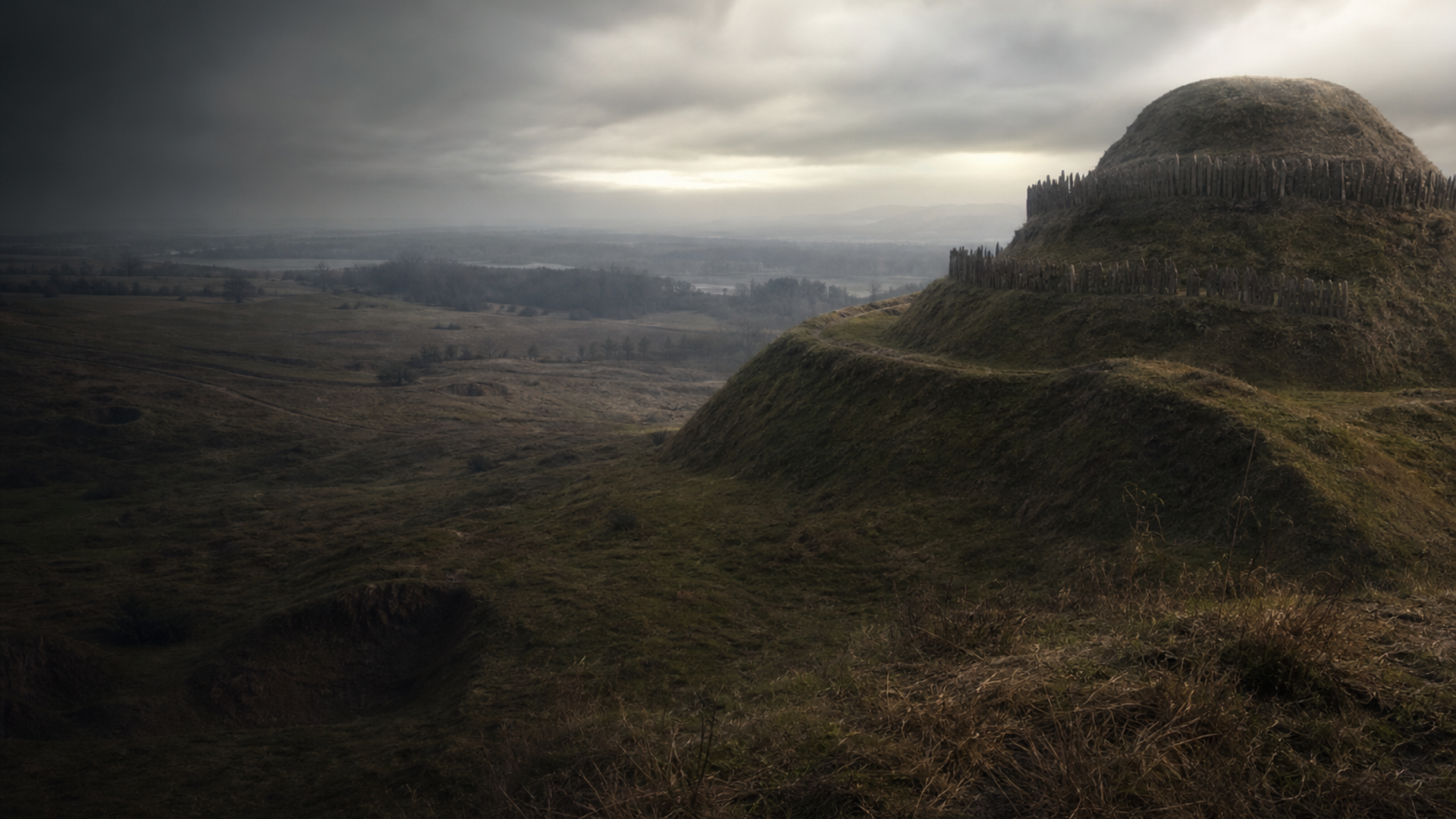
Visually, the site yields domestic ceramics, fragments of ironwork and inhumation burials characteristic of transitional medieval practices in central Poland. Archaeologists interpret this as a locality where local traditions meet incoming influences during the early High Middle Ages. Because the genetic sample set is only four individuals, any narrative about population movement, continuity, or replacement must be framed as provisional. The material culture anchors the people in a recognizable regional arc, while the genetic data—sparse but intriguing—provides new hints that demand further excavation and sampling.

In short: the archaeological evidence situates these people in a continuity of local occupation; their deeper origins, mobility, and social networks remain an open question awaiting larger datasets.

  • Medieval inhumations dated to 1000–1200 CE at Obłaczkowo
  • Site near Września integrates Iron Age loci with medieval settlement
  • Interpretation provisional due to limited sample size

Daily Life & Society

Archaeological traces from Obłaczkowo evoke a modest agrarian community lit by seasonal rhythms: ploughed fields, livestock pens, and communal pathways that cut across marshy lowlands. Finds associated with the sampled graves—simple iron tools, domestic ceramics, and textile impressions—suggest lives organized around mixed farming, craft work and local exchange networks rather than large-scale elite consumption.

Mortuary practice at the site is understated: individual inhumations with modest grave goods point to household-focused identities. The landscape would have been dotted with long-term homesteads and small chapel-or parish-centered communities forming the social scaffolding of early medieval Greater Poland. Trade links likely extended along river corridors toward Poznań and other regional hubs, bringing occasional exotic goods and influences into everyday life.

Archaeobotanical and zooarchaeological indicators are limited for this specific cemetery, but regional analogues suggest cereals, pulses, and domesticated animals formed dietary staples. Craft specializations—smithing, leatherwork, weaving—would have shaped social roles and seasonal labor. The cinematic picture is one of hearth-lighted houses, communal fields, and travelers passing between established villages and relic Iron Age sites.

Because excavations are incomplete and samples few, reconstructions of social hierarchy and mobility remain tentative and should be tested against broader surveys and further aDNA sampling.

  • Modest agrarian economy with household-focused burials
  • Local craft and riverine exchange connected Obłaczkowo to regional hubs

Genetic Profile

Four individuals from Obłaczkowo produced the following uniparental markers: Y-DNA labels reported as PF (1), L (1), M (1); mtDNA lineages H (2), T (1) and W6a (1). These results must be treated with caution. With only four samples, statistical power is extremely low and patterns can reflect chance, sampling bias, contamination, or mis-assignment of haplogroup calls at low coverage.

The maternal haplogroups (H, T, W6a) are broadly consistent with European mitochondrial diversity known from medieval and earlier contexts—H and T are common in Central Europe, while W6a is less frequent but attested in regional datasets. These mtDNA results align with archaeological expectations of local maternal ancestry.

The reported Y-DNA labels are unexpected for a straightforward Central European medieval profile: haplogroups labelled L and M are typically rare or absent in high-frequency Central European male lineages and are more commonly recorded in South Asian, Southeast Asian or island Oceania contexts in modern population surveys. The label PF may refer to a broad upstream clade or could reflect low-resolution assignment. Possible explanations include:

  • genuine signals of non-local male ancestry through migration or marriage networks;
  • technical issues: low coverage, reference bias, or haplogroup misclassification;
  • chance capture of rare lineages in a tiny sample.

Given the small sample count, archaeological context should guide interpretation: mitochondrial continuity versus anomalous paternal signals suggests complex micro-histories. Larger, well-controlled genomic datasets from Obłaczkowo and surrounding sites are essential to move beyond speculative readings.

  • Maternal mtDNA (H, T, W6a) fits European medieval variability
  • Paternal Y calls (PF, L, M) are unexpected locally; conclusions are preliminary

Legacy & Modern Connections

The Obłaczkowo individuals are a whisper from the early medieval fields of Greater Poland—fragments that may tie local communities to wider webs of movement. If future sampling confirms the mitochondrial patterns and clarifies paternal lineages, these remains could illuminate the patchwork of local continuity and episodic migration that shaped medieval Polish populations.

For present-day genetic landscapes, caution is essential: four medieval genomes cannot map directly onto modern communities. However, when integrated into larger regional aDNA datasets, they may help trace continuity of maternal lineages (H, T, W6a) and test hypotheses about male-mediated mobility. The most valuable legacy of these samples is methodological: they underscore how archaeological context and careful ancient DNA work together to reveal human stories—sometimes reaffirming local roots, sometimes exposing surprising journeys across centuries.

Limited evidence thus far offers evocative possibilities rather than firm answers; robust conclusions await broader sampling campaigns and comparative analyses across Greater Poland and neighbouring regions.

  • Potential maternal continuity with modern Central European lineages
  • Small dataset highlights need for expanded sampling and integrated analysis

Asistente de IA

Asistente de IA por DNAGENICS

Desbloquear esta función
Pregunta sobre la cultura Obłaczkowo Echoes. El asistente con IA puede explicar hallazgos genéticos, contexto histórico, pruebas arqueológicas y conexiones modernas, con sus límites de interpretación.
Ejemplo de análisis con IA

La cultura Obłaczkowo Echoes representa un capítulo de la historia humana...

El análisis genético permite estudiar similitudes con poblaciones anteriores y posibles adaptaciones. Las muestras de ADN antiguo aportan información para investigar patrones migratorios y relaciones entre poblaciones, con límites que dependen del estudio y del contexto arqueológico.

Esta es una vista previa del análisis con IA. Accede al asistente completo para explorar información sobre:

  • Composición y similitud genética
  • Patrones migratorios y orígenes
  • Vida cotidiana y prácticas culturales
  • Contexto genético moderno