Preparando el informe

Cargando la información y las referencias disponibles

Consultando el registro arqueológico...

Recopilando registros antiguos

Saltar al contenido principal
Pukara of the Precordillera — 700 BP
Cultura destacada

Pukara of the Precordillera — 700 BP

A lone Late Intermediate Period individual from the Atacama highlands, where archaeology meets DNA

1155 CE - 1260 CE
Atacama Desert, Precordillera, Chile
Desplázate para empezar
Capítulo I

La historia

Comprender la cultura Pukara of the Precordillera — 700 BP

Single Late Intermediate Period (1155–1260 CE) individual from a Pukara-associated site in the Atacama Precordillera, Chile. Archaeological context and ancient DNA (Y: Q; mt: B2) offer a tentative glimpse of highland lifeways and genetic continuity; conclusions are preliminary (n=1).

Time Period

1155–1260 CE (Late Intermediate Period)

Region

Atacama Desert, Precordillera, Chile

Common Y-DNA

Q (1 sample)

Common mtDNA

B2 (1 sample)

Capítulo II

Cronología

Momentos clave de la historia de esta cultura

1155 CE

Dated burial from a Pukara-associated site

Radiocarbon dates place the sampled individual between 1155 and 1260 CE, within the Late Intermediate Period in the Precordillera of the Atacama.

Capítulo III

Origins & Emergence

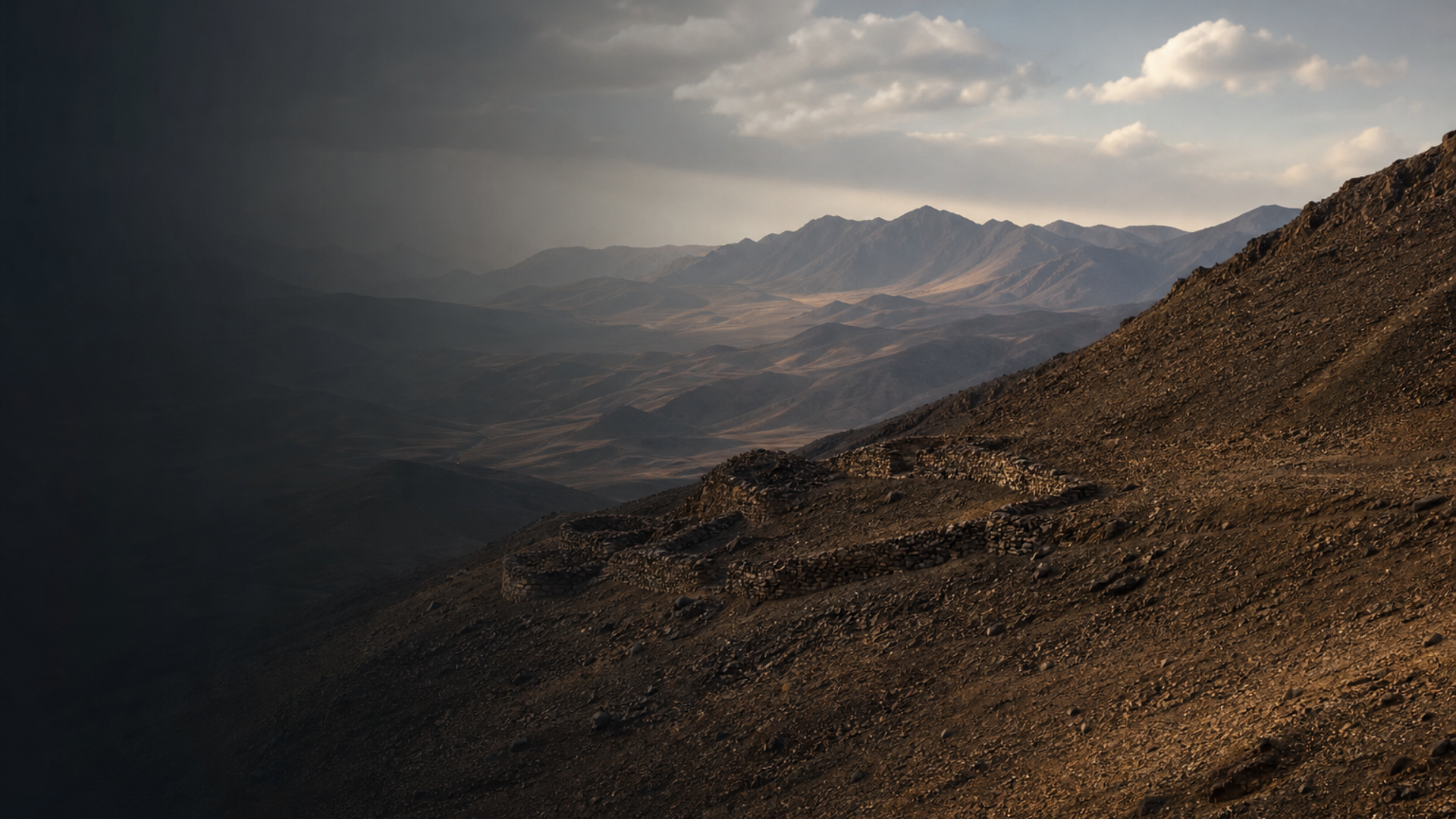
Carved by wind and light, the Precordillera foothills of the Atacama hold the traces of communities active during the Late Intermediate Period (c. 12th–13th centuries CE). Archaeological data indicates occupation at Pukara-linked loci where small settlements clustered near seasonal water sources and caravan routes that threaded between coastal and highland ecologies. Radiocarbon-calibrated materials framing this individual place it between 1155 and 1260 CE, a time of regional reorganization after earlier highland polities.

Material culture in nearby sites suggests localized forms of architecture, pottery styles, and exchange in obsidian and marine goods, pointing to networks of mobility rather than large-scale empire. Limited evidence suggests that Pukara-associated groups in this part of the Precordillera adapted highland lifeways to an arid margin: mixed herding, opportunistic cultivation where microclimates allowed, and intensified trade across ecological zones.

Because this dataset currently rests on a single sampled individual, interpretive caution is essential. The archaeological context offers atmospheric, place-based clues about social grouping and landscape use, but broader claims about population movements, cultural boundaries, or sociopolitical structure require larger and better-dated series of sites and human remains.

  • Dated to 1155–1260 CE, during the Late Intermediate Period
  • Occupation near Pukara-associated sites in the Atacama Precordillera
  • Evidence points to mobility and exchange across coastal and highland zones
Capítulo IV

Daily Life & Society

Imagine sun-baked terraces and wind-scoured corrals: inhabitants of the Precordillera margin balanced the harsh beauty of the Atacama with adaptive strategies. Archaeological indicators from Pukara contexts in this region point to small-scale settlements where households combined pastoralism—likely camelid herding—with opportunistic gardens fed by ephemeral streams and irrigation in favoured micro-valleys.

Ceramic assemblages cataloged nearby include utilitarian wares and decorated forms that may signal local identity and interregional contacts. Faunal remains and botanical traces suggest a diet mixing highland staples and coastal imports, revealing participation in long-distance exchange. Social life was probably organized around kin-based compounds and seasonal circuits that followed water and grazing availability; ritual practice and ancestor veneration are plausible given regional Andean patterns, though direct evidence at this specific site remains sparse.

Archaeological data indicates resilience and flexibility: craft production, trade in lithic and marine materials, and adaptive land use strategies underpinned daily life. Yet with only one genetic sample from the site, linking individual life histories to community-level social roles is provisional. Continued excavation and multidisciplinary sampling are needed to flesh out household composition, labor, and ritual landscapes.

  • Household economies combined pastoralism with opportunistic agriculture
  • Material culture implies local identity amid long-distance exchange
Capítulo V

Genetic Profile

Ancient DNA from the Pukara-associated individual yields Y-chromosome haplogroup Q and mitochondrial haplogroup B2 — lineages common among Indigenous peoples of the Americas. These assignments align broadly with continental patterns in South America where haplogroup Q is frequently observed on the paternal line and haplogroup B2 on the maternal line.

Because the dataset comprises only one genome (sample count = 1), genetic inferences must remain tentative. The presence of Q and B2 is consistent with genetic continuity in the Central Andean and coastal-Highland contact zones, but it does not by itself resolve questions about population structure, migration pulses, or local admixture events during the Late Intermediate Period. Archaeological signals of exchange and mobility could correspond to genetic gene flow, but linking specific cultural interactions to demographic change requires larger sample sizes and comparative datasets spanning the region and time periods before and after 1155–1260 CE.

Future aDNA sampling from neighboring Pukara sites, contemporaneous coastal settlements, and highland centers will be essential to test whether this individual reflects local continuity, incoming groups, or broader networked ancestry. For now, the genetic profile offers a cinematic but cautious bridge between a single life and the longue durée of Andean population history.

  • Y haplogroup Q and mtDNA B2 observed — typical in Indigenous South American lineages
  • n=1: conclusions are preliminary; larger comparative datasets required
Capítulo VI

Legacy & Modern Connections

The genetic and archaeological traces from this Pukara-associated individual suggest threads that may continue into the present: shared haplogroups, cultural practices adapted to harsh environments, and networks linking coast and highland. Archaeological continuity in artifact styles and settlement patterns sometimes mirrors genetic continuity, but the relationship is complex and mediated by trade, marriage, and mobility.

For descendant communities in northern Chile and the broader Andean world, such finds can illuminate ancestral ties to particular landscapes and lifeways. However, given the single-sample evidence, any claims about direct ancestry to specific modern groups must be made with humility and in consultation with Indigenous stakeholders. Ongoing collaborations that pair expanded aDNA sampling, robust archaeological context, and community engagement will best reveal how the Pukara of the Precordillera contributed to the mosaic of Andean heritage.

  • Findings hint at continuity with wider Andean genetic patterns but are preliminary
  • Responsible interpretation requires more samples and engagement with descendant communities
Con IA

Asistente de IA

Haz preguntas sobre la cultura Pukara of the Precordillera — 700 BP

Asistente de IA por DNAGENICS

Desbloquear esta función
Pregunta sobre la cultura Pukara of the Precordillera — 700 BP. El asistente con IA puede explicar hallazgos genéticos, contexto histórico, pruebas arqueológicas y conexiones modernas, con sus límites de interpretación.
Ejemplo de análisis con IA

La cultura Pukara of the Precordillera — 700 BP representa un capítulo de la historia humana...

El análisis genético permite estudiar similitudes con poblaciones anteriores y posibles adaptaciones. Las muestras de ADN antiguo aportan información para investigar patrones migratorios y relaciones entre poblaciones, con límites que dependen del estudio y del contexto arqueológico.

Esta es una vista previa del análisis con IA. Accede al asistente completo para explorar información sobre:

  • Composición y similitud genética
  • Patrones migratorios y orígenes
  • Vida cotidiana y prácticas culturales
  • Contexto genético moderno

Explora más culturas antiguas

Descubre la historia de civilizaciones de distintas partes del mundo antiguo