Preparando el informe

Cargando la información y las referencias disponibles

Consultando el registro arqueológico...

Recopilando registros antiguos

Saltar al contenido principal
Verteba Echoes: Middle-Late Trypillia
Cultura destacada

Verteba Echoes: Middle-Late Trypillia

17 individuals (3800–3500 BCE) from Verteba Cave reveal maternal ties to Neolithic farming communities

3800 CE - 3500 BCE
Ternopil oblast, Ukraine (Verteba Cave)
Desplázate para empezar
Capítulo I

La historia

Comprender la cultura Verteba Echoes: Middle-Late Trypillia

Human remains from Verteba Cave (Ternopil oblast, Ukraine) dated 3800–3500 BCE (Middle–Late Trypillia) yield 17 samples. Maternally, haplogroups K, J, H and T predominate, consistent with Neolithic farmer lineages. Archaeology and aDNA together illuminate cave ritual, mobility, and incomplete paternal data.

Time Period

3800–3500 BCE

Region

Ternopil oblast, Ukraine (Verteba Cave)

Common Y-DNA

Undetermined (limited or absent data)

Common mtDNA

K, J, H, T (K most frequent in this series)

Capítulo II

Cronología

Momentos clave de la historia de esta cultura

3650 BCE

Active use of Verteba Cave for interment

Archaeological and radiocarbon data indicate intensive, episodic deposition of human remains at Verteba Cave during the Middle–Late Trypillia period.

Capítulo III

Origins & Emergence

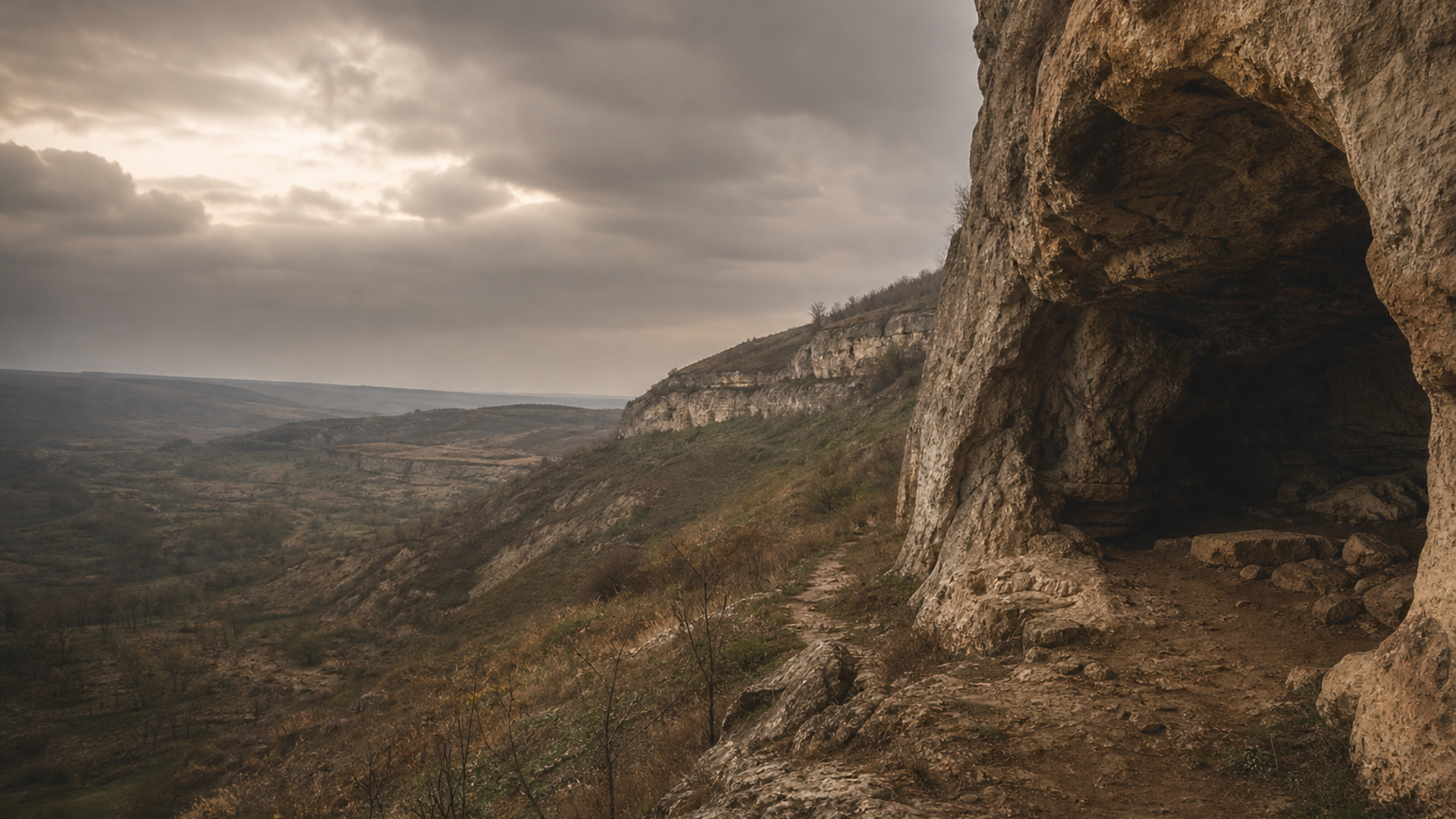
Verteba Cave sits like an obsidian throat in the loess landscape of western Ukraine. Archaeological layers and radiocarbon dates place the human deposits reported here firmly in the Middle to Late Trypillia span (roughly 3800–3500 BCE). The Trypillia phenomenon — known for densely occupied settlements, elaborated ceramics and ritual architecture across modern Ukraine and Moldova — intersected with cave use at Verteba for complex funerary and possibly commemorative practices.

Excavations at Verteba Cave (notably at Sites 7, 17 and 20) reveal repeated human depositions rather than a single catastrophic event, suggesting episodic use over generations. Material culture recovered in association — pottery sherds of Trypillia styles, occasional worked bone, and flaked stone — ties these individuals to the regional farmer communities that dominated the forest-steppe mosaic after the Neolithic expansion.

Archaeological data indicates continuity with Neolithic farming lifeways but also hints at increasing regional interaction in the fourth millennium BCE. Limited evidence suggests that cave burial and commemoration at Verteba were selective and ritualized rather than a standard household practice. The assemblage of 17 sampled individuals therefore captures a particular social expression within the broader Trypillia world, offering a focused window into community identity and landscape memory.

  • Occupational context: Verteba Cave, Sites 7, 17, 20 (Ternopil oblast)
  • Dating: 3800–3500 BCE, Middle–Late Trypillia horizon
  • Use of cave appears episodic and ritualized, not everyday habitation
Capítulo IV

Daily Life & Society

Beneath the cinematic sweep of Trypillia long-houses and heat-hazed fields, daily life was anchored in mixed farming, craft specialization and communal rituals. Osteological traces from Verteba individuals indicate activities typical of Neolithic farming communities: robust bone chemistry consistent with terrestrial diets, healed fractures and dental wear that reflect hard, practical lives. The cave context — often dark, enclosed and symbolically charged — hints that some members were chosen for special mortuary treatment rather than representing a cross-section of the whole population.

Material finds at the cave fringes and on-site sherds mirror Trypillia ceramic styles, including painted and incised motifs that articulate group identity. In life these communities practiced household-level production of pottery and textiles, and exchange networks brought exotic raw materials and stylistic influences into the forest-steppe corridor. Social organization likely emphasized extended kin groups with communal rituals: the selective deposition of remains in Verteba may reflect lineage-based memorials, seasonally timed ceremonies, or crisis events.

Archaeological interpretation must remain cautious: skeletal and contextual evidence can suggest roles and stresses but cannot reconstruct belief systems in detail. When paired with genetic data, however, these traces become more than bones and sherds — they become threads linking ancestry, mobility and social practice.

  • Evidence of farming-related stress and robusticity in skeletal remains
  • Cave interments likely selective, reflecting ritual or lineage practices
Capítulo V

Genetic Profile

Seventeen individuals from Verteba Cave provide a modest but meaningful ancient DNA snapshot from within the Middle–Late Trypillia frame. Observed mitochondrial haplogroups in this series include K (4), J (3), H (2), T (1) and H+ (1); several other samples yielded diverse or lower-coverage maternal lineages. This concentration of K and J maternal lineages aligns with patterns seen across Neolithic and Chalcolithic farmer-associated groups in continental Europe, where maternal haplogroups of this type are common.

Importantly, paternal (Y-chromosome) information is not reported here or is insufficient for firm conclusions; therefore statements about male-mediated gene flow or patrilineal organization must remain tentative. Genome-wide data would be required to quantify admixture proportions (for example, proportions of Anatolian farmer, European hunter-gatherer, and later steppe-related ancestry). Comparative aDNA studies of Trypillia-related sites often find a strong Neolithic farmer signature with varying inputs from local hunter-gatherers; steppe-related ancestry typically rises in frequency after the mid-fourth millennium BCE in some regions.

Because the sample size is 17 — moderate for aDNA but not large — conclusions about population-wide structure should be cautious. Nevertheless, the maternal profile from Verteba supports archaeological interpretations of Trypillia communities inheriting much of their maternal ancestry from earlier Neolithic farmer expansions while participating in dynamic regional networks.

  • mtDNA dominated by farmer-associated haplogroups (K, J, H, T)
  • Y-DNA data insufficient; genome-wide analyses needed for admixture estimates
Capítulo VI

Legacy & Modern Connections

Verteba Cave preserves a concentrated human story at the edge of the Trypillia world. The genetic signals carried by these individuals connect them to the broader tapestry of European Neolithic farmers — a legacy visible in maternal haplogroups that persist at varying frequencies in later populations. Yet continuity is not simple: migrations, cultural transformations and local demographic shifts over millennia mean that modern population genetics reflect many layered events since 3500 BCE.

For contemporary Ukraine and the wider region, Verteba is both an archaeological landmark and a reminder that identity is woven from mobility, exchange and lineage. From a scientific perspective, these 17 samples emphasize the value of integrating excavation context, osteological observation and ancient DNA: together they illuminate how bodies, objects and genes move through time, and they invite careful, evidence-driven stories rather than singular narratives of descent.

  • Maternal lineages echo Neolithic farmer ancestry seen across Europe
  • Genetic continuity to modern populations is complex and requires more data
Con IA

Asistente de IA

Haz preguntas sobre la cultura Verteba Echoes: Middle-Late Trypillia

Asistente de IA por DNAGENICS

Desbloquear esta función
Pregunta sobre la cultura Verteba Echoes: Middle-Late Trypillia. El asistente con IA puede explicar hallazgos genéticos, contexto histórico, pruebas arqueológicas y conexiones modernas, con sus límites de interpretación.
Ejemplo de análisis con IA

La cultura Verteba Echoes: Middle-Late Trypillia representa un capítulo de la historia humana...

El análisis genético permite estudiar similitudes con poblaciones anteriores y posibles adaptaciones. Las muestras de ADN antiguo aportan información para investigar patrones migratorios y relaciones entre poblaciones, con límites que dependen del estudio y del contexto arqueológico.

Esta es una vista previa del análisis con IA. Accede al asistente completo para explorar información sobre:

  • Composición y similitud genética
  • Patrones migratorios y orígenes
  • Vida cotidiana y prácticas culturales
  • Contexto genético moderno

Explora más culturas antiguas

Descubre la historia de civilizaciones de distintas partes del mundo antiguo