Introduction
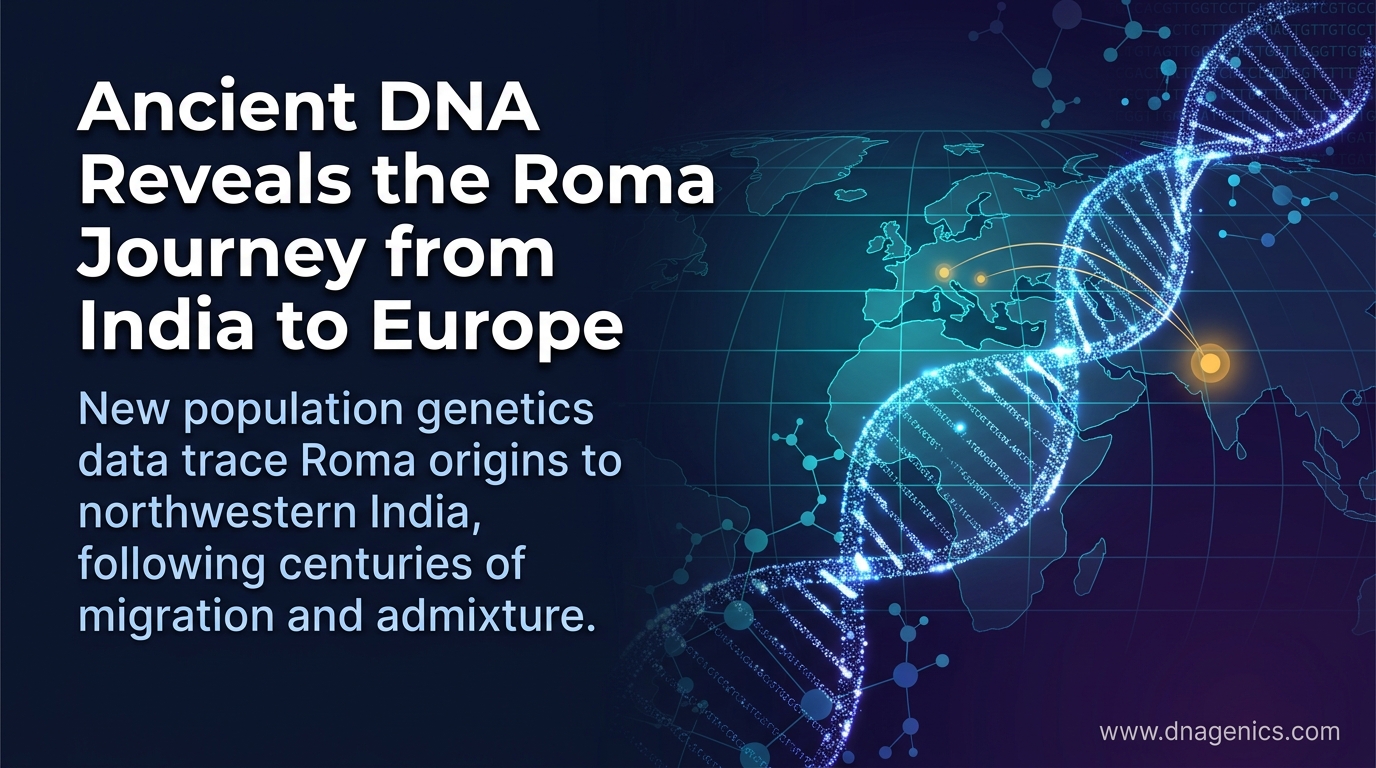
For centuries, the origins of the Roma were explained through rumor, folklore, and political labels rather than evidence. Some Europeans thought they came from Egypt, others from Anatolia, Nubia, or Bohemia, but those stories were guesses, not scientific conclusions. Today, ancient DNA, population genetics, and historical linguistics give us a much clearer picture of where Roma communities came from and how they spread across Europe.
This matters because ancestry is often misunderstood as a single place, a single people, or a single moment in time. The Roma story shows something more realistic and more interesting: a population can preserve a deep genetic signal from its origins while also absorbing ancestry from many places along the way. For anyone interested in DNA ancestry, migration, or haplogroups, the Roma provide one of the clearest examples of how genetics and history can work together.
Key Discoveries / Main Points
- Romani language is an Indo-Aryan language, closely related to languages of South Asia, which strongly supports an origin in India rather than Egypt or North Africa.
- Genome-wide studies consistently show that many Roma groups carry about 31% to 37% South Asian ancestry, with the remainder largely reflecting later mixing in West Eurasia and Europe.
- The strongest genetic match points to northwestern India, not a single modern Indian community, and the most likely departure from South Asia occurred roughly 800 to 900 years ago.
- Ancient DNA from individuals in Barc, Albania provided the first archaeological-genetic record of Roma people, and those genomes align closely with modern Roma groups.
- Roma populations across Europe share a surprisingly similar genetic profile, which suggests a shared origin followed by regional admixture, local founder effects, and long-distance movement through the Balkans.
What This Means for Your DNA
If you are interested in Roma ancestry, the most important lesson is that genetic ancestry is measured by statistical similarity to reference populations, not by a simple yes-or-no label. A DNA test may detect segments that resemble South Asian, Balkan, or broader West Eurasian reference groups, but that does not automatically tell you ethnicity, community membership, or personal identity. It does, however, help reconstruct ancestry patterns at the population level.
For Roma descendants, these findings help explain why many tests show a blend of components that can seem geographically distant at first glance. A significant South Asian signal, combined with West Eurasian and Balkan-related ancestry, fits a history of long migration, settlement, and intermarriage over many generations. In practical terms, this means a Roma ancestry report may reflect both deep ancestral roots in South Asia and later genetic history in Europe.
For non-Roma readers, this study is also useful because it shows how ancient DNA can correct long-standing historical myths. If a family story, surname tradition, or local legend suggests an origin in one region, genetics may support, refine, or challenge that idea. The Roma case reminds us that ancestry is often layered, with migration routes written into the genome rather than into written records alone.
Historical and Archaeological Context
The historical record places Roma communities in Europe by the early 15th century, when groups of travelers appeared in Central Europe with documents and a story about pilgrimage. Over time, European societies assigned them names that were often inaccurate or stigmatizing, and those labels shaped how outsiders described them for centuries. The people themselves used names connected to identity and movement, including terms tied to the road and to their own community.
Linguistics provided the first strong clue about origin. Romani contains a core of Indo-Aryan vocabulary, then layers of Iranian, Armenian, and especially Greek loanwords, which suggests a journey from South Asia through the Middle East or the Byzantine sphere before reaching Europe. That pattern fits a migration route through the eastern Mediterranean and the Balkans, rather than through Egypt or North Africa. The genetic evidence now lines up with that linguistic history.
Archaeology adds another important layer. The ancient genomes from Barc in southeastern Albania, dated to the early modern period, show that by the 1500s and 1600s there were already people in the Balkans whose genetic profile matches modern Roma populations. This means the Roma were not just passing through Europe as a vague historical idea, they were already part of the region’s demographic landscape, with communities that had been established for generations.
The Science Behind It
The strongest evidence comes from combining multiple genetic approaches. Researchers compared modern and ancient genomes using methods such as global ancestry modeling, haplotype sharing, and admixture dating. These tools can estimate how much of a genome is statistically closest to South Asian, Balkan, West Asian, or local European reference groups, and they can also help identify when major ancestry mixing events likely occurred. In the Roma case, several independent studies found a consistent South Asian component and a time window for major mixing around the medieval period.
One especially useful feature of this research is that the estimates were checked against controls and synthetic mixtures. That matters because ancestry modeling can be misleading if it is not validated. When the method was tested on genomes with known amounts of added South Asian ancestry, it performed well above low levels and became less reliable below a few percent, which is exactly the kind of limitation readers should expect in real population genetics.
In Simple Terms: Scientists compared DNA from Roma groups with DNA from many reference populations, then asked which sources best explain the observed patterns. The result is not a personal identity test, but a population history estimate that points to South Asia, the Balkans, and later European mixing.
The most striking result is the stability of the South Asian signal across many Roma communities. Whether the group is in Bulgaria, Greece, Serbia, Finland, Spain, or elsewhere, the South Asian proportion tends to cluster in a similar range. That consistency supports a shared founding event, followed by regional differences caused by later local admixture. It also helps explain why some Roma groups, such as the Romanichal of England or some Iberian communities, show more local European ancestry than others.
Why It Matters
The Roma story is important because it is a clear example of how genetics, linguistics, and archaeology can converge on the same historical answer. Written sources were incomplete, biased, or simply wrong for centuries, but the genome preserves signals that can survive long after documents have been lost. This makes the Roma case valuable not only for understanding one population, but also for studying how human groups move, adapt, and remain connected over time.
It also matters for the future of ancestry testing. As more ancient DNA samples become available and reference datasets improve, population genetics will become better at separating deep ancestry from recent mixing. That will help researchers model migration more accurately, and it will give people interested in their DNA ancestry a clearer understanding of what results can, and cannot, tell them.
References / Further Reading
- Published genome-wide studies on Roma population history and admixture dating
- Research on Romani language origins and Indo-Aryan linguistic connections
- Ancient DNA analysis from Barc, Albania, as the first archaeological Roma genomes
- General literature on population genetics, migration, and ancient DNA in Europe