A preparar o relatório

A carregar as informações e as referências disponíveis

Consultando el registro arqueológico...

Recopilando registros antiguos

Saltar para o conteúdo principal
Anatolian Hearths: Turkey Early Bronze Age
Cultura de destaque

Anatolian Hearths: Turkey Early Bronze Age

Lives and genes from 3340–2000 BCE across Anatolia’s varied landscapes

3340 CE - 2000 BCE
Turkey (Anatolia)
Desplázate para começar
Capítulo I

A História

Comprender la cultura Anatolian Hearths: Turkey Early Bronze Age

Archaeological and genetic evidence from 27 Early Bronze Age individuals across Turkey (3340–2000 BCE) reveals a patchwork of local Anatolian ancestries and maternal diversity. Sites span the Mediterranean, Aegean, Southeast and Black Sea regions, linking material culture to emerging genetic patterns.

Time Period

3340–2000 BCE

Region

Turkey (Anatolia)

Common Y-DNA

J (1/27)

Common mtDNA

K (4), U (4), H (3), R (2), T (2)

Capítulo II

Cronologia

Momentos-chave da história desta cultura

3340 BCE

Earliest sampled contexts

Earliest individuals in this dataset date to ~3340 BCE, from tell-sites in western and southeastern Anatolia.

2500 BCE

Expansion of exchange networks

Around 2500 BCE archaeological evidence suggests increased long-distance exchange and the appearance of new metalwork styles at several Anatolian sites.

2000 BCE

Regional reorganization

By 2000 BCE many Early Bronze Age settlements show reorganization or transformation, signaling transition toward later Bronze Age polities.

Capítulo III

Origins & Emergence

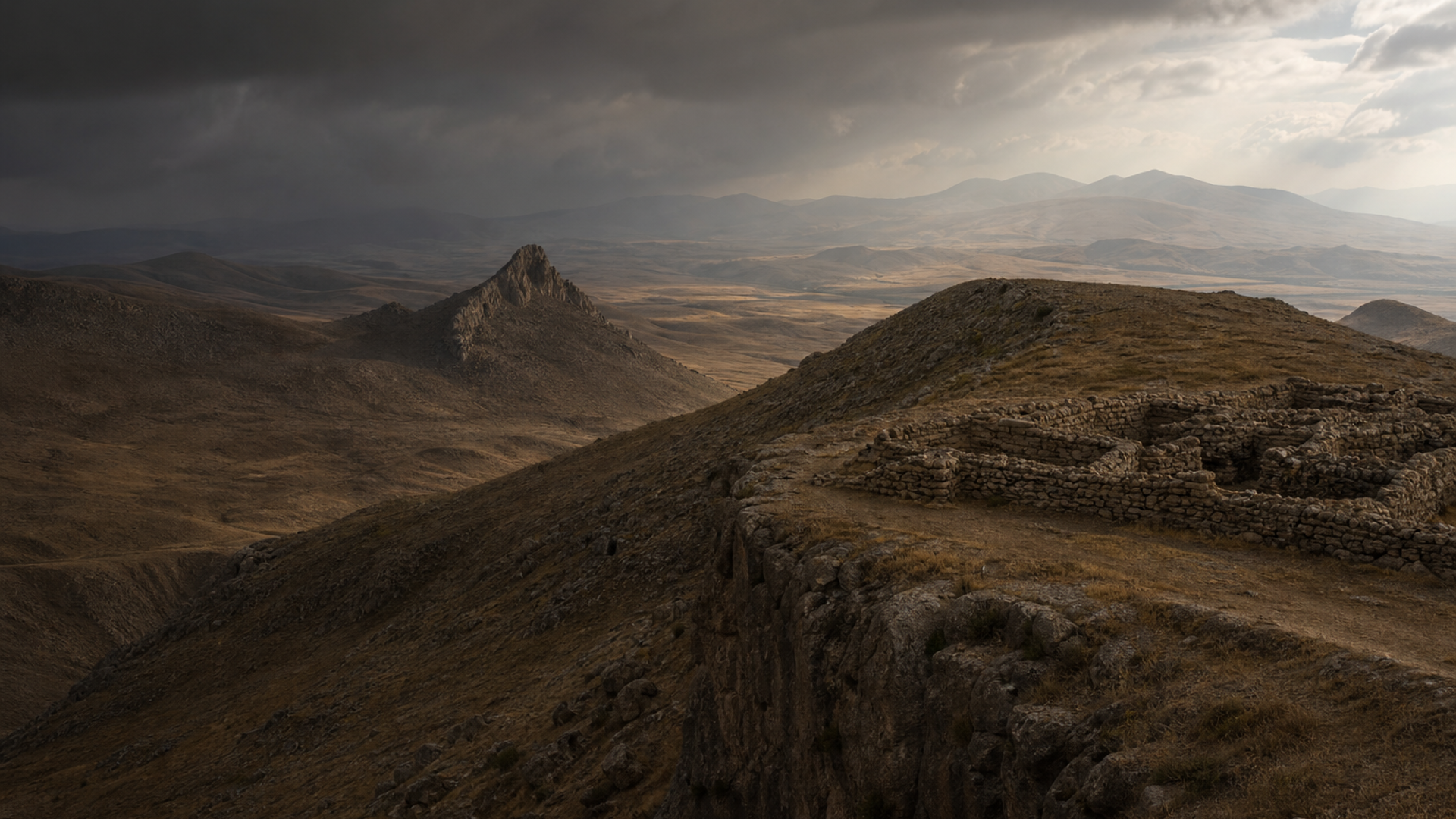
Across Anatolia the Early Bronze Age (3340–2000 BCE) marks a time when long-established Neolithic farming traditions met expanding regional networks. Archaeological data indicates intensified settlement at tell-sites and new craft specializations at places like Harmanören-Göndürle Höyük (Isparta), Oylum Höyük (Kilis) and Yassıtepe (İzmir). These settlements preserve layered sequences of occupation: domestic floors, kiln complexes and grave deposits that record changing social rhythms.

Material culture—wheel-made pottery, bronze tools in later phases, and regional burial practices—suggests both local continuity from the Chalcolithic and connections with neighboring Anatolian and Levantine communities. The spatial spread from Mediterranean highlands to the Black Sea plain (Devret Höyük, Amasya) points to diverse ecological adaptations and inter-regional exchange. Limited evidence suggests increasing long-distance contacts after ~2500 BCE, visible in exotic raw materials and stylistic influences, but the pattern is uneven across sites.

Taken together, archaeological layers and stratigraphic sequences reveal an Anatolia that is neither uniform nor static: a mosaic of village cores, emerging towns and regional interaction spheres that set the stage for demographic and cultural change in the later Bronze Age.

  • Sites sampled include Harmanören-Göndürle Höyük, Tilbe ar Höyük, Oylum Höyük, Tatika, Yassıtepe, Devret Höyük
  • Material change shows local continuity plus episodic external influence after ~2500 BCE
  • Landscape diversity produced varied settlement and economic strategies
Capítulo IV

Daily Life & Society

Archaeological contexts portray domestic routines framed by herding, cereal agriculture and localized craft specialization. At tell-sites, excavations reveal mudbrick houses, storage pits and hearths that sustained multi-generational households. Pottery assemblages—bowls, jars and fine burnished wares—served everyday needs and ritual functions; in some locations, specialized workshops processed metals, stone and pigments.

Economies were rooted in mixed farming: archaeobotanical remains and faunal assemblages from nearby Early Bronze Age sites indicate wheat, barley and sheep-goat herding as staples. Craft production of copper-alloy objects and standardized pottery forms points to growing artisan roles and nascent craft economies. Burial practices vary regionally: inhumations with grave goods occur alongside more modest interments, implying social differentiation but not uniform hierarchy.

Seasonal mobility, local trade routes and river corridors likely structured household resilience. Archaeological data indicates both stable village life and episodes of reorganization—abandonment or rebuilding—that reflect environmental pressures, social negotiation and wider exchange networks across Anatolia.

  • Mixed farming (wheat, barley; sheep-goat) underpinned household economies
  • Workshops and bronze artifacts indicate increasing craft specialization and trade
Capítulo V

Genetic Profile

Genome-wide data from 27 Early Bronze Age individuals sampled across Turkey provide a window into population structure during 3340–2000 BCE. The Y-DNA record in this set is sparse: a single observed J haplogroup (1/27), a lineage commonly associated with Near Eastern and Anatolian populations. Maternal lineages are more diverse—mtDNA haplogroups include K (4), U (4), H (3), R (2) and T (2)—reflecting multiple maternal ancestries persisting in the region.

These maternal haplogroups mirror a long-standing Anatolian and Near Eastern genetic substrate: K and H appear frequently in farming-derived populations, while U and T can reflect both Neolithic continuity and later inputs. Archaeogenetic signals suggest that Early Bronze Age Anatolia retained substantial local ancestry linked to earlier Neolithic and Chalcolithic groups, with regional heterogeneity between sites. Limited evidence in some Anatolian samples points to episodic additional ancestry components—potentially from steppe-related or Levantine sources—particularly in later EBA contexts after ~2500 BCE, but these signals vary by site and are not uniform across the dataset.

With 27 samples, conclusions are cautiously supported: the dataset is sufficient to observe broad patterns of maternal diversity and local continuity, yet finer-scale demographic processes (sex-biased migration, minor admixture pulses) require larger and denser sampling to resolve. Future sampling across more sites and time slices will clarify the timing and scale of external genetic inputs into Anatolia during the Bronze Age.

  • Y-DNA: J observed (1/27), consistent with Anatolian/Near Eastern male lineages
  • mtDNA diversity (K, U, H, R, T) indicates mixed maternal ancestries and regional continuity
Capítulo VI

Legacy & Modern Connections

The genetic and archaeological signatures of Early Bronze Age Anatolia echo into later millennia. Material continuity in settlement patterns and craft traditions helps explain how Anatolia remained a cultural crossroads between the Near East and the Aegean. Genetically, much of the region’s foundation derives from earlier Neolithic and Chalcolithic populations; later admixture events layered new elements onto this substrate, contributing to the complex ancestry seen in modern populations of Turkey and neighboring regions.

Modern genetic gradients in Anatolia preserve echoes of these deep processes, but they result from many subsequent movements—Iron Age migrations, historical empires and medieval exchanges—that complicate simple lines of descent. Archaeogenetic study of Turkey_EBA therefore provides an essential chapter: it anchors local continuity and reveals the first broad contours of demographic change in a region that would remain pivotal for Bronze Age connectivity.

  • Provides a genetic baseline for later Anatolian population history
  • Highlights long-term continuity punctuated by episodic external inputs
Com IA

Assistente de IA

Haz preguntas sobre la cultura Anatolian Hearths: Turkey Early Bronze Age

Assistente de IA por DNAGENICS

Desbloquear esta função
Pregunta sobre la cultura Anatolian Hearths: Turkey Early Bronze Age. El asistente con IA puede explicar hallazgos genéticos, contexto histórico, pruebas arqueológicas y conexiones modernas, con sus límites de interpretación.
Exemplo de análise com IA

La cultura Anatolian Hearths: Turkey Early Bronze Age representa un capítulo de la historia humana...

A análise genética permite estudar semelhanças com populações anteriores e possíveis adaptações. As amostras de DNA antigo fornecem informações para investigar padrões migratórios e relações entre populações, com limites que dependem do estudo e do contexto arqueológico.

Esta é uma antevisão da análise com IA. Aceder ao assistente completo para explorar informações sobre:

  • Composição e similaridade genética
  • Padrões migratórios e origens
  • Vida cotidiana e práticas culturais
  • Contexto genético moderno

Explore mais culturas antigas

Descubra a história de civilizações de diferentes partes do mundo antigo