A preparar o relatório

A carregar as informações e as referências disponíveis

Consultando el registro arqueológico...

Recopilando registros antiguos

Saltar para o conteúdo principal
Arkhangai Echoes (500–1050 CE)
Cultura de destaque

Arkhangai Echoes (500–1050 CE)

Early Medieval graves from Arkhangai that reveal steppe mobility and mixed ancestry

500 CE - 1050 CE
Arkhangai Province, central Mongolia
Desplázate para começar
Capítulo I

A História

Comprender la cultura Arkhangai Echoes (500–1050 CE)

Archaeogenetic study of 12 individuals (500–1050 CE) from Nomgonii Khundii and Olon Dov, Arkhangai, Mongolia. DNA and burial evidence point to a mosaic of West and East Eurasian lineages, reflecting steppe mobility, contact, and complex social landscapes.

Time Period

500–1050 CE

Region

Arkhangai Province, central Mongolia

Common Y-DNA

R (5/12), C (1/12)

Common mtDNA

T (2), U (1), H (1), H6b (1), D4 (1)

Capítulo II

Cronologia

Momentos-chave da história desta cultura

552 CE

Rise of early Turkic polities

Expansion of Turkic confederations across Inner Asia, reshaping networks of alliance and mobility that influenced steppe communities (contextual regional event).

745 CE

Uyghur Khaganate prominence

The Uyghur Khaganate's emergence restructured political and trade routes across Mongolia and adjacent regions, altering connectivity among pastoral groups.

1206 CE

Proto-Mongol consolidation

Later political consolidation in the Mongol steppe foreshadows large-scale demographic shifts; included as a long-term context for legacy connections.

Capítulo III

Origins & Emergence

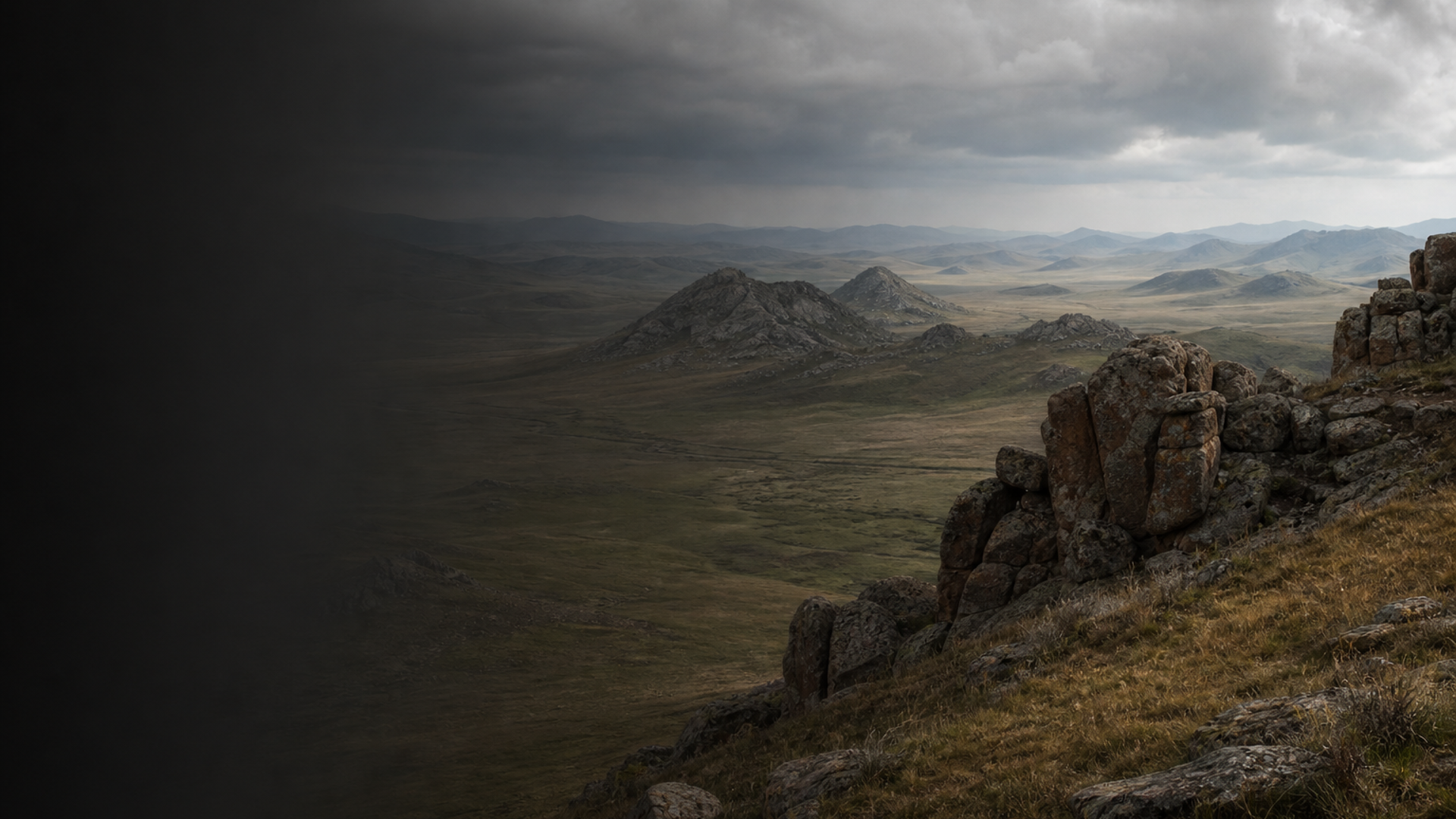
The Arkhangai assemblage sits on the high grassy plateaus and river valleys of central Mongolia, where human presence during the Early Medieval period is shaped by mobility and networks of exchange. Archaeological data from the cemeteries at Nomgonii Khundii and Olon Dov indicate discrete burial clusters dated to c. 500–1050 CE. These graves, when read alongside regional surveys, point to communities organized around seasonal herding of sheep, goats, and horses and tied into wider steppe circuits of contact.

Genetically, the Arkhangai individuals present a layered origin story. The predominance of Y-chromosome R lineages (5 of the 12 typed males) suggests male-line connections that reach westward across the steppe corridor. Maternal haplogroups include both West Eurasian types (T, U, H, H6b) and East Eurasian lineages (D4), signalling that ancestry in Arkhangai was not monolithic but composed of interwoven strands. Limited evidence suggests this pattern reflects prolonged contact and movement rather than a single migration event.

Caveats: the sample is modest and spatially constrained to two sites. Archaeological context provides essential nuance, and further sampling across Arkhangai and neighboring provinces is required to map the full demographic pulse of Early Medieval Mongolia.

  • Burial clusters at Nomgonii Khundii and Olon Dov dated 500–1050 CE
  • Material and landscape evidence point to mobile pastoral lifeways
  • Genetic mixture indicates long-standing East–West steppe connections
Capítulo IV

Daily Life & Society

Life in Early Medieval Arkhangai likely unfolded as a rhythm of seasons: spring pastures, summer highland camps, and sheltered wintering sites. Archaeological data indicates use of riverine terraces and valley corridors for movement and resource aggregation. Cemetery architecture and grave orientation at the two sampled sites show variability that may reflect kin groups, status differences, or changing ritual practices over the 500-year span.

Economy and material culture were centered on pastoralism. Bones, tool traces, and regional analogies point to animal husbandry as the economic backbone; craft and trade connections are plausible given Arkhangai’s position along interior steppe routes. Social organization was probably flexible, with households coalescing into larger seasonal compounds when environmental or political pressures demanded.

Cultural life would have been sensory and mobile: horses, felted tents, and woven textiles shaping identity. While direct artefactual associations from Nomgonii Khundii and Olon Dov are limited, the burial evidence combined with landscape data suggests communities adept at negotiating both local resources and long-distance ties.

  • Seasonal pastoralism likely structured settlement and mobility
  • Burial variability may reflect kinship, status, or shifting practices
Capítulo V

Genetic Profile

Twelve individuals from Arkhangai were analyzed for ancient DNA, producing a snapshot of Early Medieval ancestry in central Mongolia. Y-chromosome results are notable for a dominance of haplogroup R (observed in 5 male individuals) and the presence of haplogroup C in one male. Haplogroup R is widespread across the western Eurasian steppe and commonly found in earlier and contemporaneous steppe assemblages; haplogroup C has stronger associations with East and Inner Asian populations. This combination hints at male-mediated connections spanning the width of the steppe belt.

Mitochondrial lineages show a mixed picture: West Eurasian-associated haplogroups (T, U, H, H6b) occur alongside an East Eurasian lineage (D4). The presence of both maternal and paternal lineages from different broad geographic spheres suggests admixture at multiple timescales — likely the product of longstanding east–west contact on the steppe rather than a single event.

Important caveats: although 12 individuals provide useful preliminary data, the counts for specific haplogroups are small. Some untyped or degraded samples could bias observed frequencies. Thus while patterns of mixed ancestry and possible sex-biased inputs are visible, they should be treated as provisional until larger datasets from Arkhangai and neighboring regions are available.

  • Male lineages skew toward West Eurasian-associated haplogroup R
  • Mitochondrial mix of West and East Eurasian haplogroups suggests admixture
Capítulo VI

Legacy & Modern Connections

The Arkhangai genetic tapestry contributes a chapter to Mongolia’s long demographic story: one in which mobility, exchange, and local adaptation produce enduring genetic and cultural mosaics. Some of the lineages observed here—both Y and mtDNA—are part of broader patterns documented across Mongolia and the Eurasian steppe, implying continuity in certain ancestry components even as social and political landscapes shift.

Modern populations in Mongolia carry signals of multiple ancestries layered over millennia; the Arkhangai samples help to anchor one segment of that continuum in the Early Medieval era. However, the dataset is modest and geographically limited. Continued archaeogenetic sampling, integrated with archaeology and palaeoenvironmental studies, will be required to trace which lineages persisted, which diffused, and how social practices shaped genetic outcomes.

  • Contributes to understanding long-term East–West ancestry blending in Mongolia
  • Preliminary data; broader sampling needed to map persistence into modern populations
Com IA

Assistente de IA

Haz preguntas sobre la cultura Arkhangai Echoes (500–1050 CE)

Assistente de IA por DNAGENICS

Desbloquear esta função
Pregunta sobre la cultura Arkhangai Echoes (500–1050 CE). El asistente con IA puede explicar hallazgos genéticos, contexto histórico, pruebas arqueológicas y conexiones modernas, con sus límites de interpretación.
Exemplo de análise com IA

La cultura Arkhangai Echoes (500–1050 CE) representa un capítulo de la historia humana...

A análise genética permite estudar semelhanças com populações anteriores e possíveis adaptações. As amostras de DNA antigo fornecem informações para investigar padrões migratórios e relações entre populações, com limites que dependem do estudo e do contexto arqueológico.

Esta é uma antevisão da análise com IA. Aceder ao assistente completo para explorar informações sobre:

  • Composição e similaridade genética
  • Padrões migratórios e origens
  • Vida cotidiana e práticas culturais
  • Contexto genético moderno

Explore mais culturas antigas

Descubra a história de civilizações de diferentes partes do mundo antigo