A preparar o relatório

A carregar as informações e as referências disponíveis

Consultando el registro arqueológico...

Recopilando registros antiguos

Saltar para o conteúdo principal
Beniamin: Armenia at the Achaemenid Edge
Cultura de destaque

Beniamin: Armenia at the Achaemenid Edge

Human stories from Shirak Province where local life met imperial currents (450 BCE–550 CE)

450 BCE - 550 CE
Armenia (Shirak Province, Beniamin)
Desplázate para começar
Capítulo I

A História

Comprender la cultura Beniamin: Armenia at the Achaemenid Edge

Archaeological and genetic evidence from Beniamin (Shirak Province, Armenia) illuminates a small, transitional population active between 450 BCE and 550 CE. Limited ancient DNA (7 samples) offers preliminary insight into local continuity and contacts with Achaemenid-era networks.

Time Period

c. 450 BCE–550 CE

Region

Armenia (Shirak Province, Beniamin)

Common Y-DNA

Not reported (7 samples)

Common mtDNA

Not reported (7 samples)

Capítulo II

Cronologia

Momentos-chave da história desta cultura

550 BCE

Achaemenid Expansion into the South Caucasus

The Achaemenid Empire extends influence into Armenia and the South Caucasus, creating new administrative and trade links that affect communities like Beniamin.

331 BCE

Regional Aftermath of Alexander's Campaigns

Alexander's conquests destabilize Achaemenid control, triggering shifts in political networks and local power structures across Armenia.

301 CE

Late Antique Transformations

By the early centuries CE, regional polities and trade routes reconfigure, and communities in Shirak experience new cultural and economic linkages.

Capítulo III

Origins & Emergence

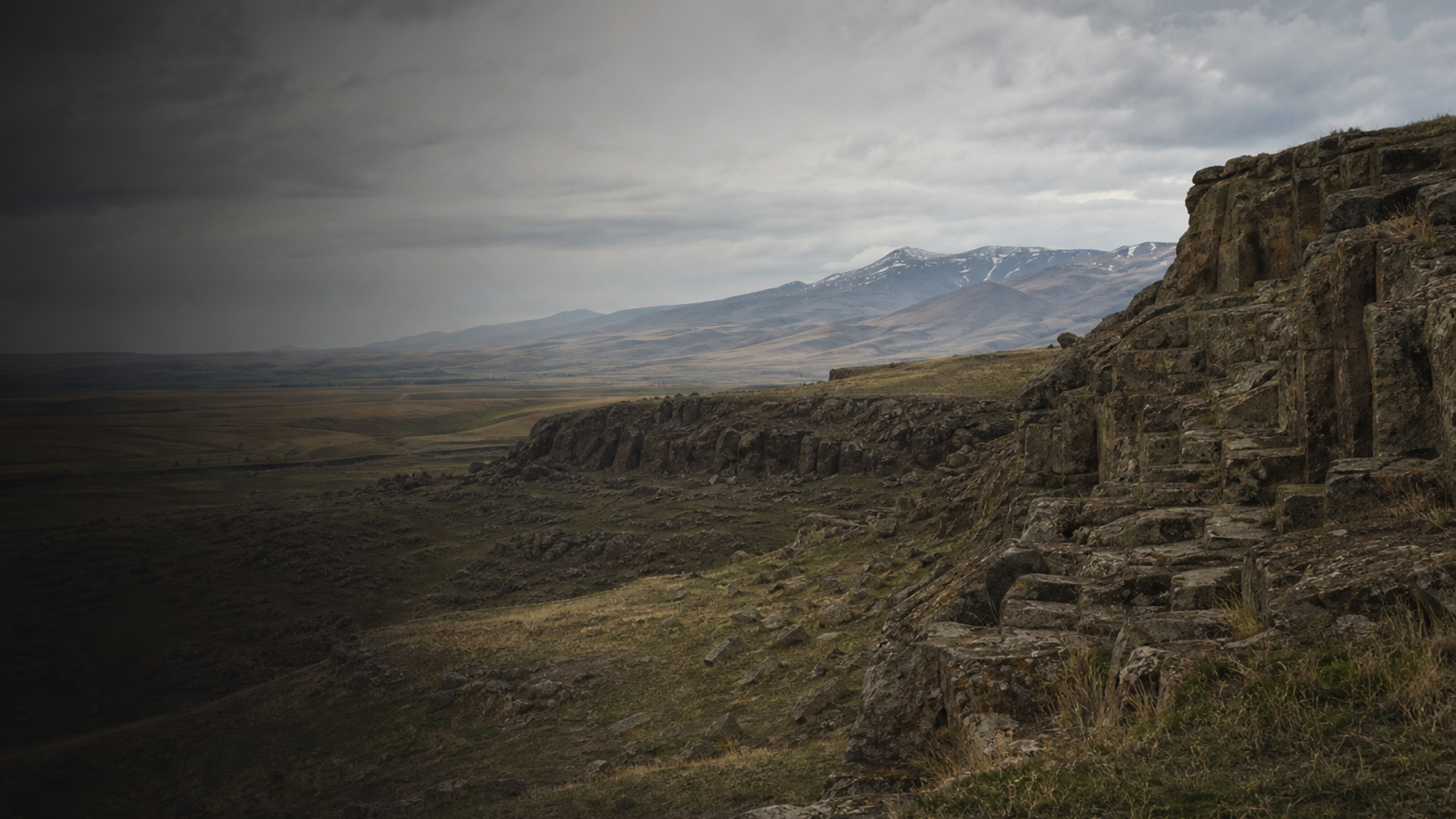
Perched on the high plateaus of Shirak, the archaeological locus of Beniamin registers the slow accretion of local traditions with the imprint of imperial presence. Radiocarbon-calibrated contexts and stratified burials placed at the site span the late Achaemenid horizon into the early medieval centuries (c. 450 BCE–550 CE). Archaeological data indicates a community rooted in long-standing Caucasian lifeways — pastoralism, mixed agriculture, and localized craft traditions — while material traces show intermittent exchange with larger polities to the south and west.

Cinematic fragments of life emerge from pottery sherds, metal fragments, and funerary architecture: household assemblages that echo Bronze and Iron Age practices, punctuated by imported or regionally styled goods that reflect Achaemenid-era trade and administrative networks. Limited evidence suggests the inhabitants of Beniamin participated in these cross-cultural flows without fully abandoning regional identities. The picture is one of continuity shaded with connectivity: a landscape where local lineage and the pressures of imperial integration coexisted for centuries, producing a population whose archaeological signature sits at the intersection of indigenous Caucasian traditions and imperial-era influences.

  • Site: Beniamin, Shirak Province, Armenia (human remains and funerary contexts)
  • Dates: c. 450 BCE–550 CE, spanning late Achaemenid to early medieval periods
  • Context: Local continuity with periodic contacts across the Achaemenid imperial network
Capítulo IV

Daily Life & Society

Daily life at Beniamin can be imagined through the surviving material record: rounded household vessels, agricultural tools, and burial rites that emphasize family and community continuity. Archaeological indicators point to a mixed economy — seasonal herding on uplands paired with cultivation in valley plots — and craft specialization that likely combined local metalworking and ceramic production with imported finished goods and raw materials.

Social organization appears anchored by kin networks and small-scale household units rather than large urban institutions. Funerary contexts suggest differentiated treatment of the dead, though evidence for pronounced social stratification is limited. The presence of objects stylistically linked to Achaemenid forms — without wholesale cultural replacement — implies selective adoption of external prestige goods, possibly mediated by trade routes or administrative ties during imperial rule.

These patterns evoke daily scenes of domestic labor, religious observance rooted in local traditions, and intermittent movement of people and objects along regional corridors. Yet archaeological interpretations remain cautious: preservation biases and a modest excavation record at Beniamin constrain how fully we can reconstruct lived experience.

  • Economy: Mixed pastoralism and agriculture with local craft production
  • Society: Kin-focused households; limited evidence for major social stratification
Capítulo V

Genetic Profile

Seven ancient individuals sampled from Beniamin (dated c. 450 BCE–550 CE) provide a small but valuable window into population history at the margins of the Achaemenid world. Because the sample count is low (<10), conclusions are preliminary: genetic patterns should be treated as suggestive rather than definitive. The dataset currently lacks broadly reported Y-chromosome and mitochondrial haplogroup tallies, limiting fine-grained male-line or maternal-line inferences for the community.

Comparative frameworks from the South Caucasus show that populations in this zone commonly reflect mixtures of deep Caucasus-related ancestry with varying contributions from Near Eastern and steppe-derived sources over millennia. Archaeogenetic expectations for Beniamin therefore include potential signals of local continuity from Bronze/Iron Age Armenian populations alongside pulses of gene flow tied to imperial-era mobility. The archaeological context — Achaemenid-era trade and administration — could plausibly have facilitated genetic exchange from Anatolia, the Zagros, and other imperial provinces, but the Beniamin samples alone cannot resolve the timing or directionality of such admixture.

Future sampling and genome-wide analyses with higher coverage, combined with chronological refinement and isotope data, are needed to test hypotheses about continuity, migration, and the demographic impact of imperial networks at Beniamin.

  • Sample size small (7 individuals) — interpretations are preliminary
  • No specific Y or mt haplogroups reported; genome-wide signals not yet definitive
Capítulo VI

Legacy & Modern Connections

Beniamin sits within a long tapestry of Armenian habitation where echoes of ancient lifeways persist in landscape use and cultural memory. Archaeogenetic work — even at small scale — helps bridge archaeology and living genealogies by charting lines of continuity and contact across centuries. Limited but evocative genetic data from Beniamin suggest that modern populations of the region may inherit complex ancestries shaped by deep Caucasian roots and episodic connections to imperial networks.

These findings carry both scientific and cultural resonance: scientifically, they underscore the need for larger sample sets to clarify demographic processes; culturally, they highlight the layered histories that contribute to contemporary Armenian identity. By combining careful excavation, radiocarbon dating, and expanding ancient DNA sampling, researchers can more fully illuminate how a small Shirak community participated in broader historical currents without losing its local character.

  • Connects local Armenian continuity with wider imperial-era interactions
  • Highlights need for more samples and interdisciplinary study to refine modern links
Com IA

Assistente de IA

Haz preguntas sobre la cultura Beniamin: Armenia at the Achaemenid Edge

Assistente de IA por DNAGENICS

Desbloquear esta função
Pregunta sobre la cultura Beniamin: Armenia at the Achaemenid Edge. El asistente con IA puede explicar hallazgos genéticos, contexto histórico, pruebas arqueológicas y conexiones modernas, con sus límites de interpretación.

Exemplo de análise com IA

La cultura Beniamin: Armenia at the Achaemenid Edge representa un capítulo de la historia humana...

A análise genética permite estudar semelhanças com populações anteriores e possíveis adaptações. As amostras de DNA antigo fornecem informações para investigar padrões migratórios e relações entre populações, com limites que dependem do estudo e do contexto arqueológico.

Esta é uma antevisão da análise com IA. Aceder ao assistente completo para explorar informações sobre:

  • Composição e similaridade genética
  • Padrões migratórios e origens
  • Vida cotidiana e práticas culturais
  • Contexto genético moderno

Explore mais culturas antigas

Descubra a história de civilizações de diferentes partes do mundo antigo