A preparar o relatório

A carregar as informações e as referências disponíveis

Consultando el registro arqueológico...

Recopilando registros antiguos

Saltar para o conteúdo principal
Capelinha Sambaqui — Early Holocene Coast
Cultura de destaque

Capelinha Sambaqui — Early Holocene Coast

A single ancient genome illuminates a dawn-era shell mound on Brazil’s southeast shore

8547 CE - 8304 BCE
Capelinha, Southeast Coast, Brazil
Desplázate para começar
Capítulo I

A História

Comprender la cultura Capelinha Sambaqui — Early Holocene Coast

Ancient DNA from one individual at Capelinha sambaqui (c. 8547–8304 BCE) links coastal shell-midden builders to pan-American lineages (Y‑Q, mtDNA‑C). Archaeological data indicates a maritime lifeway; genetic results are preliminary and invite further sampling.

Time Period

c. 8547–8304 BCE

Region

Capelinha, Southeast Coast, Brazil

Common Y-DNA

Q (1 sample)

Common mtDNA

C (1 sample)

Capítulo II

Cronologia

Momentos-chave da história desta cultura

8425 BCE

Radiocarbon date from Capelinha Sambaqui

Contextual dating places human activity at Capelinha between c. 8547 and 8304 BCE, marking an Early Holocene coastal occupation.

Capítulo III

Origins & Emergence

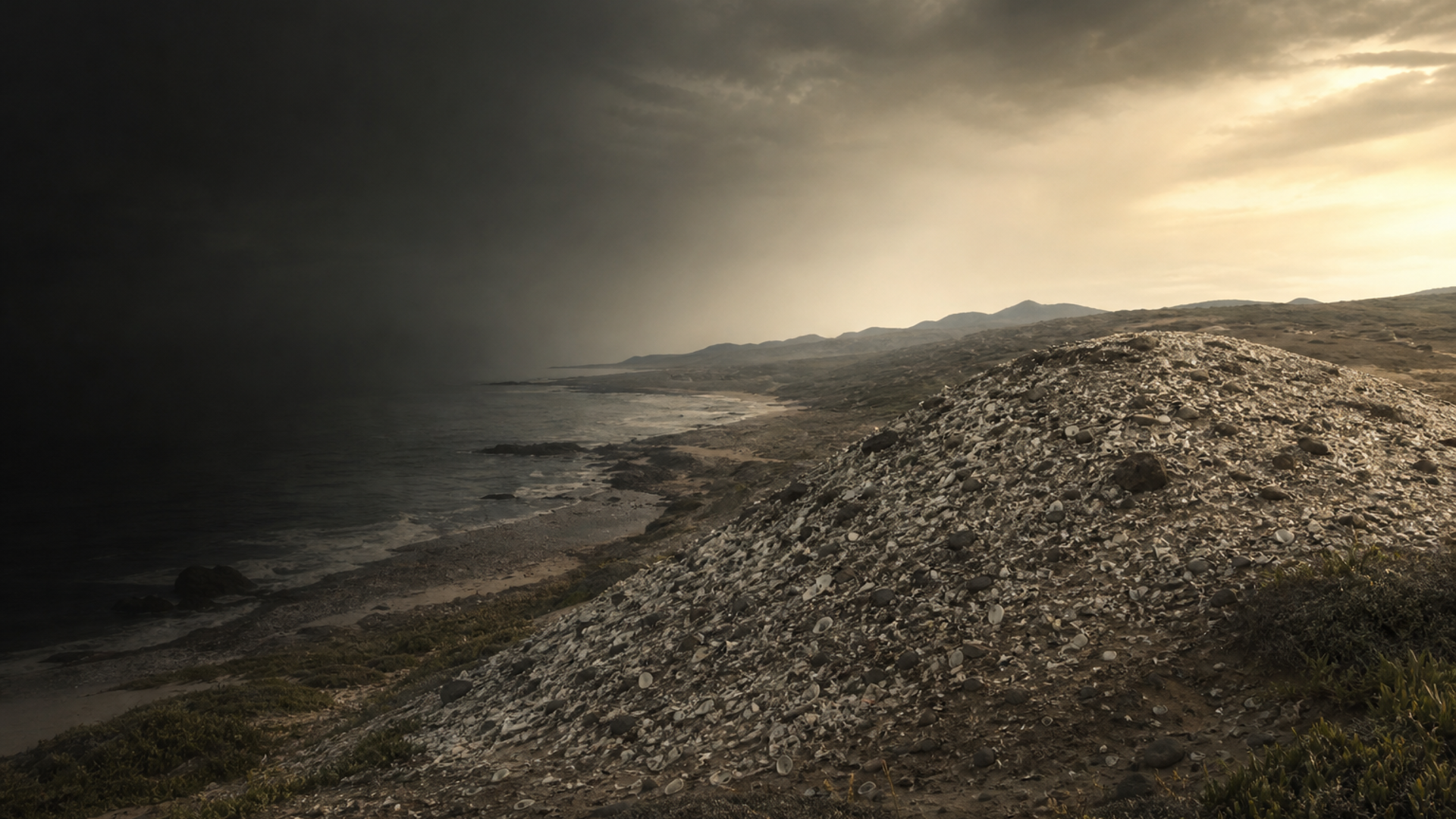
On a windswept curve of Brazil’s southeast shore, the Capelinha sambaqui preserves the breath of the Early Holocene. Archaeological data indicates large shell deposits and episodic occupation on coastal terraces now partly inundated by later sea‑level rise. Radiocarbon-calibrated dates for the context of the recovered individual fall between c. 8547 and 8304 BCE, placing this human presence among the earliest documented sambaqui (shell-midden) horizons in the region.

Limited evidence suggests these communities organized around abundant littoral resources — shellfish, fish, and coastal birds — and created visible landscape features through repeated discard and construction. The Capelinha finds sit in a larger mosaic of early Brazilian settlements that includes inland Lagoa Santa groups; however, direct cultural or demographic links remain a subject of ongoing research. Environmental shifts in the early Holocene, including stabilizing coastlines and rich estuarine systems, likely encouraged persistent use of particular shoreline knots where people returned seasonally or maintained year-round camps.

The cinematic silhouette of shell mounds against an ancient shoreline evokes long-term human attachment to the coast. Yet archaeological footprints are patchy: erosion, later human activity, and uneven excavation limit our view. Each new radiocarbon date and stratigraphic observation refines a picture that is still being sketched.

  • Capelinha sambaqui dated to c. 8547–8304 BCE (Early Holocene)
  • Site preserves shell-midden deposits indicative of coastal exploitation
  • Connections to inland Lagoa Santa groups remain plausible but unproven
Capítulo IV

Daily Life & Society

Archaeological traces from sambaqui sites like Capelinha paint an evocative portrait of coastal lifeways: tactile, salt-scented, and cyclical. Shell middens are archaeological palimpsests — accumulations of food remains, hearths, and discarded tools that mark repeated human presence. At Capelinha, material contrasts between organic midden layers and interspersed occupation horizons indicate seasonal intensity and possibly long-term use of the same coastal vantage points.

Diet was likely dominated by marine and estuarine resources: mollusks, fish, and crustaceans would have formed reliable caloric bases, complemented by opportunistic terrestrial hunting and plant gathering from nearby coastal forests and dunes. Stone and shell tools, though not richly described for this specific sample, commonly found at sambaqui sites include scrapers, points, and modified shells used as implements. Social organization can be inferred indirectly: sustained midden-building implies cooperative labor and knowledge transmission across generations, while burial practices at some sambaqui sites suggest place-based identity and ritualized engagement with the dead.

Because Capelinha’s genomic dataset currently derives from a single individual, linking specific social practices to genetic kin groups is premature. Archaeological context, however, consistently highlights the centrality of coastal resources and repeated, generational occupation of favorable shoreline loci.

  • Diet centered on shellfish, fish, and other coastal resources
  • Middens document repeated occupation and collective landscape shaping
Capítulo V

Genetic Profile

Ancient DNA from the Capelinha individual provides a rare genomic window into one Early Holocene coastal inhabitant. The sample count is one; therefore conclusions are necessarily provisional. The paternal marker falls into haplogroup Q, and the mitochondrial lineage is haplogroup C. Both haplogroups are recognized elements of the broader Pan-American genetic repertoire seen in prehistoric and contemporary Indigenous populations across the Americas.

Haplogroup Q on the Y chromosome is commonly associated with early male lineages in the Americas, and its presence here aligns with expectations for a deeply rooted paternal ancestry in South America. Mitochondrial haplogroup C is likewise one of several founding maternal clades spread throughout the hemisphere. Together these markers are consistent with an ancestry deriving from the initial peopling waves of the Americas, but they do not by themselves resolve fine-scale relationships or migration routes.

With a single genome, we cannot robustly test hypotheses about local continuity versus later population turnover, nor confidently measure affinity to nearby Lagoa Santa individuals or to later coastal sambaqui populations. Genetic affinity estimates, isotope data, and expanded sampling from contemporaneous coastal and inland sites are required to move from evocative suggestion to statistical inference. Until then, the Capelinha DNA is a valuable but solitary note in a much longer genetic symphony.

  • Y‑DNA: Q — consistent with early South American paternal lineages
  • mtDNA: C — one of the founding maternal clades in the Americas
Capítulo VI

Legacy & Modern Connections

The Capelinha genome connects the silent architecture of shell mounds to threads that still run through the genetic tapestry of the Americas. Limited though it is, this ancient DNA offers a direct biological link to early Holocene coastal inhabitants and underscores the deep time depth of Indigenous presence on Brazil’s shores. Contemporary Indigenous peoples and local communities may share distant genetic affinities with these ancient lineages, but genetic continuity should be framed cautiously: one sample cannot demonstrate unbroken ancestry, and cultural descent involves complex social histories beyond DNA alone.

Archaeologically, sambaqui landscapes remain fragile. Coastal erosion, urban development, and sea-level change threaten stratified deposits that preserve both material culture and DNA. Expanding respectful, collaborative research — combining archaeology, genomics, and Indigenous knowledge — is essential to enrich the story the Capelinha individual begins to tell. Each new well-contextualized sample will clarify patterns of mobility, social interaction, and biological ancestry across time.

  • Provides a biological link to Early Holocene coastal inhabitants of Brazil
  • Highlights need for more sampling and community-engaged research
Com IA

Assistente de IA

Haz preguntas sobre la cultura Capelinha Sambaqui — Early Holocene Coast

Assistente de IA por DNAGENICS

Desbloquear esta função
Pregunta sobre la cultura Capelinha Sambaqui — Early Holocene Coast. El asistente con IA puede explicar hallazgos genéticos, contexto histórico, pruebas arqueológicas y conexiones modernas, con sus límites de interpretación.
Exemplo de análise com IA

La cultura Capelinha Sambaqui — Early Holocene Coast representa un capítulo de la historia humana...

A análise genética permite estudar semelhanças com populações anteriores e possíveis adaptações. As amostras de DNA antigo fornecem informações para investigar padrões migratórios e relações entre populações, com limites que dependem do estudo e do contexto arqueológico.

Esta é uma antevisão da análise com IA. Aceder ao assistente completo para explorar informações sobre:

  • Composição e similaridade genética
  • Padrões migratórios e origens
  • Vida cotidiana e práticas culturais
  • Contexto genético moderno

Explore mais culturas antigas

Descubra a história de civilizações de diferentes partes do mundo antigo