A preparar o relatório

A carregar as informações e as referências disponíveis

Consultando el registro arqueológico...

Recopilando registros antiguos

Saltar para o conteúdo principal
Chichén Itzá: Echoes of the Lowland Maya
Cultura de destaque

Chichén Itzá: Echoes of the Lowland Maya

A DNA-informed portrait of a bustling Yucatán metropolis (550–1200 CE)

550 CE - 1200 CE
Chichén Itzá, Yucatán Peninsula, Mexico
Desplázate para começar
Capítulo I

A História

Comprender la cultura Chichén Itzá: Echoes of the Lowland Maya

Archaeological and genetic evidence from 95 individuals at Chichén Itzá illuminates maternal continuity with Indigenous American lineages and the cultural dynamism of the Maya Lowland Classic to Early Postclassic transition.

Time Period

550 CE – 1200 CE

Region

Chichén Itzá, Yucatán Peninsula, Mexico

Common Y-DNA

Not reported / insufficient Y-DNA data

Common mtDNA

A (29), A2 (11), A2r (6), B2l (4), A2g (4)

Capítulo II

Cronologia

Momentos-chave da história desta cultura

2500 BCE

Agricultural intensification in Mesoamerica

Expansion of maize cultivation and regional food systems laid economic foundations that centuries later supported Maya urbanism in the Lowlands.

Capítulo III

Origins & Emergence

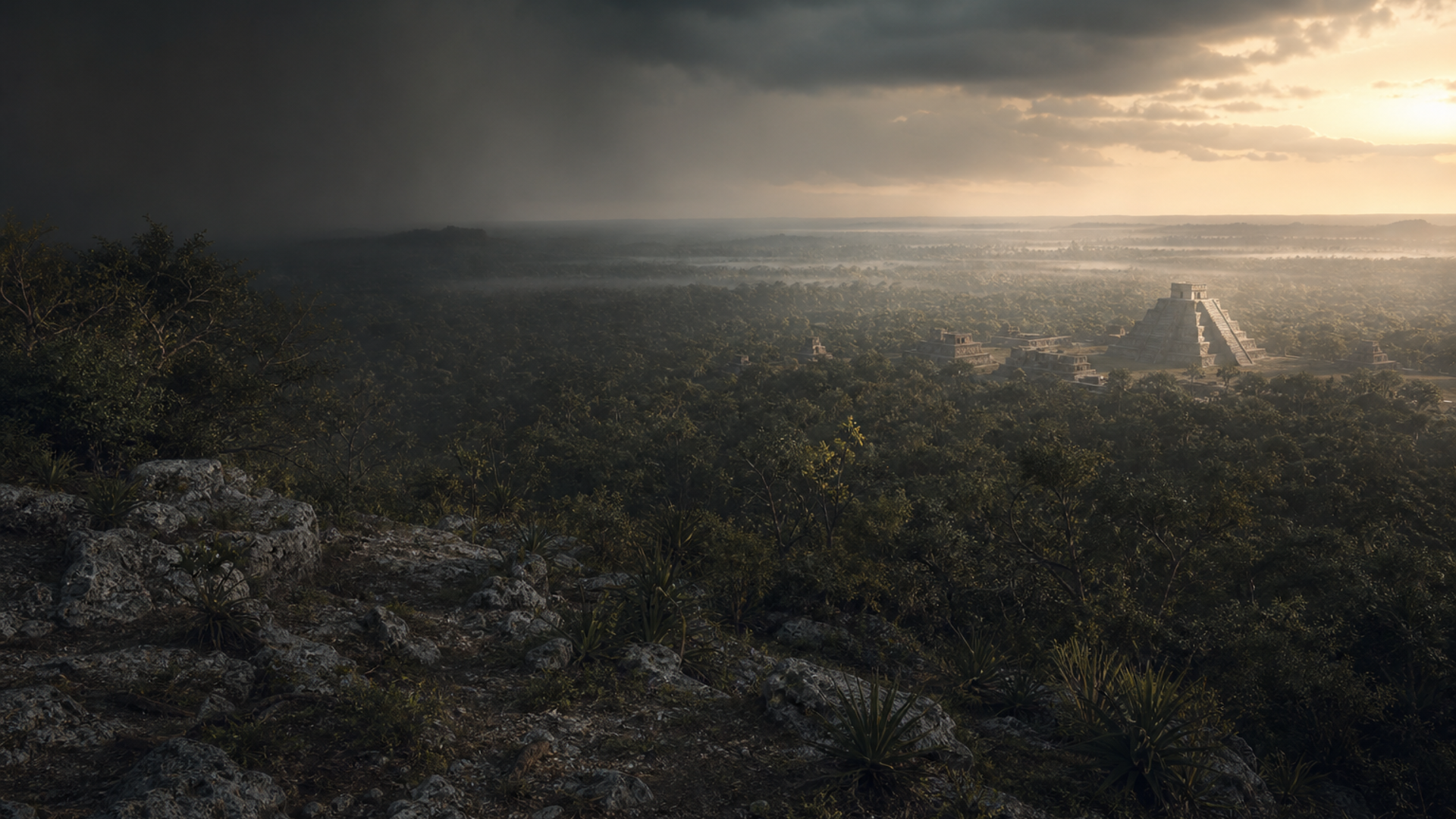
Rising from the dense lowland forests of the northern Yucatán, Chichén Itzá became one of the great urban centers of Late Classic and Early Postclassic Maya life. Between 550 and 1200 CE, the city blossomed into a landscape of monumental stone — pyramids, ballcourts, and colonnaded avenues — that articulated political power, ritual performance, and long-distance exchange. Archaeological excavations at the core and peripheral residential groups reveal phases of construction, episodes of remodeling, and material evidence for craft production and trade in obsidian, ceramics, and carved stone. Ceramic seriation and architectural styles link Chichén Itzá with broader Lowland Classic traditions while also showing distinctive local innovations.

Genetically, a dataset of 95 individuals sampled from burial contexts provides a city-scale window onto population composition. The strong presence of maternal haplogroup A and its subclades aligns Chichén Itzá inhabitants with deep Indigenous American maternal lineages that were widespread across Mesoamerica. Limited evidence for paternal lineages is currently available from these samples, so models of male-mediated migration or elite exchange must be treated cautiously. Archaeological stratigraphy, radiocarbon dates from construction and burial contexts, and the genetic signal together suggest continuity of local populations augmented by regional connections — a tapestry woven from local roots and Lowland-wide interactions.

  • Urban florescence between 550–1200 CE in northern Yucatán
  • Monumental architecture and craft/trade ties across the Maya Lowlands
  • Maternal genetic continuity with Indigenous American lineages
Capítulo IV

Daily Life & Society

Life in Chichén Itzá would have unfolded in a city of stone plazas and shaded residential compounds. Markets likely thrummed near major thoroughfares; artisans worked obsidian, shell, bone, and ceramics in neighborhood workshops; and agricultural hinterlands supplied maize, beans, squash, and manioc. Archaeobotanical remains and recovered household artifacts indicate diets centered on maize complemented by wild and cultivated local resources adapted to the porous limestone environment of the Yucatán.

Social life revolved around ritual calendars, public performance, and the maintenance of lineage and craft identities. Ballcourts and ceremonial platforms hosted events that reinforced social hierarchies and cosmological narratives; elite tombs and offerings attest to long-distance alliances and access to prestige goods. Osteological analyses from the site show a range of health profiles and occupational markers consistent with a mixed urban population that included elites, specialists, and agrarian households. Funerary variability — from simple interments to bundled elite burials — signals social differentiation and ritualized memory.

Stratified household contexts and isotopic work (where available) together allow archaeologists to reconstruct mobility patterns, diet, and life histories at the city scale. However, interpretations of daily life must balance rich material detail with the uneven preservation and sampling that shape the archaeological record.

  • Markets, workshops, and plazas structured urban daily life
  • Diet centered on maize with local marine and forest resources
Capítulo V

Genetic Profile

The Chichén Itzá genetic dataset (95 individuals) is large enough to reveal population-level trends while still requiring caution in interpreting fine-grained patterns. Mitochondrial DNA is dominated by haplogroup A and several of its subclades (A2, A2r, A2g) with additional representation of B2-like lineages (B2l). This maternal profile is consistent with broader Indigenous American maternal diversity reported across Mesoamerica and suggests substantial local maternal continuity through the Late Classic into the Early Postclassic period.

Subclade counts: A total of 29 samples assigned to clade A (including 11 A2, 6 A2r, 4 A2g) and 4 assigned to B2l. Some subclades are represented by small numbers (<10), so conclusions about fine-scale maternal founder events or microregional structure remain preliminary. The relative abundance of A-lineages may reflect long-standing maternal lineages in the northern lowlands or sampling biases toward certain burial contexts.

Notably, the provided dataset lacks a clear, consistently reported set of Y-DNA haplogroups. The absence of well-characterized paternal markers could stem from preservation differences, laboratory sampling choices, or historically lower yields of male-specific data. Therefore, claims about male-mediated migration, elite paternal lineages, or shifts in paternal ancestry should be treated as unresolved until further Y-chromosome or autosomal analyses are published.

Autosomal analyses (when available) would help clarify admixture, kinship within burial plots, and degrees of genetic continuity versus influx. For now, the mitochondrial signal anchors Chichén Itzá to deep Indigenous maternal roots, while the paternal and autosomal picture remains an active area for future research.

  • mtDNA dominated by haplogroup A and subclades; B2l also present
  • Y-DNA data not sufficiently reported — paternal patterns remain uncertain
Capítulo VI

Legacy & Modern Connections

Chichén Itzá's stones still cast long shadows over contemporary Yucatec communities. Architectural forms, artistic motifs, and ritual calendars from the city continued to shape regional practices well into the Postclassic and contact periods. The genetic continuity visible in maternal lineages underscores a biological thread linking ancient inhabitants with modern Indigenous populations of the Yucatán.

For modern descendants and scholars, these data are a bridge: they validate ancestral presence while highlighting complexities of migration, trade, and social change. Where some genetic signals are robust, others remain muted by limited sampling or preservation; ongoing collaboration with local communities, expanded sampling, and inclusion of autosomal and paternal data will refine the picture. The interplay of archaeology and ancient DNA at Chichén Itzá transforms silent bones into narrators of resilience, connectivity, and deep time in the Maya Lowlands.

  • Maternal genetic continuity connects ancient inhabitants to modern Indigenous groups
  • Future autosomal and Y-chromosome studies will deepen understanding
Com IA

Assistente de IA

Haz preguntas sobre la cultura Chichén Itzá: Echoes of the Lowland Maya

Assistente de IA por DNAGENICS

Desbloquear esta função
Pregunta sobre la cultura Chichén Itzá: Echoes of the Lowland Maya. El asistente con IA puede explicar hallazgos genéticos, contexto histórico, pruebas arqueológicas y conexiones modernas, con sus límites de interpretación.
Exemplo de análise com IA

La cultura Chichén Itzá: Echoes of the Lowland Maya representa un capítulo de la historia humana...

A análise genética permite estudar semelhanças com populações anteriores e possíveis adaptações. As amostras de DNA antigo fornecem informações para investigar padrões migratórios e relações entre populações, com limites que dependem do estudo e do contexto arqueológico.

Esta é uma antevisão da análise com IA. Aceder ao assistente completo para explorar informações sobre:

  • Composição e similaridade genética
  • Padrões migratórios e origens
  • Vida cotidiana e práticas culturais
  • Contexto genético moderno

Explore mais culturas antigas

Descubra a história de civilizações de diferentes partes do mundo antigo