A preparar o relatório

A carregar as informações e as referências disponíveis

Consultando el registro arqueológico...

Recopilando registros antiguos

Saltar para o conteúdo principal
Ertebølle Denmark: Coastal Foragers
Cultura de destaque

Ertebølle Denmark: Coastal Foragers

Late Mesolithic communities on Danish shores, revealed by archaeology and ancient DNA

5520 CE - 4241 BCE
Denmark (Jutland, Zealand, Funen)
Desplázate para começar
Capítulo I

A História

Comprender la cultura Ertebølle Denmark: Coastal Foragers

Denmark_LM_Ertebølle (5520–4241 BCE): a coastal Mesolithic tradition across Jutland, Zealand and Funen. Archaeology and 22 ancient genomes reveal hunter‑gatherer continuity, maritime lifeways, and hints of incoming influences during the Mesolithic–Neolithic transition.

Time Period

5520–4241 BCE

Region

Denmark (Jutland, Zealand, Funen)

Common Y-DNA

I (dominant), I2, F

Common mtDNA

U (predominant), R (minor)

Capítulo II

Cronologia

Momentos-chave da história desta cultura

5520 BCE

Earliest Ertebølle occupations

First dated coastal midden and habitation deposits in Jutland and Zealand mark sustained maritime foraging around 5520 BCE.

Capítulo III

Origins & Emergence

Along the drowned shorelines and lagoonal bays of Denmark, a distinctive coastal forager tradition emerged in the mid 6th millennium BCE. Sites such as Ertebølle (Jutland), Holmegard‑Djursland, and Vedbæk (Henriksholm‑Bøgebakken) record dense shell middens, stone tools, and burial deposits dated across 5520–4241 BCE. Archaeological data indicates a long continuity of maritime exploitation — fishing, seal hunting, and seasonal exploitation of estuaries — that defined lifeways for centuries.

Material culture is recognizable by characteristic pottery and microlithic toolkits at later phases, reflecting local innovation rather than wholesale replacement. Limited evidence suggests contacts with early farming communities to the south and east during the later part of this sequence, but the timing and extent of cultural exchange remain debated. Radiocarbon dates from Dragsholm and Norsminde anchor a chronology of gradual change rather than abrupt disruption.

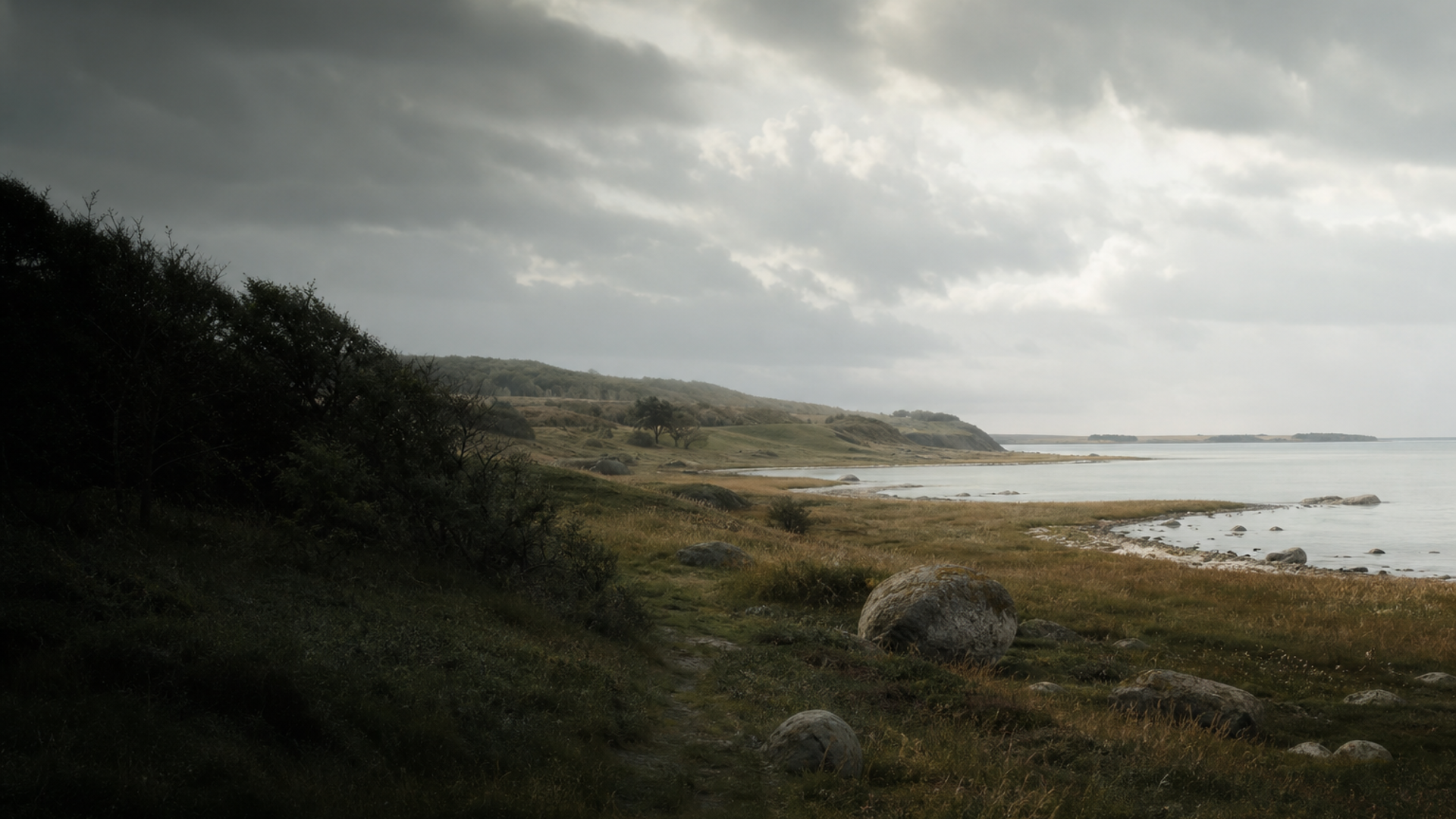
The cinematic landscapes of reed beds, tidal flats and oak‑parkland that these people inhabited are preserved archaeologically in thick midden deposits and burial contexts. While the Ertebølle label groups a range of local expressions across Jutland, Zealand and Funen, each site provides a patch in a larger mosaic of coastal adaptation and resilience.

  • Core sites: Ertebølle, Holmegard‑Djursland, Vedbæk, Dragsholm, Norsminde
  • Chronology: 5520–4241 BCE, spanning late Mesolithic & early Neolithic transition
  • Maritime economy: shell middens, fishbone, and seal remains dominate assemblages
Capítulo IV

Daily Life & Society

Daily life for Ertebølle communities unfolded along dynamic coastlines. Middens — heaped shells, fish bone and charcoal — are both refuse and archive: they preserve meals, tool production debris, hearths, and occasional offerings. Burial contexts, like those at Vedbæk and Dragsholm, reveal varied mortuary treatments including inhumation with personal ornaments, suggesting social differentiation and ritual practice.

Subsistence focused on rich estuarine and offshore resources: fish (cod, salmon), sea mammals, waterfowl, and molluscs, supplemented by terrestrial hunting and gathered plants. Lithic technology shows continued use of microliths and composite tools; later pottery appears in some contexts, signaling new technical choices rather than immediate dietary overhaul. Settlement patterns indicate a mix of seasonal camps and more persistent loci of activity near sheltered bays.

Social networks likely extended across the Kattegat and Baltic coasts, facilitating exchange of goods, knowledge and genes. However, preservation bias means many aspects of social organization remain inferential; organic structures and textiles rarely survive, so reconstruction depends on the material signals that do endure.

  • Economy: primarily marine—fish, shellfish, seals—with hunting and gathering
  • Burial evidence suggests ritual variability and possible social differentiation
Capítulo V

Genetic Profile

Genetic data from 22 individuals dated between 5520 and 4241 BCE provide a window into the biological heritage of Denmark_LM_Ertebølle. Mitochondrial DNA is dominated by haplogroup U (18 of 22), a lineage strongly associated with European Mesolithic hunter‑gatherers; this points to substantial maternal continuity with earlier forager populations. The presence of R (3) indicates some maternal diversity, but the dataset is not large enough to assign specific migration events to those lineages unequivocally.

On the paternal side, haplogroup I and its subclades (including I2) are the most common (≈12 combined), consistent with long‑standing male lineages in northern and western Europe among Mesolithic groups. A small number of non‑I paternal markers (e.g., F) appear, suggesting limited incoming male lineages or rarity in local variance. Taken together, the genetic signal emphasizes persistence of Mesolithic ancestry in coastal Denmark across this interval.

Genome‑wide analyses (where available) tend to place these individuals within the broader Western Hunter‑Gatherer (WHG) cluster, with varying degrees of admixture in late samples that may reflect contacts with early farmers or other neighboring groups. Because the sample set is moderate (n=22) and geographically clustered, conclusions about the timing and scale of admixture remain provisional; finer resolution will require broader temporal and spatial sampling.

  • mtDNA predominance of U (18/22) — strong Mesolithic maternal continuity
  • Y‑DNA dominated by I/I2 (majority), with sparse non‑I lineages (e.g., F)
Capítulo VI

Legacy & Modern Connections

The Ertebølle communities left a lasting imprint on Denmark’s coastal landscapes and genetic heritage. The predominance of U mtDNA and Y haplogroup I underscores a deep hunter‑gatherer substrate that persisted into the Neolithic era in this region. Genetic continuity implies that the cultural changes of the Neolithic transition — pottery, some novel technologies, and new economic options — often involved cultural diffusion and gene flow rather than population replacement everywhere.

For modern populations in Denmark and southern Scandinavia, these ancient genomes contribute to the ancestral mosaic alongside later Neolithic farmers and Bronze Age arrivals. While direct lines of descent cannot be traced from a single dataset, the Ertebølle genetic signature helps explain components of northern European ancestry today. Continued sampling and integration of archaeology with ancient DNA will refine these links and illuminate how coastal lifeways shaped biological and cultural landscapes.

  • Highlights deep Mesolithic contribution to northern European ancestry
  • Suggests cultural change often accompanied by limited, variable gene flow
Com IA

Assistente de IA

Haz preguntas sobre la cultura Ertebølle Denmark: Coastal Foragers

Assistente de IA por DNAGENICS

Desbloquear esta função
Pregunta sobre la cultura Ertebølle Denmark: Coastal Foragers. El asistente con IA puede explicar hallazgos genéticos, contexto histórico, pruebas arqueológicas y conexiones modernas, con sus límites de interpretación.
Exemplo de análise com IA

La cultura Ertebølle Denmark: Coastal Foragers representa un capítulo de la historia humana...

A análise genética permite estudar semelhanças com populações anteriores e possíveis adaptações. As amostras de DNA antigo fornecem informações para investigar padrões migratórios e relações entre populações, com limites que dependem do estudo e do contexto arqueológico.

Esta é uma antevisão da análise com IA. Aceder ao assistente completo para explorar informações sobre:

  • Composição e similaridade genética
  • Padrões migratórios e origens
  • Vida cotidiana e práticas culturais
  • Contexto genético moderno

Explore mais culturas antigas

Descubra a história de civilizações de diferentes partes do mundo antigo