A preparar o relatório

A carregar as informações e as referências disponíveis

Consultando el registro arqueológico...

Recopilando registros antiguos

Saltar para o conteúdo principal
Goyet Q53-1: A Paleolithic Portrait
Cultura de destaque

Goyet Q53-1: A Paleolithic Portrait

A single 26,000‑year‑old individual from Goyet cave linking stone, bone and DNA.

26440 CE - 25823 BCE
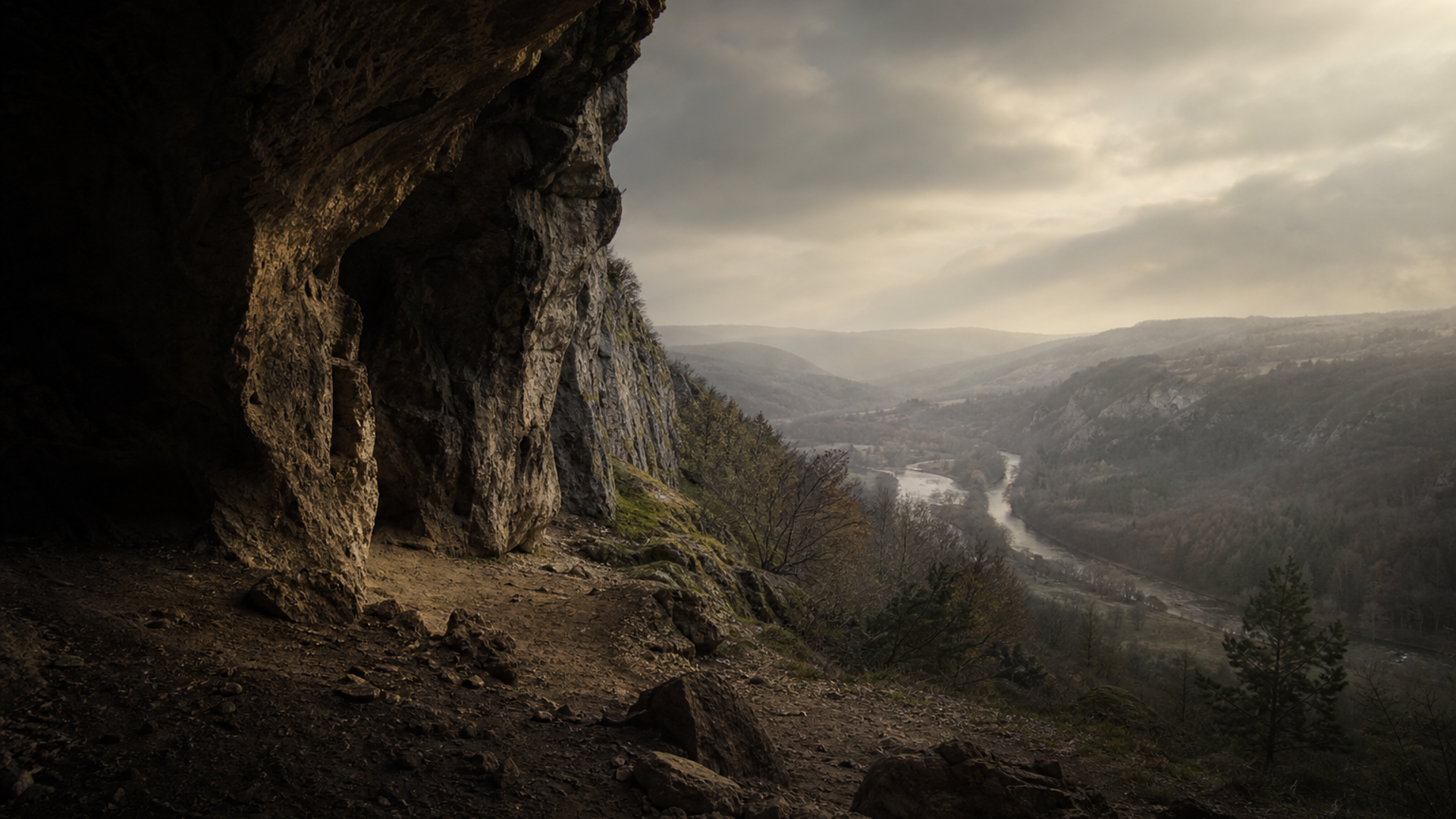
Goyet cave, Namur province, Belgium (Western Europe)
Desplázate para começar
Capítulo I

A História

Comprender la cultura Goyet Q53-1: A Paleolithic Portrait

An Upper Paleolithic individual (26440–25823 BCE) from the Troisième caverne of Goyet cave, Belgium. Archaeological context and ancient mtDNA (U2) offer a rare glimpse into Late Pleistocene life in northwest Europe; conclusions remain preliminary given a single sample.

Time Period

26440–25823 BCE (Upper Paleolithic)

Region

Goyet cave, Namur province, Belgium (Western Europe)

Common Y-DNA

Unknown (no Y-DNA data from this single sample)

Common mtDNA

U2 (1 sample)

Capítulo II

Cronologia

Momentos-chave da história desta cultura

26132 BCE

Occupation of Goyet cave (Q53-1 individual)

Radiocarbon-dated individual inhabits Troisième caverne; traces of tool use and hearths indicate episodic occupation by hunter‑gatherers.

Capítulo III

Origins & Emergence

The specimen labeled Belgium_UP_GoyetQ53_1 comes from the Troisième caverne of Goyet cave, a deep karst system in the Namur region whose stratigraphy preserves repeated occupations through the Upper Paleolithic. Radiocarbon bounds for this individual fall between 26,440 and 25,823 BCE, situating it in a cold phase of the Late Pleistocene several thousand years before the Last Glacial Maximum. Archaeological data indicates that Goyet was a long-lived place of shelter, with layers containing lithic technology often associated in this region with Gravettian and later Upper Paleolithic industries. The human presence here likely reflects mobile hunter‑gatherer groups exploiting rich, patchy environments of steppe and tundra-edge habitats.

Cinematic in its silence, the cave preserves hearth stains, chipped flints, and worked bone — signatures of episodic occupation rather than permanent settlement. Limited evidence suggests that people returned to the same caves across generations, perhaps following animal herds and seasonal resources. While the single genomic sample is a powerful window into individual life, population-level inferences are necessarily tentative; one genome cannot capture the full demographic diversity of Upper Paleolithic Belgium.

  • Single individual dated 26,440–25,823 BCE from Goyet cave (Troisième caverne)
  • Site contains repeated Upper Paleolithic layers (local Gravettian associations)
  • Evidence of episodic cave use by mobile hunter‑gatherer groups
Capítulo IV

Daily Life & Society

Daily life for the people who used Goyet cave would have been framed by a harsh, variable Pleistocene landscape: open plains punctuated by patches of woodland, with cold-adapted fauna such as reindeer, horse and large ungulates. Archaeological assemblages from Goyet more broadly include blade and bladelet industries, retouched tools, pierced bone, and personal ornaments in other layers — indicators of sophisticated toolkits and symbolic behavior. Hearth features and refitting studies show here and elsewhere that camps were organized around small, task-divided activities: raw material preparation, tool production, hide processing and food preparation.

Social groups were likely small and highly mobile, moving across river valleys and limestone shelves that funnelled animals and people. Articulate social networks are implied by long-distance exchange of raw materials documented in the region; such networks would help buffer environmental risk through information and mate exchange. However, at Goyet Q53-1 specifically, direct evidence of social structure is limited. The material record preserves the traces of skillful adaptation and cultural expression, but interpreting social roles or group sizes from a single burial-associated individual remains speculative.

  • Toolkits reflect blade technology and bone working
  • Small, mobile groups exploited seasonal resources and exchange networks
Capítulo V

Genetic Profile

Genetic data from Belgium_UP_GoyetQ53_1 are sparse but informative: mitochondrial DNA belongs to haplogroup U2. mtDNA U lineages (including U2, U4, U5) are known across Upper Paleolithic Europe and are often interpreted as part of the deep maternal substrate of Pleistocene hunter‑gatherers. The presence of U2 in this individual aligns with broader patterns of maternal diversity in Late Pleistocene western Eurasia, suggesting connections—either through ancestry or gene flow—with other Upper Paleolithic groups in Europe.

No Y-chromosome haplogroup is reported for this sample, and autosomal data are limited or not available in public summaries; therefore, population-level affinities (e.g., relationships to contemporaneous groups or to later Mesolithic and Neolithic populations) cannot be robustly assessed from this single individual. Importantly, with n=1, any genetic signal must be treated as preliminary. Ancient DNA from nearby sites and additional Goyet samples would help clarify whether U2 at Goyet represents local continuity, a transient lineage brought by a migrating band, or part of a wider, regionally distributed maternal pool.

  • mtDNA haplogroup U2 identified in the single sample
  • No Y-DNA reported; autosomal affinities remain tentative
Capítulo VI

Legacy & Modern Connections

The individual from Goyet cave resonates across deep time as a point of contact between archaeology and genomics. mtDNA U2 ties this person to a maternal tapestry that stretches across Ice Age Europe, but the story is fragmentary: one genome illuminates a thread, not the whole weave. Archaeological deposits at Goyet continue to inform on technological continuity and cultural expression in northwest Europe, while ancient DNA adds biological dimensions—ancestry, migrations, and kinship—that artifacts alone cannot resolve.


For modern audiences, the primary legacy is methodological: combining stratigraphic, radiocarbon, and genetic evidence refines narratives of human survival in extreme climates. Yet caution is essential—small sample counts mean that broader claims about population structure, migration, or lineage persistence require corroboration from additional individuals and sites. As more data accumulate, Goyet Q53-1 will play a role in reconstructing how Late Pleistocene peoples shaped the genetic landscape of post‑glacial Europe.

  • Links archaeological patterns at Goyet with Ice Age maternal lineages
  • Conclusions are provisional; more samples needed for population-level claims
Com IA

Assistente de IA

Haz preguntas sobre la cultura Goyet Q53-1: A Paleolithic Portrait

Assistente de IA por DNAGENICS

Desbloquear esta função
Pregunta sobre la cultura Goyet Q53-1: A Paleolithic Portrait. El asistente con IA puede explicar hallazgos genéticos, contexto histórico, pruebas arqueológicas y conexiones modernas, con sus límites de interpretación.
Exemplo de análise com IA

La cultura Goyet Q53-1: A Paleolithic Portrait representa un capítulo de la historia humana...

A análise genética permite estudar semelhanças com populações anteriores e possíveis adaptações. As amostras de DNA antigo fornecem informações para investigar padrões migratórios e relações entre populações, com limites que dependem do estudo e do contexto arqueológico.

Esta é uma antevisão da análise com IA. Aceder ao assistente completo para explorar informações sobre:

  • Composição e similaridade genética
  • Padrões migratórios e origens
  • Vida cotidiana e práticas culturais
  • Contexto genético moderno

Explore mais culturas antigas

Descubra a história de civilizações de diferentes partes do mundo antigo