A preparar o relatório

A carregar as informações e as referências disponíveis

Consultando el registro arqueológico...

Recopilando registros antiguos

Saltar para o conteúdo principal
Khovsgol Late Bronze Age Echoes
Cultura de destaque

Khovsgol Late Bronze Age Echoes

Arbulag sorum burials (1539–700 BCE) reveal Siberian maternal lines and steppe paternal contacts

1539 CE - 700 BCE
Khovsgol aimag, Mongolia
Desplázate para começar
Capítulo I

A História

Comprender la cultura Khovsgol Late Bronze Age Echoes

Ancient DNA from 20 Late Bronze Age individuals at Arbulag sorum, Khovsgol aimag (1539–700 BCE) shows dominant Y haplogroup Q and maternal C, D, A lineages. Archaeology and genetics together paint a picture of mobile herders with deep North Asian roots and intermittent steppe links.

Time Period

1539–700 BCE

Region

Khovsgol aimag, Mongolia

Common Y-DNA

Q (dominant), N, R

Common mtDNA

C, D, A, U (East Eurasian-dominant)

Capítulo II

Cronologia

Momentos-chave da história desta cultura

1539 BCE

Earliest dated burials at Arbulag sorum

Radiocarbon and stratigraphic data mark the start of the Arbulag sorum sequence, anchoring Mongolia_LBA_Khovsgol_6 to the mid–2nd millennium BCE.

Capítulo III

Origins & Emergence

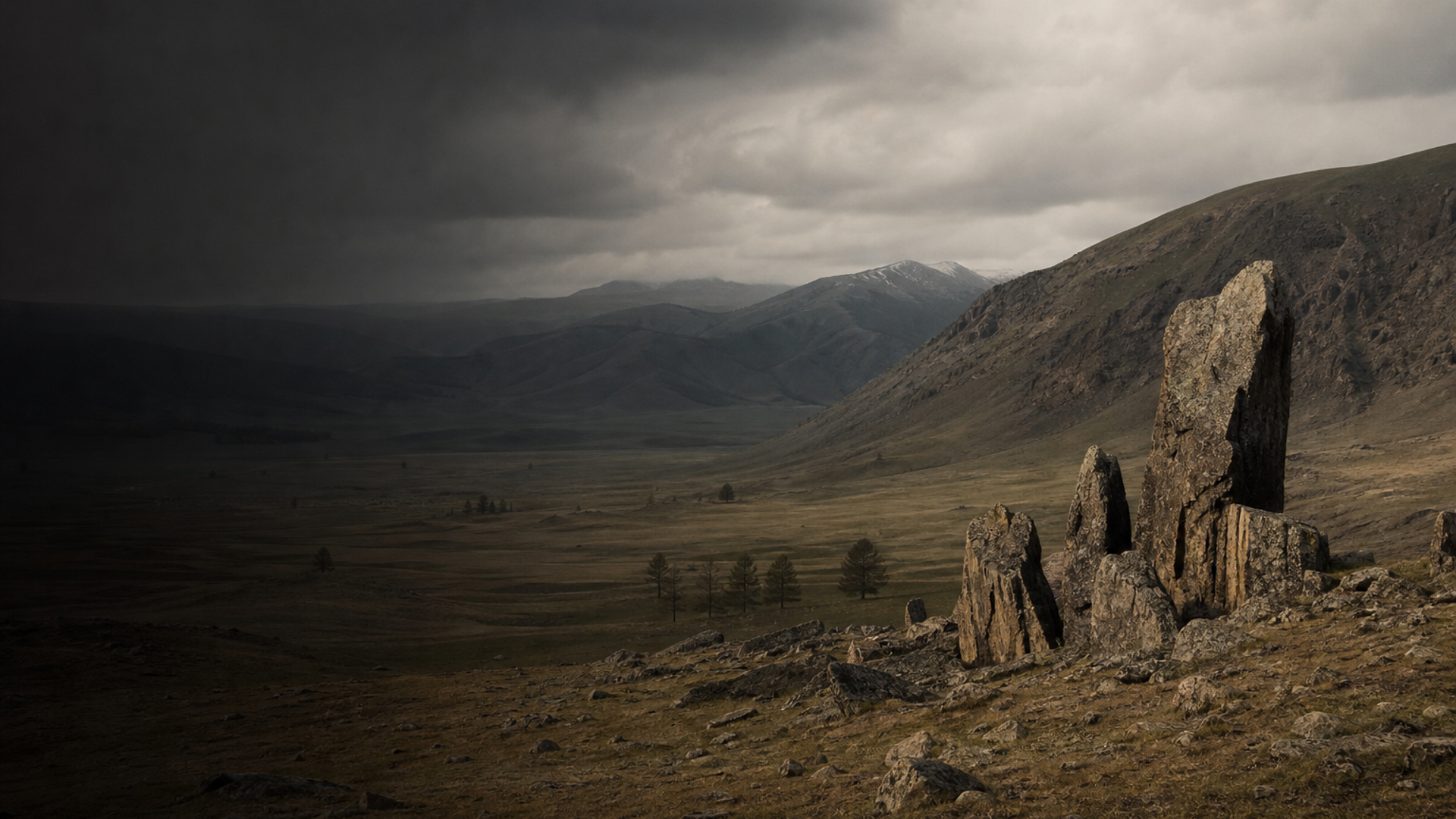
Beneath the wind-swept plateaus north of Lake Khovsgol, the Late Bronze Age horizon labeled Mongolia_LBA_Khovsgol_6 emerges in a patchwork of burials and camp scatters dated between 1539 and 700 BCE. Archaeological data from Arbulag sorum (Khovsgol aimag) indicates seasonal occupation by communities practicing mobile herding and small-scale metalworking. The landscape itself—conifer-dark slopes, river valleys and high pastures—shaped lifeways that favored mobility and flexible settlement.

Genetically, this group appears to derive predominantly from long-standing North Asian populations: maternal lineages such as mtDNA C and D are common, echoing deeper Siberian ancestry. The prevalence of Y haplogroup Q among the male individuals further supports continuity with northern Eurasian paternal lines. At the same time, the occasional presence of Y haplogroup R and mtDNA U hints at episodic contact or gene flow from western steppe groups.

These intersecting signals suggest a cultural and biological mosaic: local hunter-herder traditions augmented by networks of exchange and movement across the eastern steppe. Limited evidence means we should be cautious about large-scale migration hypotheses; instead, the data favor a picture of regional persistence with intermittent external connections. Further sampling across nearby valleys and temporal layers will clarify whether Arbulag sorum represents a local nucleus or a waypoint within broader Bronze Age frontier dynamics.

  • Archaeological nexus: Arbulag sorum, Khovsgol aimag (1539–700 BCE)
  • Material culture suggests mobile pastoralism and localized metalworking
  • Genetic signals indicate North Asian roots with occasional steppe influence
Capítulo IV

Daily Life & Society

Imagine a ring of low hearths at dusk, smoke rising where reindeer-grass and steppe herbs dry—this is the sensory world reconstructed from Late Bronze Age sites in Khovsgol. Archaeological traces at Arbulag sorum include house floors, hearth features, and faunal remains that imply herding economies focused on sheep, goat, cattle and possibly horses. Seasonal mobility between river valleys and high pastures likely structured the annual cycle: birthing in sheltered lowlands, summer grazing at higher elevations, and autumnal aggregations.

Craft life probably centered on portable technologies: bone and antler tools, woven textiles, and metal ornaments or practical bronzework. Funerary deposits—burials with personal items—speak to social identities formed through kin networks and the stewardship of herds. While direct evidence for hierarchies is limited, the distribution of grave goods and burial treatments suggests some differentiation in status or role.

Archaeological data indicates dynamic contact zones: trade in raw copper or finished metal, intermittent craft specialization, and shared symbolic motifs point to exchange with neighboring communities across the eastern steppe. Environmental constraints and the rhythms of mobility created resilient social structures adapted to the cold-season margins of northern Mongolia.

  • Seasonal pastoralism with multi-species herds inferred from faunal remains
  • Portable crafts and small-scale bronzework, with burials indicating social identities
Capítulo V

Genetic Profile

The genetic portrait from 20 individuals labeled Mongolia_LBA_Khovsgol_6 is evocative: a strong majority of paternal lineages fall into haplogroup Q (10 of the typed Y-chromosomes), with isolated occurrences of N (1) and R (1). The maternal spectrum is dominated by East Eurasian haplogroups—mtDNA C (7), D (4), and A (2), with smaller counts of D4 (1) and U (1) among the cataloged samples. These counts reflect only the reported haplogroup designations and may not sum to the full sample set due to preservation or typing limits.

Interpretation: Y haplogroup Q is widely associated with northern Eurasian and Siberian populations, consistent with an enduring paternal ancestry in the region. The presence of N, often linked to northeastern Eurasian and Uralic-speaking groups, and R, commonly associated with broader Eurasian steppe populations, suggests episodic male-mediated gene flow from neighboring regions. The maternal dominance of C, D and A aligns with deep East Asian/Siberian maternal continuity.

Caveats and context: with 20 samples the dataset is valuable but still regionally limited; it offers a window into population structure at Arbulag sorum but may not capture the full diversity of Khovsgol communities. Where autosomal genome-wide data are available for similar contexts, they often show mixed ancestry profiles reflecting both ancient Siberian and later steppe-related components—however, direct comparisons require matched genome-wide analyses. Overall, the combined archaeogenetic signal supports a community rooted in North Asian ancestry that engaged in intermittent contact with the broader Bronze Age steppe world.

  • Paternal dominance of haplogroup Q indicates deep Siberian connections
  • Maternal lineages (C, D, A) show strong East Eurasian continuity; sporadic R and N suggest external contacts
Capítulo VI

Legacy & Modern Connections

The echoes of Mongolia_LBA_Khovsgol_6 reach into the present as genetic and cultural threads woven across northern Mongolia and adjacent Siberia. Many mtDNA and Y-DNA lineages observed at Arbulag sorum persist in modern northern Eurasian populations, implying long-term regional continuity in maternal and paternal ancestries. Archaeological continuities in subsistence strategies—seasonal herding and portable material culture—also resonate with ethnographic patterns recorded among later Mongolic and Tungusic-speaking groups.

Nevertheless, direct one-to-one descent should be stated cautiously. Centuries of migration, admixture and cultural change have reshaped the genetic landscape since the Late Bronze Age. The Arbulag sorum dataset contributes a crucial temporal anchor: it helps map which lineages were present in northern Mongolia during a formative period and frames questions about how those lineages moved and transformed in subsequent millennia.

Future work integrating more genome-wide data, wider geographic sampling, and refined archaeological chronologies will sharpen our understanding of continuity and change between these ancient communities and modern populations.

  • Genetic continuity in northern Eurasian maternal and paternal lineages is suggested but not definitive
  • Archaeology + DNA provide a baseline for tracing later population dynamics in Mongolia
Com IA

Assistente de IA

Haz preguntas sobre la cultura Khovsgol Late Bronze Age Echoes

Assistente de IA por DNAGENICS

Desbloquear esta função
Pregunta sobre la cultura Khovsgol Late Bronze Age Echoes. El asistente con IA puede explicar hallazgos genéticos, contexto histórico, pruebas arqueológicas y conexiones modernas, con sus límites de interpretación.
Exemplo de análise com IA

La cultura Khovsgol Late Bronze Age Echoes representa un capítulo de la historia humana...

A análise genética permite estudar semelhanças com populações anteriores e possíveis adaptações. As amostras de DNA antigo fornecem informações para investigar padrões migratórios e relações entre populações, com limites que dependem do estudo e do contexto arqueológico.

Esta é uma antevisão da análise com IA. Aceder ao assistente completo para explorar informações sobre:

  • Composição e similaridade genética
  • Padrões migratórios e origens
  • Vida cotidiana e práticas culturais
  • Contexto genético moderno

Explore mais culturas antigas

Descubra a história de civilizações de diferentes partes do mundo antigo