A preparar o relatório

A carregar as informações e as referências disponíveis

Consultando el registro arqueológico...

Recopilando registros antiguos

Saltar para o conteúdo principal
Majaky Usatove: Coastal Echoes
Cultura de destaque

Majaky Usatove: Coastal Echoes

A coastal Eneolithic community on the northwestern Black Sea, glimpsed through graves and DNA

2911 CE - 2573 BCE
Majaky, Odessa Oblast, Ukraine
Desplázate para começar
Capítulo I

A História

Comprender la cultura Majaky Usatove: Coastal Echoes

Archaeological remains from Majaky (Odessa Oblast) and three ancient genomes (2911–2573 BCE) illuminate the Usatove horizon — a coastal Eneolithic community with Black Sea connections. Limited genetic samples hint at steppe-linked Y-R lineages and diverse maternal haplogroups H and U.

Time Period

2911–2573 BCE

Region

Majaky, Odessa Oblast, Ukraine

Common Y-DNA

R (observed)

Common mtDNA

U, H, H1 (observed)

Capítulo II

Cronologia

Momentos-chave da história desta cultura

2500 BCE

Usatove horizon active at Majaky

Archaeological and genetic traces at Majaky indicate a coastal Usatove presence involved in maritime exchange and mixed steppe–local ancestry.

Capítulo III

Origins & Emergence

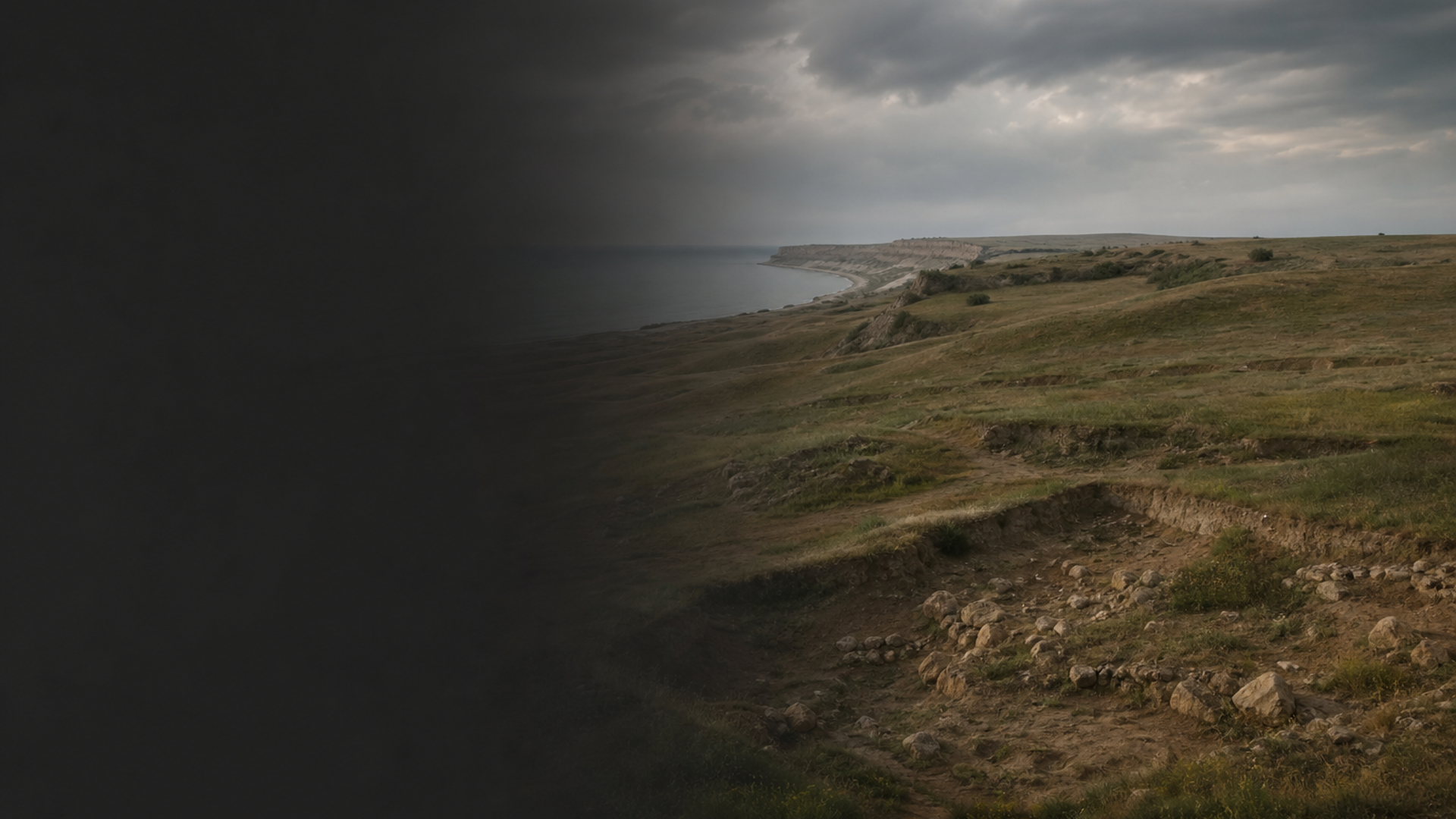
The Usatove-related assemblage at Majaky sits on the windswept littoral of the northwestern Black Sea. Archaeological data indicates a cultural horizon bridging inland steppe traditions and maritime networks of the Black Sea littoral during the late Eneolithic to early Bronze Age (context dated here to 2911–2573 BCE). Usatove settlements and cemeteries have been documented across southwestern Ukraine, often associated with rich grave goods, pottery types that echo both steppe and Balkan forms, and signs of long-distance exchange.

At Majaky (Odesa District), material traces — burial features and imported-style pottery — suggest a community engaged with coastal trade, fishing, and pastoral lifeways. The horizon likely emerged from a mosaic of influences: local Eneolithic traditions, incoming steppe groups, and contacts with the Balkans and the northern Black Sea islands. Archaeological evidence indicates increasing social differentiation in some Usatove contexts, visible in selective grave wealth and mound burials, but patterns vary regionally.

Limited osteological and contextual samples from Majaky mean that reconstructions remain cautious: stylistic affinities and settlement patterns point to a community negotiating land and sea resources, but many details of origins, migration, and interaction remain debated among specialists.

  • Situated on the Black Sea littoral, Majaky connects steppe and maritime networks
  • Cultural mix: local Eneolithic roots with steppe and Balkan influences
  • Evidence suggests growing social differentiation in burial practices
Capítulo IV

Daily Life & Society

Imagine a community living where the salt-scented wind meets fertile estuaries: households at Majaky balanced fishing, cattle and ovicaprid herding, and small-scale cultivation. Archaeological data indicates coastal subsistence strategies — fish bones, shell middens, and imported ceramics suggest active maritime engagement alongside pastoral mobility. Settlement traces hint at seasonal patterns: some sites appear occupied year-round, others show episodic use linked to grazing cycles and fishing seasons.

Grave assemblages from Usatove contexts often contain pottery, metal items, and ornaments that imply craft specialization and long-distance exchange. Such grave goods, when present, can indicate status differences and networked identities — traders, herders, or coastal specialists. Household organization likely revolved around extended kin groups; social relations were expressed through burial placement and the differential presence of exotic items.

Archaeological evidence indicates that ritual and social memory were important: cemeteries and mounds at Usatove sites became focal markers on the landscape. However, preservation and excavation coverage in the Majaky area are uneven, so reconstructions of daily life must remain provisional until more systematic excavation and environmental sampling are completed.

  • Mixed economy: fishing, herding, and small-scale farming
  • Burials and grave goods indicate status variation and exchange networks
Capítulo V

Genetic Profile

Genetic data from Majaky comprises three individuals dated to 2911–2573 BCE. Because the sample count is small, conclusions are preliminary and must be framed as hypotheses awaiting larger datasets. The observed Y-DNA signal includes haplogroup R (one individual), a lineage common in many steppe-descended populations and often associated in broader Eurasian prehistory with pastoralist expansions. Mitochondrial diversity among the three samples includes haplogroups U, H, and H1 — maternal lineages that are widespread across Neolithic and later European populations and that suggest mixed maternal ancestry.

When paired with archaeological context, these genomes hint at a community with steppe-linked paternal ancestry integrated into a broader coastal genetic landscape. Limited evidence suggests admixture between incoming steppe-related groups and local or Balkan-associated populations, consistent with material signs of cultural blending. However, three samples cannot resolve the timing, directionality, or demographic scale of gene flow.

Future sampling across Usatove sites and contemporaneous coastal settlements will be crucial to test whether the Majaky pattern reflects local heterogeneity, male-biased migration, or small-scale kin group movements. For now, the genetics add a human voice to the archaeological story: a small, diverse ensemble of mothers and at least one steppe-linked father living on the Black Sea edge.

  • Small dataset (n=3): results are preliminary and require caution
  • Y-DNA R observed; mtDNA U, H, H1 indicate mixed maternal ancestries
Capítulo VI

Legacy & Modern Connections

The human threads from Majaky weave into long-term patterns across the northwestern Black Sea. Archaeological continuities in burial rites, pottery forms, and exchange routes suggest that Usatove communities played a role in transmitting cultural practices between the steppe and the Balkans. Genetically, the presence of steppe-associated paternal lineages alongside diverse maternal haplogroups mirrors broader Bronze Age processes of migration and admixture that shaped the genetic landscape of Eastern Europe.

For modern populations, these ancient genomes are part of a deep palimpsest: some genetic lineages persist in contemporary Ukrainian and surrounding populations, but the signal has been reshaped by millennia of subsequent movements. The Majaky samples remind us that coastal corridors were conduits of people, ideas, and genes. Given the small sample set, their legacy is best described as suggestive — a cinematic whisper rather than a full chorus — beckoning for expanded sampling and careful interdisciplinary work.

  • Usatove acted as a cultural bridge between steppe and Balkans
  • Genetic signals point to long-term contributions to Eastern European ancestry, but patterns are complex
Com IA

Assistente de IA

Haz preguntas sobre la cultura Majaky Usatove: Coastal Echoes

Assistente de IA por DNAGENICS

Desbloquear esta função
Pregunta sobre la cultura Majaky Usatove: Coastal Echoes. El asistente con IA puede explicar hallazgos genéticos, contexto histórico, pruebas arqueológicas y conexiones modernas, con sus límites de interpretación.
Exemplo de análise com IA

La cultura Majaky Usatove: Coastal Echoes representa un capítulo de la historia humana...

A análise genética permite estudar semelhanças com populações anteriores e possíveis adaptações. As amostras de DNA antigo fornecem informações para investigar padrões migratórios e relações entre populações, com limites que dependem do estudo e do contexto arqueológico.

Esta é uma antevisão da análise com IA. Aceder ao assistente completo para explorar informações sobre:

  • Composição e similaridade genética
  • Padrões migratórios e origens
  • Vida cotidiana e práticas culturais
  • Contexto genético moderno

Explore mais culturas antigas

Descubra a história de civilizações de diferentes partes do mundo antigo