A preparar o relatório

A carregar as informações e as referências disponíveis

Consultando el registro arqueológico...

Recopilando registros antiguos

Saltar para o conteúdo principal
Mebrak Tomb: Himalayan Voices
Cultura de destaque

Mebrak Tomb: Himalayan Voices

Three late Iron Age individuals from Mebrak reveal a Himalayan genetic imprint — preliminary but evocative.

450 BCE - 100 CE
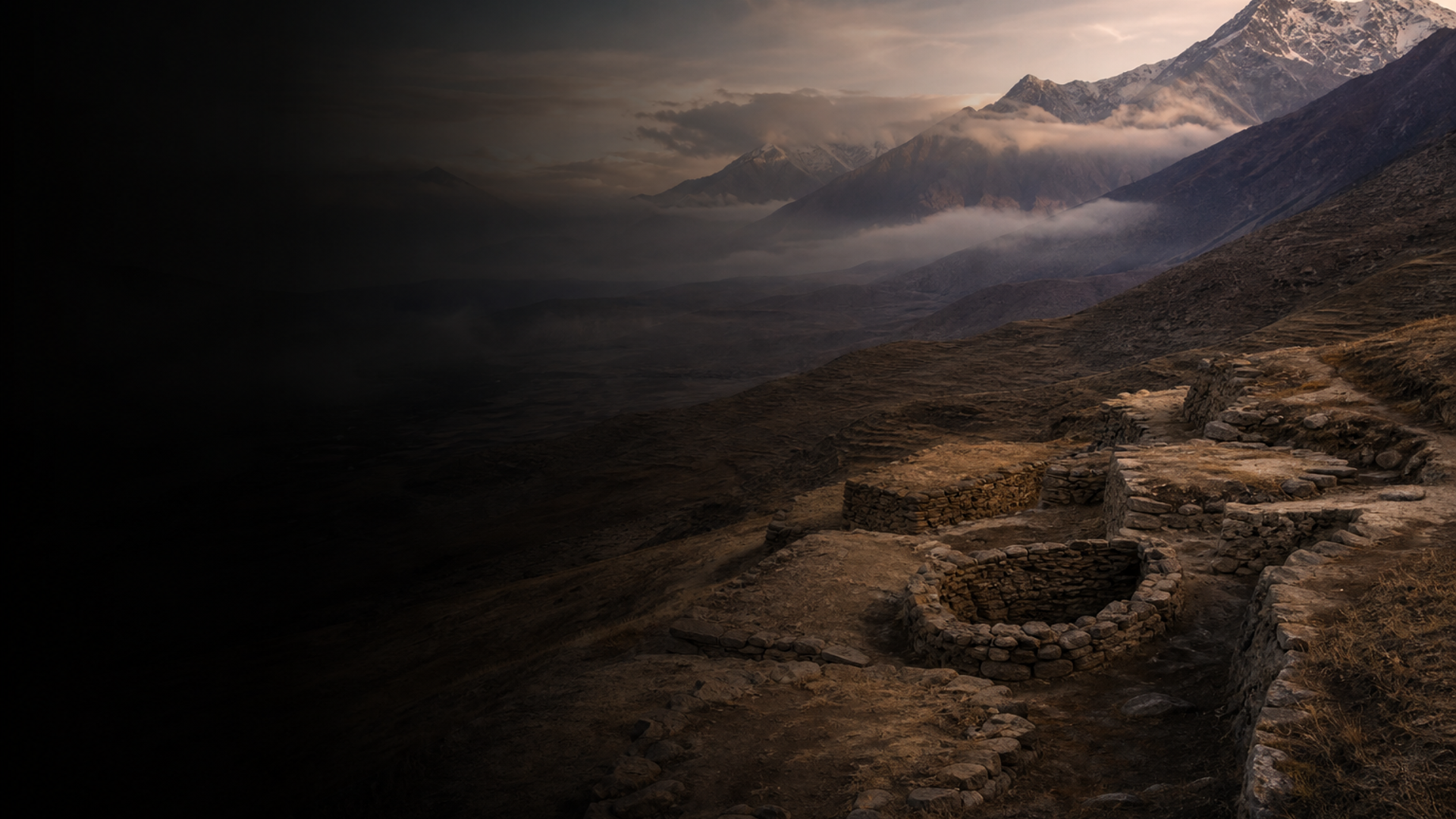
Mebrak, Nepal (Himalaya)
Desplázate para começar
Capítulo I

A História

Comprender la cultura Mebrak Tomb: Himalayan Voices

Archaeogenetic study of three individuals from Mebrak Tomb, Nepal (450 BCE–100 CE) links archaeological burial evidence with Y‑DNA O and mtDNA M/Z lineages. Limited sample size means interpretations are tentative, but findings hint at East‑Asian affinities and local Himalayan continuity.

Time Period

450 BCE – 100 CE

Region

Mebrak, Nepal (Himalaya)

Common Y-DNA

O (all 3)

Common mtDNA

M (2), Z (1)

Capítulo II

Cronologia

Momentos-chave da história desta cultura

450 BCE

Approximate date of Mebrak burials

Three individuals interred at Mebrak Tomb date to the period 450 BCE–100 CE, offering a narrow window into Himalayan population history; interpretations remain tentative.

Capítulo III

Origins & Emergence

Set high in the shadow of the Himalaya, the Mebrak Tomb assemblage (Mebrak Tomb, Nepal) dates to approximately 450 BCE–100 CE. Archaeological data indicates funerary activity at this site preserved skeletal remains and grave goods consistent with local Iron Age traditions. The pottery styles and burial context suggest continuity with regional highland lifeways rather than direct imitation of lowland traditions.

Genetically, the small sample from Mebrak carries Y haplogroup O and maternal lineages M and Z, markers frequently encountered across East and parts of Central and South Asia. This combination is archaeologically plausible for Himalayan upland populations that sat at a crossroads of north–south and east–west contacts. Limited evidence suggests the Mebrak individuals represent a local branch of broader East Asian‑associated ancestry rather than transient colonists.

Because only three genomes are available, any model of origin remains provisional: the data hint at long‑standing highland populations with periodic interaction across adjacent valleys. Future excavation and DNA sampling in neighboring tombs and settlements will be critical to test whether Mebrak reflects a local community or a more mobile regional network.

  • Mebrak Tomb burials dated to 450 BCE–100 CE
  • Material culture suggests highland Iron Age parallels
  • Small sample hints at local East‑Asian–affiliated ancestry
Capítulo IV

Daily Life & Society

Archaeology at Mebrak, though limited, paints a tactile evening of daily life: stone tools, fragments of coarse pottery, and burial arrangement imply a community adapted to steep slopes and seasonal mobility. Faunal remains in nearby contexts (where preserved) suggest a mixed subsistence of herding and small‑scale agriculture adapted to alpine niches.

The funerary placement and treatment of the dead reflect social values — attention to burial position and associated goods indicates social memory and identity were important. Ethnographic analogies with Himalayan pastoral and terrace‑farming societies allow cautious reconstruction: households likely combined yak or cattle herding with barley and millet cultivation, complemented by trade along mountain passes.

Archaeological evidence indicates resilient lifeways shaped by altitude, limited arable land, and long inter‑valley exchange routes. Material culture and the genetic signals together suggest communities maintaining local traditions while engaging in wider networks of exchange and gene flow.

  • Adaptive mixed economy: herding plus highland crops
  • Burial practices indicate social memory and localized identity
Capítulo V

Genetic Profile

Three individuals from Mebrak were successfully sequenced. All three males carry Y‑chromosome haplogroup O, a lineage widespread in East and Southeast Asia and present among many Himalayan and Tibeto‑Burman speaking populations today. On the mitochondrial side, two individuals belong to haplogroup M and one to haplogroup Z — both matrilineal clades with deep roots across Asia and known representation in northern and highland regions.

These genetic markers cohere with an East‑Asian‑affiliated ancestry component, suggesting paternal continuity of haplogroup O in this upland corridor and maternal diversity that includes lineages common to broader South and Central Asian networks. Archaeological context — burial style and local material culture — aligns with a scenario of a resident highland population rather than only transient traders.

Caveats are essential: with only three genomes (sample count <10), statistical power is low. Observed frequencies might not reflect the broader population and could be skewed by kinship among the interred. Further sampling across contemporaneous sites and genome‑wide analyses are necessary to refine admixture models, timing of gene flow, and potential links to Tibeto‑Burman expansions or other regional demographic events.

  • Y‑DNA O in all three individuals suggests East Asian paternal affinity
  • mtDNA M and Z indicate regional maternal diversity; conclusions are preliminary
Capítulo VI

Legacy & Modern Connections

The Mebrak individuals offer a cinematic but cautious glimpse into prehistoric Himalayan identities. Their genetic signatures resonate with lineages carried by many modern Himalayan and adjacent populations, implying threads of biological continuity across two millennia. Archaeological continuity in material culture supports the idea of long‑term local adaptation and exchange along mountain corridors.

However, given the very small sample size, any connection to specific modern groups must remain tentative. The true legacy of Mebrak is methodological: it demonstrates how tightly integrated archaeological context and ancient DNA can illuminate the lived realities of highland communities, setting a foundation for larger regional studies that can move from evocative snapshots to robust population histories.

  • Genetic affinities align with several modern Himalayan populations, cautiously interpreted
  • Mebrak underscores the need for broader sampling to clarify long‑term regional continuity
Com IA

Assistente de IA

Haz preguntas sobre la cultura Mebrak Tomb: Himalayan Voices

Assistente de IA por DNAGENICS

Desbloquear esta função
Pregunta sobre la cultura Mebrak Tomb: Himalayan Voices. El asistente con IA puede explicar hallazgos genéticos, contexto histórico, pruebas arqueológicas y conexiones modernas, con sus límites de interpretación.
Exemplo de análise com IA

La cultura Mebrak Tomb: Himalayan Voices representa un capítulo de la historia humana...

A análise genética permite estudar semelhanças com populações anteriores e possíveis adaptações. As amostras de DNA antigo fornecem informações para investigar padrões migratórios e relações entre populações, com limites que dependem do estudo e do contexto arqueológico.

Esta é uma antevisão da análise com IA. Aceder ao assistente completo para explorar informações sobre:

  • Composição e similaridade genética
  • Padrões migratórios e origens
  • Vida cotidiana e práticas culturais
  • Contexto genético moderno

Explore mais culturas antigas

Descubra a história de civilizações de diferentes partes do mundo antigo