A preparar o relatório

A carregar as informações e as referências disponíveis

Consultando el registro arqueológico...

Recopilando registros antiguos

Saltar para o conteúdo principal
Pitted Ware Shorelines
Cultura de destaque

Pitted Ware Shorelines

Coastal hunter-gatherers of Gotland whose graves whisper of sea and ancestry

3100 CE - 2150 BCE
Gotland, Sweden
Desplázate para começar
Capítulo I

A História

Comprender la cultura Pitted Ware Shorelines

Archaeology and ancient DNA from Gotland (Ajvide, Stora Karlsö) link the Sweden_PWC Pitted Ware people (3100–2150 BCE) to longstanding hunter‑gatherer lineages. Limited samples suggest strong Y‑DNA I and mtDNA U4d signals, consistent with Mesolithic ancestry but preliminary.

Time Period

3100–2150 BCE

Region

Gotland, Sweden

Common Y-DNA

I (predominant)

Common mtDNA

U4d, U, V

Capítulo II

Cronologia

Momentos-chave da história desta cultura

2500 BCE

Peak coastal lifeways

On Gotland, dense middens and stone‑lined graves indicate intensive marine resource use and established cemetery traditions among Pitted Ware communities.

Capítulo III

Origins & Emergence

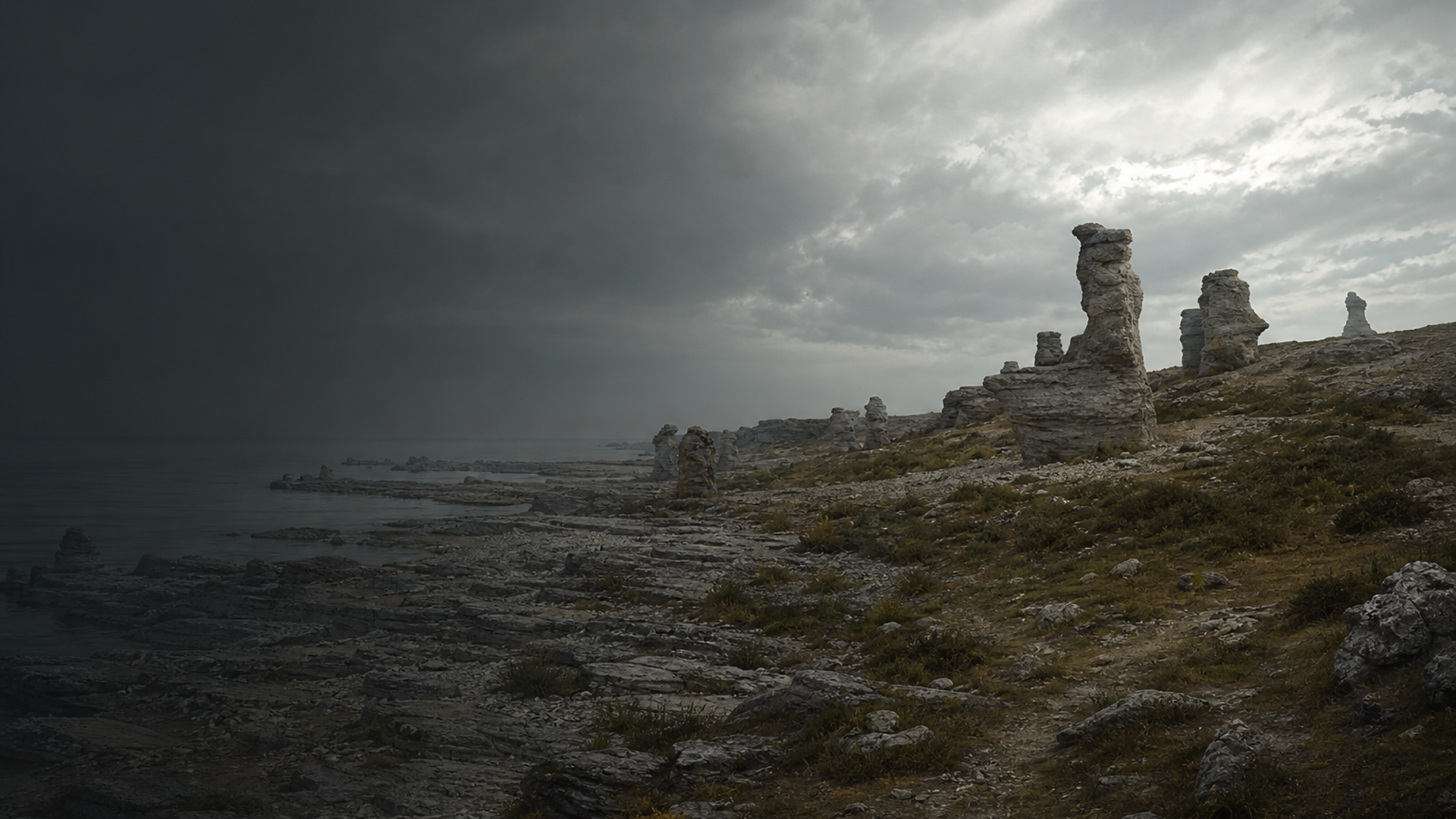
Along the wind-swept shores of Gotland, bands of people assembled pottery stamped with pits, hunted seals and fish, and buried their dead in stone settings that still punctuate the coastline. Archaeological data indicates the Pitted Ware groups in Sweden (often grouped as Sweden_PWC) emerged around 3100 BCE as a maritime adaptation during the later Neolithic and into the Early Bronze Age horizon. Key sites include Ajvide and the small islets such as Stora Karlsö, where midden deposits, grave fields, and habitation traces preserve seasonal camps and ritual places.

Material culture — shell middens, characteristic pitted pottery, and hunting gear — points to a lifeway oriented to the sea and rocky coasts rather than inland agriculture. Limited evidence suggests continuity with earlier Mesolithic coastal populations in both economy and certain artifact types, though contacts with farming communities and mobility across the Baltic are archaeologically documented. Because the dataset is small and preservation varies, interpretations of population continuity, migration, and cultural transmission remain cautious and subject to refinement as more finds and genetic data appear.

  • Emergence ~3100 BCE on Gotland; persistence to ~2150 BCE
  • Characteristic pitted pottery, shell middens, coastal cemeteries (Ajvide, Stora Karlsö)
  • Archaeology indicates maritime specialization and ties to earlier Mesolithic traditions
Capítulo IV

Daily Life & Society

The scene is cinematic: people hauling boats onto stony beaches, knapping blades from flint, and boiling fish and seal over open hearths. Archaeological remains point to a seasonal, coastal economy built on fishing, seal and seal‑bone tool production, seabird exploitation, and the gathering of littoral resources. Settlement traces at Ajvide include house structures, hearths and rich shell deposits that record repeated occupation episodes and communal consumption.

Burials often occur in small cemeteries with stone settings and grave goods such as bone tools, which suggest social identities linked to maritime skills. Household and craft debris show skilled use of organic materials — bone, antler and baleen — although preservation biases mean organic craft is underrepresented. Archaeological indicators suggest relatively mobile groups with strong local ecological knowledge and social networks connecting islands and the mainland. However, many behavioral inferences are tentative because preservation and sampling are uneven.

  • Marine-focused subsistence: fishing, seal hunting, seabird exploitation
  • Cemeteries and grave goods indicate social identities tied to maritime life
Capítulo V

Genetic Profile

Seven ancient DNA samples from Gotland sites (Ajvide and Stora Karlsö) dated between 3100 and 2150 BCE provide a preliminary genetic snapshot of the Sweden_PWC groups. The Y‑chromosome record is dominated by haplogroup I (6 of 7 males), a lineage commonly associated in northern Europe with Mesolithic hunter‑gatherers. Mitochondrial DNA is dominated by U4d (4 samples), with two additional U lineages and one V — maternal haplogroups frequently found in European hunter‑gatherer contexts.

These patterns are consistent with archaeological interpretations of continuity from earlier hunter‑gatherers on the Baltic coasts: the predominance of Y‑I and mtDNA U variants aligns with a band-derived, forager ancestry rather than clear signatures of early farming lineages. Limited evidence suggests there may have been sex‑biased interactions with neighboring farming or incoming groups, but with only seven samples these signals are highly preliminary. Archaeogenetic data should be treated cautiously: small sample sizes (<10) can misrepresent regional diversity and admixture. Future, broader sampling across time and site types on Gotland and the mainland will help clarify how these coastal communities fit into wider demographic shifts in Neolithic and Bronze Age Scandinavia.

  • Y‑DNA dominated by haplogroup I (6/7), suggesting male-line continuity with hunter‑gatherers
  • mtDNA mainly U4d and other U/V lineages, consistent with Mesolithic maternal ancestry; conclusions are preliminary due to low sample count
Capítulo VI

Legacy & Modern Connections

The echoes of Pitted Ware life linger in both the archaeology of Gotland and the genetic tapestry of northern Europe. Modern populations of Scandinavia are genetically mixed, carrying traces of Mesolithic hunter‑gatherer lineages alongside Neolithic farmer and later Steppe ancestries. The strong I and U signals in the limited Sweden_PWC dataset suggest that some paternal and maternal lineages present in ancient coastal populations may have contributed to the regional gene pool, but they are only part of a much larger, complex story.

Culturally, the maritime expertise and coastal traditions of Sweden_PWC communities resonate in later Scandinavian coastal lifeways. Because the genetic sample count is small, any direct links to contemporary groups must be regarded as tentative; broader sampling and integrative study of archaeology and genomics are needed to map the full legacy.

  • Some hunter‑gatherer Y and mt lineages seen in ancient samples persist in modern northern Europe, but admixture is complex
  • Cultural legacy visible in enduring coastal economies and ritual landscapes on Gotland
Com IA

Assistente de IA

Haz preguntas sobre la cultura Pitted Ware Shorelines

Assistente de IA por DNAGENICS

Desbloquear esta função
Pregunta sobre la cultura Pitted Ware Shorelines. El asistente con IA puede explicar hallazgos genéticos, contexto histórico, pruebas arqueológicas y conexiones modernas, con sus límites de interpretación.
Exemplo de análise com IA

La cultura Pitted Ware Shorelines representa un capítulo de la historia humana...

A análise genética permite estudar semelhanças com populações anteriores e possíveis adaptações. As amostras de DNA antigo fornecem informações para investigar padrões migratórios e relações entre populações, com limites que dependem do estudo e do contexto arqueológico.

Esta é uma antevisão da análise com IA. Aceder ao assistente completo para explorar informações sobre:

  • Composição e similaridade genética
  • Padrões migratórios e origens
  • Vida cotidiana e práticas culturais
  • Contexto genético moderno

Explore mais culturas antigas

Descubra a história de civilizações de diferentes partes do mundo antigo