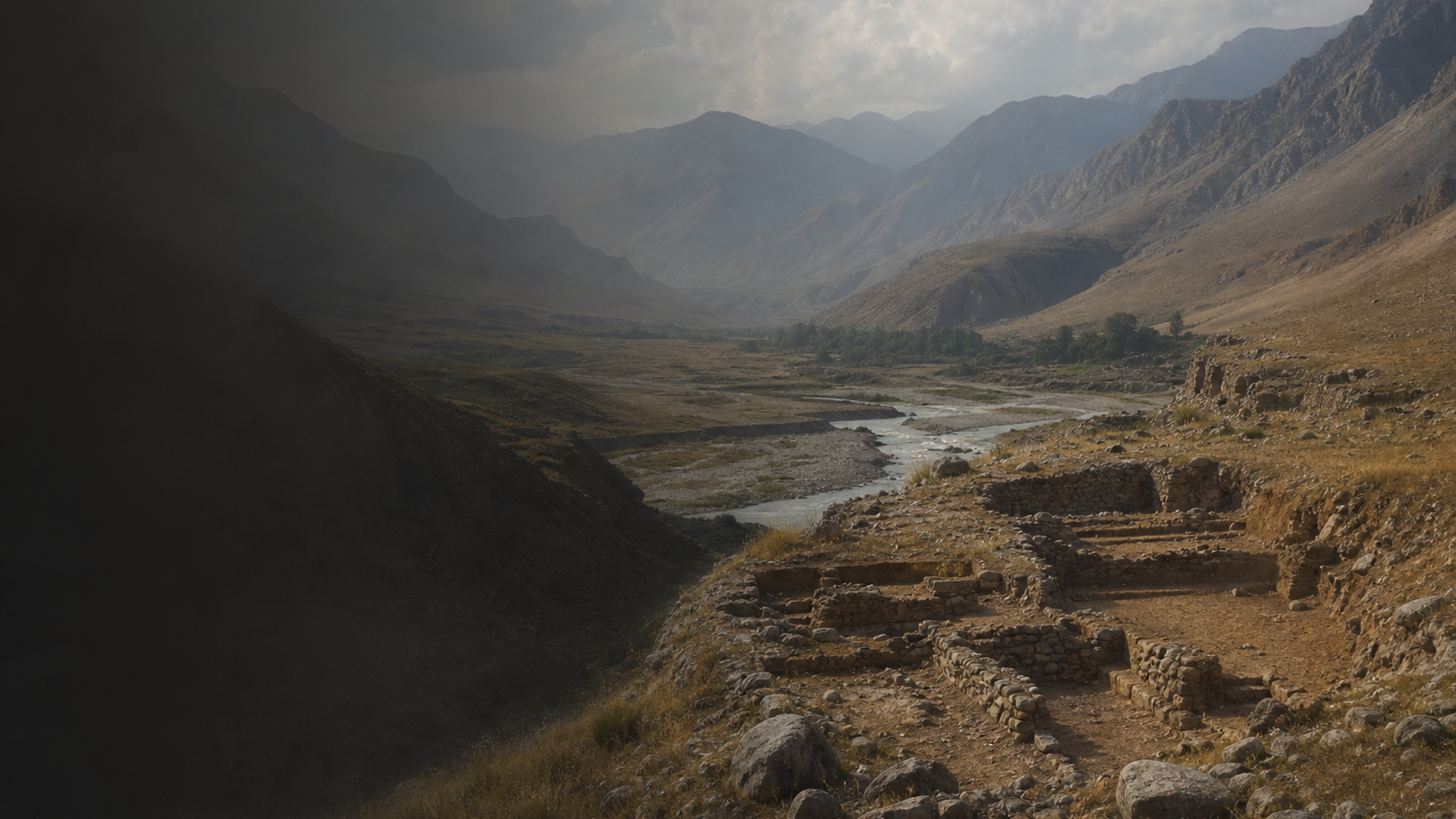
Four ancient individuals from Butkara IV provide a preliminary genetic snapshot. Uniparental markers show two Y-chromosome haplogroups labeled J and mitochondrial diversity dominated by M30 (2 samples), plus U2a and HV. M30 is a lineage common in South Asia, often associated with long-standing maternal continuity in the subcontinent. U2a also occurs in South and Central Asia and may reflect deep regional ancestry. HV is widespread in West Eurasia and appears at low frequencies across South Asia, indicating past connections beyond the immediate valley.
Y-haplogroup J, observed in two of the four males, has a strong presence in West Asia and is also found in parts of South Asia; its appearance at Butkara IV could reflect male-mediated gene flow from west-to-east at some point in the preceding millennia, or the persistence of lineages introduced earlier. However, with only four samples (n=4), these uniparental signals are suggestive rather than definitive.
Archaeological context combined with these genetic signals points toward a mixed picture: a largely South Asian maternal substrate (M30) punctuated by paternal lineages that suggest contacts across the western corridors. Robust conclusions about admixture proportions, timing, or social patterns (for example, whether incoming males integrated into local communities) require larger autosomal datasets and more samples from contemporaneous sites across Gandhara and the Swat Valley.