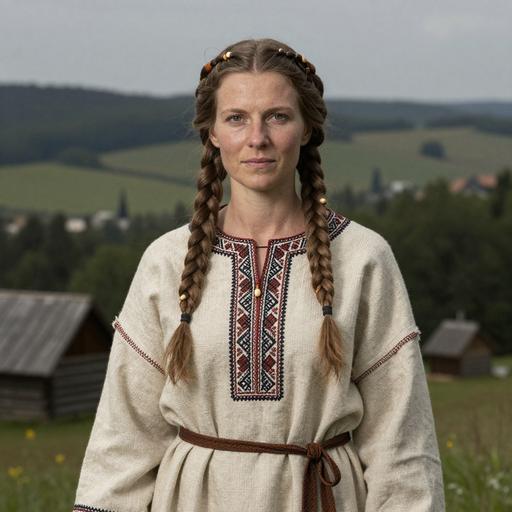
Fourteen ancient genomes from sites across Czechia, Croatia, Slovakia, Bosnia-Herzegovina and as far north as Murmansk provide a first genetic glimpse into populations labeled here as Slavic. The Y-DNA distribution in this dataset is dominated by haplogroup R (2 samples), with single instances of I and G; mitochondrial lineages are heavily weighted toward haplogroup H (8 samples), with U (3), V (1), J (1) and a specific H9a (1). Mitochondrial H’s prevalence mirrors broader European maternal continuity during the first and second millennia CE.
These genetic signals suggest a heterogeneous population profile: patrilineal markers include lineages (R and I) common across Europe and often associated with post-Neolithic and Bronze Age expansions, while maternal diversity points to long-standing local continuity and regional admixture. Archaeogenetic data indicates that Slavic-associated groups were not genetically uniform; instead they likely formed through interaction between migrating groups and established local populations, producing a mosaic of ancestries.
With only 14 genomes, interpretations must remain cautious. Sample numbers are modest, spatially uneven (for example, a single northern sample at Chalmny-Varre), and temporally broad (200–1900 CE), which limits resolution about when specific genetic shifts occurred. Nevertheless, the combined archaeological and genetic picture highlights continuity in maternal lineages and variable paternal signatures consistent with complex population dynamics during the Early Medieval period.