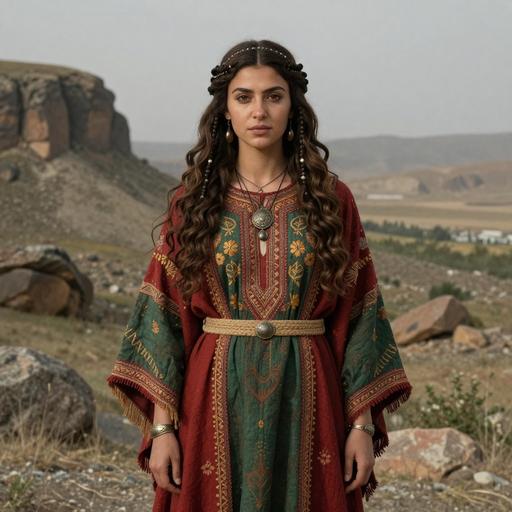
DNA analysis of the two Vardbakh individuals identifies mitochondrial haplogroup U7b in both samples. U7b today is observed at higher frequencies in parts of the Near East, Iran and the South Caucasus, and it has a deep time depth in western Eurasia. Archaeogenetically, the presence of U7b in these Antiquity Armenian individuals suggests maternal connections with southern and western Asian populations, but with only two maternal genomes the pattern cannot be generalized.
No consistent Y-DNA haplogroup is reported for this dataset; reasons can include the absence of male samples, poor preservation of Y-chromosomal DNA, or simply that Y-haplogroups were not successfully recovered or are heterogeneous across individuals. Without robust paternal-line data, interpretations of patrilineal descent, migration waves or male-mediated gene flow remain unresolved.
Genetic signals must be read alongside archaeology: trade, mobility and population contact in the Armenian highlands could produce mixtures of local and incoming maternal lineages. However, because the sample count is extremely low (n=2), any inference about population structure, continuity, or migration during 100 BCE–300 CE is preliminary. Further genome-wide sampling across cemeteries and settlements in Armenia would clarify whether U7b represents a localized maternal continuity, episodic migration, or a broader regional ancestry component in Antiquity Armenia.