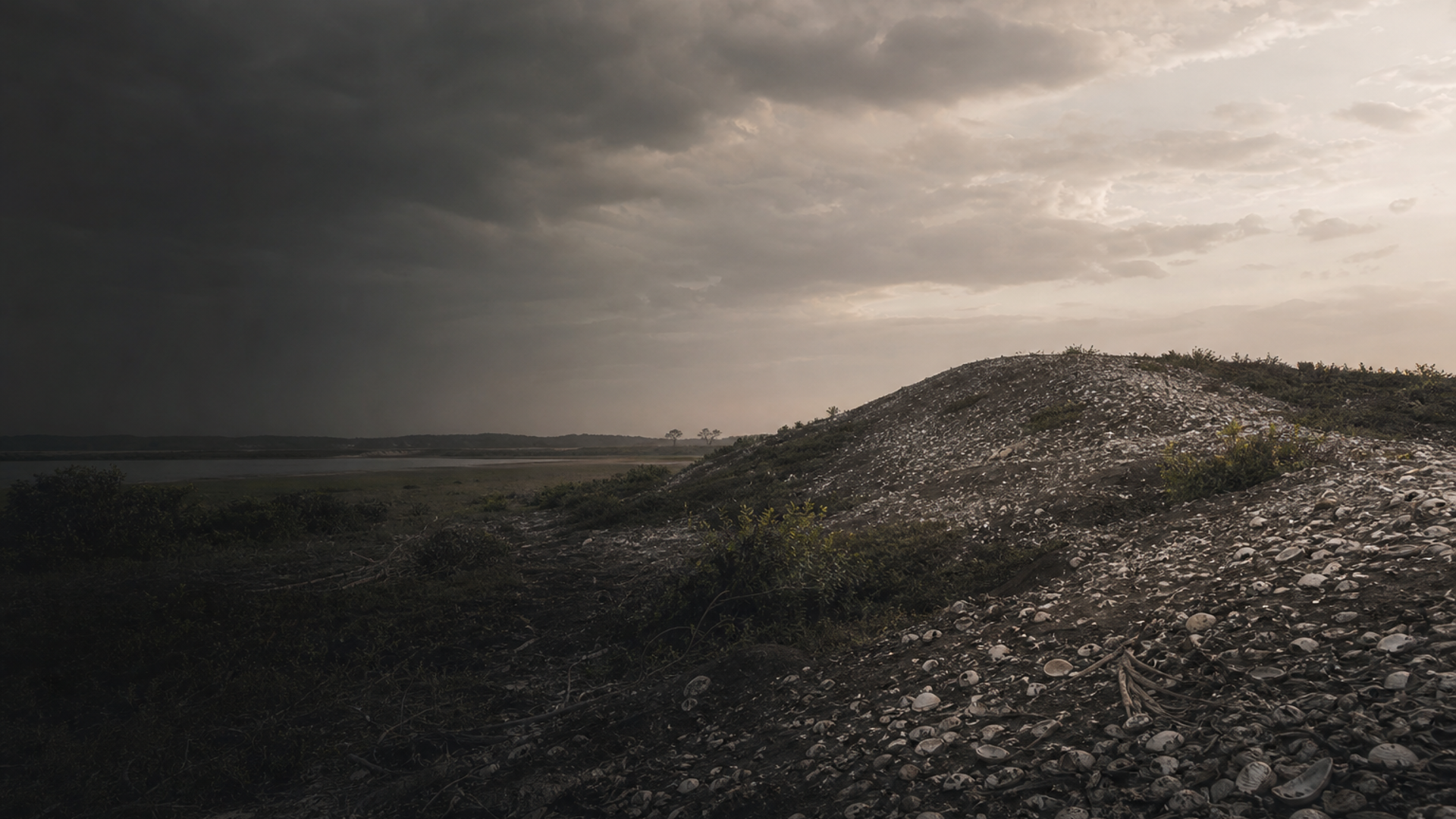
The world of the sambaqui dweller was framed by tides and estuaries. Archaeological evidence from shell mounds indicates diets rich in mollusks, fish, and seabirds; midden stratigraphy preserves the daily detritus of food, tools, and ornaments. At Vau‑Una, as at many coastal sites, layered shells and interleaved hearths suggest repeated seasonal occupation and long‑term place attachment.
Material culture recovered from comparable sambaqui sites includes bone and shell tools, carved ornaments, and occasional lithic items—objects that speak to craft specialization and symbolic display. Funerary contexts in sambaquis range from simple interments to burials placed within the mound matrix, indicating that these places also anchored ancestral memory. Social organization likely combined kin groups with broader networks of exchange along the coast; archaeological data indicates interaction between neighboring mounds through shared artifact styles and raw materials.
Cinematic though the picture can be—mounds rising like petrified tides—the archaeological record is uneven. Preservation biases, later disturbance, and limited excavation at many sites mean our reconstructions of daily life are built on fragmentary evidence. Integrating ancient DNA with stratigraphic and isotopic data promises to enrich interpretations of diet, mobility, and social ties, but at Vau‑Una such integrative studies are at an early stage.