Menu
Store
Blog
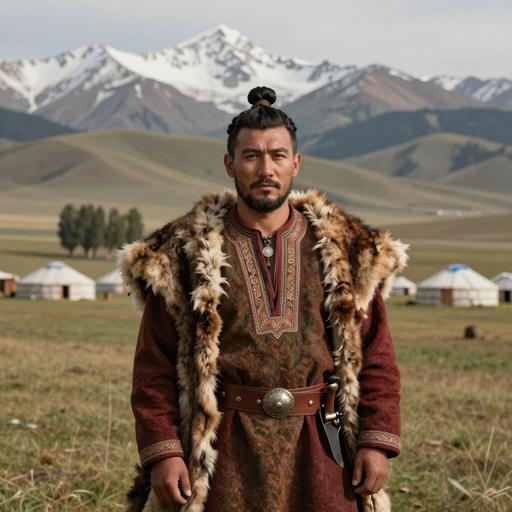
Portrait reconstruction of DA179
Ancient Individual

A man buried in Kazakhstan in the Middle Ages era

DA179
1000 CE - 1200 CE
Male
Kipchak Period 1, Kazakhstan
Kazakhstan
Scroll to begin
Chapter I

Identity

The biological and cultural markers that define this ancient individual

Sample ID

DA179

Date Range

1000 CE - 1200 CE

Biological Sex

Male

mtDNA Haplogroup

D4

Y-DNA Haplogroup

G-Z6922

Cultural Period

Kipchak Period 1, Kazakhstan

Chapter II

Place

Where this individual was discovered

Country Kazakhstan
Locality Tian Shan. Central Steppe
Coordinates 49.0436, 73.6211
Chapter III

Time

When this individual lived in the broader context of human history

DA179 1000 CE - 1200 CE
Chapter IV

Story

The narrative of this ancient life

The Kipchak Period, particularly the first phase in Kazakhstan, is a fascinating era that highlights the rich cultural tapestry and historical dynamism of Turkic nomadic societies. Spanning approximately between the 10th and 13th centuries, this period is notable for the rise and influence of the Kipchak confederation, a powerful Turkic nomadic group that exerted significant cultural, political, and economic influence across the Eurasian steppes.

Geographic and Historical Context

Kazakhstan, located in Central Asia, served as a crucial segment of the vast steppes that stretched from Eastern Europe to Mongolia. This expanse provided the perfect environment for nomadic societies whose livelihoods were intertwined with the land and seasons. The Kipchaks, also known as the Cumans in Western sources, were part of the complex tapestry of Turkic tribes that roamed these steppes.

Social and Political Structure

The social structure of the Kipchak society was largely clan-based, with each tribe led by a chieftain who wielded considerable influence. The Kipchak confederation was not a centralized state; instead, it was a loosely connected network of tribes unified by language, culture, and common interests. Yet, in times of external threats or during expansive campaigns, they could unite under charismatic leaders.

The role of the khan was pivotal, serving as both a military leader and a unifying figure for the numerous tribes. Decision-making was often conducted in kurultai (councils), where leaders convened to discuss military strategies, diplomatic relations, and internal governance.

Economy and Lifestyle

The Kipchak economy was predominantly pastoral, relying on the herding of sheep, goats, horses, and camels. The mobility provided by horseback riding was central to their way of life, facilitating not only trade but also military campaigns and migrations. The Kipchaks were skilled horsemen and archers, with these skills being crucial for both hunting and warfare.

Trade was another vital component of their economy. Positioned strategically along emerging trade routes, the Kipchaks engaged in extensive trade activities with neighboring sedentary civilizations, exchanging animal products, furs, and horses for textiles, grains, and manufactured goods.

Cultural and Religious Aspects

Culturally, the Kipchak period was marked by a synthesis of indigenous Turkic traditions with influences from neighboring cultures. This cultural fusion is most evident in their art, language, and rituals. The Orkhon script, used by many Turkic peoples, provides insights into their language and customs.

Religion during the Kipchak era was primarily Tengriism, a shamanistic belief system centered around Tengri, the sky god, and other nature deities. However, as they came into contact with Islamic, Christian, and Buddhist cultures through trade and conquest, gradual conversions occurred, creating a diverse religious landscape.

Military Prowess and Expansion

Militarily, the Kipchaks were formidable opponents, known for their agility, strategic coordination, and expert cavalry tactics. Their military excursions extended their influence significantly, impacting regions such as Kievan Rus, the Byzantine Empire, and later, interactions with the Mongols played a critical role in the shaping of Eurasian history.

Their reputation as mercenaries and traders also meant that the Kipchaks were involved in various alliances and conflict engagements, leading to both territorial expansions and retreats depending on the political dynamics of the time.

Legacy

The legacy of the Kipchak period in Kazakhstan is profound, with linguistic, cultural, and genetic imprints still observable in the region today. They played a crucial role in the ethnogenesis of later Turkic peoples and influenced the political landscapes of medieval Eurasia.

In summary, the Kipchak Period in Kazakhstan is emblematic of the dynamic interactions between nomadic and sedentary worlds, highlighting how mobility and adaptability could sustain significant political and cultural power in the medieval era.

Chapter V

Genetics

The genetic ancestry of this ancient individual

Ancient Genetic Admixture

This analysis compares the DNA profile of DA179 with ancient reference populations, showing the genetic composition in terms of prehistoric ancestral groups.

Ancient Asians 35.7%
Neolithic Farmers 32.7%
European Hunter-Gatherers 20.3%
Western Steppe Pastoralists 9.2%
Ancient Oceanians 2.1%

Modern Genetic Admixture

This analysis compares the DNA profile with present-day reference populations, showing what percentage of genetic makeup resembles modern populations from different regions.

Asia 81.9%
Central Asian, Northern Indian & Pakistani 23.4%
Central Asian 11.9%
Indian 6.3%
Pakistan 5.2%
Arab, Egyptian & Levantine 21.9%
Levantine 15.3%
Arabian 6.6%
Northern West Asian 18.8%
Caucasian 18.8%
Chinese & Southeast Asian 14.4%
Chinese 14.4%
Northern Asian 3.1%
Siberian 2.9%
Europe 17.6%
Southern European 8.1%
Balkan 8.1%
Northwestern European 5.8%
Northwestern European 4.8%
Scandinavian 1.1%
Eastern European 3.7%

Closest Modern Populations

These are the modern populations showing the closest statistical alignment to A man buried in Kazakhstan in the Middle Ages era, ranked by genetic distance. Lower distance values indicate closer statistical similarity.

1
Turkmen Iran
4.3343
2
Turkmen
4.8278
3
Turkmen Uzbekistan
5.3386
4
Tajik Tajikistan Ayni
5.3681
5
Tajik Tajikistan Hisor
5.5899
6
Pamiri Sarikoli
7.1876
7
Tatar Crimean Steppe
7.1960
8
Tajik Tajikistan Kulob
7.3444
9
Tatar Lipka
7.3780
10
Pamiri Badakhshan
8.2746
Chapter VI

Context

Other ancient individuals connected to this sample

Sources

References

Scientific publications and genetic data

Scientific Publication

137 ancient human genomes from across the Eurasian steppes

Authors Damgaard PB, Marchi N, Rasmussen S
Abstract

For thousands of years the Eurasian steppes have been a centre of human migrations and cultural change. Here we sequence the genomes of 137 ancient humans (about 1× average coverage), covering a period of 4,000 years, to understand the population history of the Eurasian steppes after the Bronze Age migrations. We find that the genetics of the Scythian groups that dominated the Eurasian steppes throughout the Iron Age were highly structured, with diverse origins comprising Late Bronze Age herders, European farmers and southern Siberian hunter-gatherers. Later, Scythians admixed with the eastern steppe nomads who formed the Xiongnu confederations, and moved westward in about the second or third century BC, forming the Hun traditions in the fourth-fifth century AD, and carrying with them plague that was basal to the Justinian plague. These nomads were further admixed with East Asian groups during several short-term khanates in the Medieval period. These historical events transformed the Eurasian steppes from being inhabited by Indo-European speakers of largely West Eurasian ancestry to the mostly Turkic-speaking groups of the present day, who are primarily of East Asian ancestry.

G25 Coordinates

The G25 coordinates for sample DA179 can be used for detailed admixture analysis in our G25 Studio tool.

DA179,0.07330944,-0.01600026,-0.01051096,0.00662834,-0.01850706,0.00719176,0.0042395,0.00274038,-0.0099718,-0.01846066,-0.00663866,-0.00461192,0.01138468,-0.00436212,0.00111024,0.00317598,-0.00988206,0.00125132,-0.00136854,-0.00266666,0.00345408,0.00720724,-0.00178852,-0.00023132,0.00093391
Analyze in G25 Studio
Use code for 40% off Expires Feb 27