Menu
Store
Blog
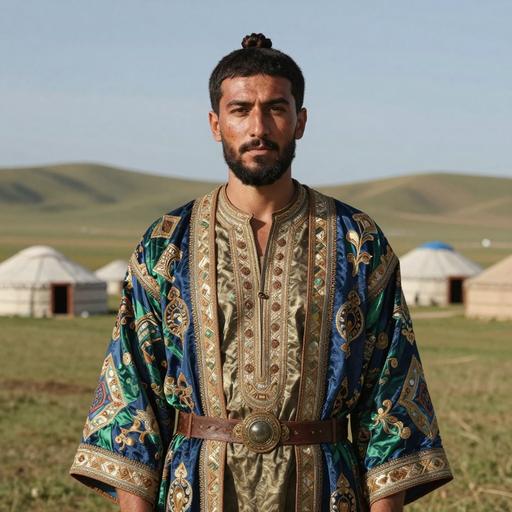
Portrait reconstruction of DA204
Ancient Individual

A man buried in Kazakhstan in the Medieval Islamic era

DA204
886 CE - 979 CE
Male
Karakhanid Khanate
Kazakhstan
Scroll to begin
Chapter I

Identity

The biological and cultural markers that define this ancient individual

Sample ID

DA204

Date Range

886 CE - 979 CE

Biological Sex

Male

mtDNA Haplogroup

A+152+16362+16189

Y-DNA Haplogroup

J-Z7706

Cultural Period

Karakhanid Khanate

Chapter II

Place

Where this individual was discovered

Country Kazakhstan
Locality Butakty-1 (Almaty Region, Medeu District)
Coordinates 43.2025, 76.9817
Chapter III

Time

When this individual lived in the broader context of human history

DA204 886 CE - 979 CE
Chapter IV

Story

The narrative of this ancient life

The Karakhanid Khanate, a prominent state in Central Asia, thrived from the 9th to the 13th centuries. It represents a significant cultural and political era characterized by the integration of Turkic and Islamic elements. Founded in the mid-9th century by the Karakhanid dynasty, this khanate played a crucial role in the history of Central Asia by marking the transition of the region from predominantly Buddhist and Tengrist beliefs to Islam.

Origins and Political Structure

The Karakhanid Khanate originated from the Karluks, a confederation of Turkic tribes that converted to Islam. The dynasty’s foundation is often attributed to Abdulkarim Satuk Bughra Khan, who is considered the first Karakhanid ruler to convert to Islam, around the late 10th century. This conversion profoundly influenced the region, facilitating both diplomatic relationships and cultural exchanges with the Islamic world.

The Karakhanids established a feudal system where power was divided among different branches of the family, which became a defining feature of their political structure. The state was divided into two main branches: the eastern and western khanates, governed from Kashgar and Samarkand, respectively. Despite occasional internal conflicts, this structure allowed for efficient control over a vast and culturally diverse territory.

Cultural and Religious Impact

One of the hallmark achievements of the Karakhanids was their role in the spread and institutionalization of Islam in Central Asia. Their conversion to Islam led to the flourishing of Islamic culture, scholarship, and architecture in the region. Cities like Bukhara, Samarkand, Balasagun, and Kashgar became key centers of Islamic learning, attracting scholars, poets, and theologians. The Karakhanids patronized various religious and educational institutions, promoting the Islamic Golden Age’s intellectualism.

The Karakhanid Khanate’s embrace of Islam also had a profound impact on local culture. The use of the Arabic script became widespread, replacing earlier scripts and facilitating the incorporation of Islamic teachings and administrative practices. A fusion of Turkic traditions with newly adopted Islamic customs characterized the cultural landscape, evident in art, literature, and architecture.

Achievements and Contributions

Art and Architecture: The Karakhanid era is noted for its distinctive architectural style, marrying Turkic and Islamic elements. It saw the construction of madrasas, mosques, and mausoleums, featuring intricate brickwork and ornamental decoration. The minarets and tombs of the era often display elaborate tilework and Kufic inscriptions.

Language and Literature: Under the Karakhanids, the Turkic language flourished alongside Persian and Arabic, leading to the development of a Turkic Islamic literature. Yusuf Balasaguni’s “Kutadgu Bilig” and Mahmud al-Kashgari’s “Diwan Lughat al-Turk” are noteworthy literary works from this period, the latter being a comprehensive dictionary of Turkic languages, informing us greatly about the culture and language of the time.

Economy and Trade

Economically, the Karakhanid Khanate was strategically positioned along the Silk Road, making it a vital link between the East and West. It facilitated the trade of silk, spices, and other luxury goods, promoting economic prosperity within the khanate. The fertile Fergana Valley and the trade routes running through their domain ensured that agriculture and commerce thrived. The Karakhanids issued their own coins, which played an integral role in boosting trade and economic cohesion across the region.

Decline and Legacy

The Mongol invasion in the early 13th century marked the decline of the Karakhanid Khanate. However, their legacy endured through the centuries, particularly in the cultural and religious transformations they instigated in Central Asia. By acting as a bridge between Turkic traditions and Islamic culture, the Karakhanid era laid the groundwork for future Islamic empires in the region, influencing subsequent states, including the Khwarezmian Empire and the later Timurid and Safavid Empires.

In conclusion, the Karakhanid Khanate was a pivotal player in Central Asia's medieval history. It ushered in an era of cultural, religious, and economic dynamism that continues to be reflected in the region's identity today.

Chapter V

Context

Other ancient individuals connected to this sample

Sources

References

Scientific publications and genetic data

Scientific Publication

137 ancient human genomes from across the Eurasian steppes

Authors Damgaard PB, Marchi N, Rasmussen S
Abstract

For thousands of years the Eurasian steppes have been a centre of human migrations and cultural change. Here we sequence the genomes of 137 ancient humans (about 1× average coverage), covering a period of 4,000 years, to understand the population history of the Eurasian steppes after the Bronze Age migrations. We find that the genetics of the Scythian groups that dominated the Eurasian steppes throughout the Iron Age were highly structured, with diverse origins comprising Late Bronze Age herders, European farmers and southern Siberian hunter-gatherers. Later, Scythians admixed with the eastern steppe nomads who formed the Xiongnu confederations, and moved westward in about the second or third century BC, forming the Hun traditions in the fourth-fifth century AD, and carrying with them plague that was basal to the Justinian plague. These nomads were further admixed with East Asian groups during several short-term khanates in the Medieval period. These historical events transformed the Eurasian steppes from being inhabited by Indo-European speakers of largely West Eurasian ancestry to the mostly Turkic-speaking groups of the present day, who are primarily of East Asian ancestry.

Use code for 40% off Expires Feb 27