Menu
Store
Blog
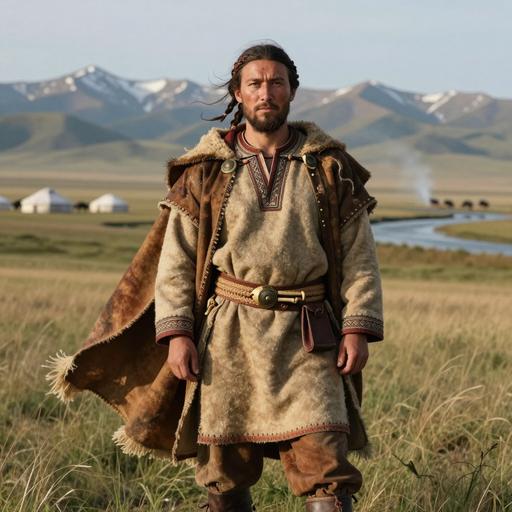
Portrait reconstruction of DA92
Ancient Individual

A man buried in Kazakhstan in the Iron Age era

DA92
51 BCE - 204 CE
Male
Iron Age Nomad, Kazakhstan
Kazakhstan
Scroll to begin
Chapter I

Identity

The biological and cultural markers that define this ancient individual

Sample ID

DA92

Date Range

51 BCE - 204 CE

Biological Sex

Male

mtDNA Haplogroup

J1b1a1-a

Y-DNA Haplogroup

R-Y20768

Cultural Period

Iron Age Nomad, Kazakhstan

Chapter II

Place

Where this individual was discovered

Country Kazakhstan
Locality Tian Shan. Central Steppe
Coordinates 52.1739, 77.0397
Chapter III

Time

When this individual lived in the broader context of human history

DA92 51 BCE - 204 CE
Chapter IV

Story

The narrative of this ancient life

The Iron Age Nomads of Kazakhstan, situated within the larger context of the Eurasian Steppe, represent a vibrant and dynamic culture that thrived from approximately 800 BCE to 400 CE. This period is characterized by significant developments in technology, metallurgy, social organization, and trade, underscoring the adaptability and innovation of these nomadic peoples.

Geographical and Historical Context

Kazakhstan, occupying a vast portion of Central Asia, is defined by diverse landscapes ranging from expansive steppes and deserts to mountainous terrains. This varied geography was crucial in shaping the lifestyle and culture of the Iron Age nomadic societies, facilitating their mobility and their distinct pastoralist economy. The region served as a cultural crossroads due to its strategic location, linking various parts of Eurasia through the Eurasian Steppe, which acted as a conduit for trade, migration, and cultural exchange.

Society and Social Structure

Iron Age nomadic societies in Kazakhstan were primarily organized in tribal confederations. These groups were often semi-nomadic, moving with the seasons to access grazing lands for their livestock, which included horses, sheep, goats, and cattle. Social hierarchy was based largely on kinship ties and military prowess, with tribal leaders and warriors holding significant power and influence. The role of the chieftain was crucial, often assuming not just political leadership but also military and spiritual roles.

The societal framework was likely flexible, allowing for alliances and exchanges between different tribes. This flexibility was essential for survival and prosperity, enabling them to adapt to changing environmental and political conditions. Women in these societies, though often overlooked in historical texts, played crucial roles in domestic spheres and even in trade and diplomacy.

Economy and Trade

The economy of the Iron Age nomads was predominantly based on animal husbandry. Horses, in particular, were central to their lifestyle, serving not only as a mode of transport enabling their nomadic way of life but also as key elements in trade, warfare, and social status. The domestication and mastery of horse breeding and riding were critical developments that empowered these nomadic groups to dominate vast territories.

Trade was another significant aspect of their economy, facilitated by the extensive network of the Silk Road that traversed Kazakhstan. The Iron Age nomads traded livestock and crafted goods such as textiles, leather, and metalwork for essentials and luxuries from settled civilizations, including grains, pottery, and silk from the East. This interaction fostered cultural exchanges and the spread of technologies and ideas.

Art and Craftsmanship

The art and craftsmanship of the Iron Age nomads are renowned for their intricate designs and symbolic motifs. Metalworking, particularly in bronze and later iron, was highly developed, reflecting both utilitarian and aesthetic purposes. Items such as weapons, jewelry, and horse gear were often decorated with zoomorphic motifs, which held significant cultural symbolism and demonstrated impressive technical skill.

The Saka, one of the prominent groups during this era, are known for their \animal style" art, which depicted dynamic scenes of animals both real and mythical. This style highlights the spiritual and symbolic importance of animals in their worldview, likely reflecting beliefs in shamanism and the animistic practices prevalent among these societies.

Culture and Spiritual Beliefs

Religious and spiritual beliefs were deeply woven into the fabric of societal life. Shamanism is believed to have been a predominant spiritual practice, with shamans acting as intermediaries between the physical world and the spiritual realm. The cosmos and nature were integral to their spiritual beliefs, influencing everything from burial practices to daily rituals.

Funerary customs provide significant insight into their spiritual beliefs and social structures. Elaborate burial mounds called kurgans have been discovered throughout Kazakhstan, revealing rich grave goods and ceremonial artifacts. These kurgans indicate a belief in the afterlife and the importance of honoring the dead.

Legacy and Influence

The legacy of the Iron Age nomads of Kazakhstan is profound, impacting subsequent cultures and civilizations across Eurasia. Their advancements in metallurgy, particularly iron smelting, played a significant role in technological progress. Their approaches to warfare and cavalry tactics influenced neighboring cultures and empires, shaping the military strategies of societies throughout the region.

In conclusion, the Iron Age Nomads of Kazakhstan were a dynamic and influential culture whose lifestyle was intricately linked to their adaptive strategies in a vast and challenging environment. Their contributions to technology, trade, and cultural interchange make them a pivotal chapter in the history of the Eurasian Steppe, highlighting their enduring impact on the cultural and historical landscape of Central Asia."

Chapter V

Genetics

The genetic ancestry of this ancient individual

Ancient Genetic Admixture

This analysis compares the DNA profile of DA92 with ancient reference populations, showing the genetic composition in terms of prehistoric ancestral groups.

Ancient Asians 40.2%
Western Steppe Pastoralists 27.2%
European Hunter-Gatherers 14.7%
Neolithic Farmers 10.5%
Ancient Native Americans 5.4%
Ancient Oceanians 2.0%

Modern Genetic Admixture

This analysis compares the DNA profile with present-day reference populations, showing what percentage of genetic makeup resembles modern populations from different regions.

Asia 55.1%
Central Asian, Northern Indian & Pakistani 36.3%
Pakistan 19.6%
Central Asian 16.7%
Northern Asian 15.8%
Siberian 15.8%
Chinese & Southeast Asian 3.0%
Chinese 3.0%
Europe 37.6%
Eastern European 19.1%
Northwestern European 18.6%
English 6.5%
Finnish 6.1%
Scandinavian 5.3%
Northwestern European 0.7%
America 6.3%
America 6.3%
Native American 6.3%
Oceania 1.0%
Melanesian 1.0%
Papuan 1.0%

Closest Modern Populations

These are the modern populations showing the closest statistical alignment to A man buried in Kazakhstan in the Iron Age era, ranked by genetic distance. Lower distance values indicate closer statistical similarity.

1
Bashkir
4.8381
2
Khanty O1
7.1812
3
Tatar Siberian
7.4642
4
Udmurt
7.8471
5
Besermyan
8.4568
6
Tatar Crimean Steppe
9.1402
7
Mari
9.2569
8
Uzbek
9.3758
9
Chuvash
9.4229
10
Tatar Lipka
9.4817
Chapter VI

Context

Other ancient individuals connected to this sample

Sources

References

Scientific publications and genetic data

Scientific Publication

137 ancient human genomes from across the Eurasian steppes

Authors Damgaard PB, Marchi N, Rasmussen S
Abstract

For thousands of years the Eurasian steppes have been a centre of human migrations and cultural change. Here we sequence the genomes of 137 ancient humans (about 1× average coverage), covering a period of 4,000 years, to understand the population history of the Eurasian steppes after the Bronze Age migrations. We find that the genetics of the Scythian groups that dominated the Eurasian steppes throughout the Iron Age were highly structured, with diverse origins comprising Late Bronze Age herders, European farmers and southern Siberian hunter-gatherers. Later, Scythians admixed with the eastern steppe nomads who formed the Xiongnu confederations, and moved westward in about the second or third century BC, forming the Hun traditions in the fourth-fifth century AD, and carrying with them plague that was basal to the Justinian plague. These nomads were further admixed with East Asian groups during several short-term khanates in the Medieval period. These historical events transformed the Eurasian steppes from being inhabited by Indo-European speakers of largely West Eurasian ancestry to the mostly Turkic-speaking groups of the present day, who are primarily of East Asian ancestry.

G25 Coordinates

The G25 coordinates for sample DA92 can be used for detailed admixture analysis in our G25 Studio tool.

DA92,0.09007084,-0.08253902,0.04992252,0.05865772,-0.0378175,0.00109172,-0.0029489,-0.00096976,-0.00320748,-0.02204878,0.00983332,-0.00580976,0.01406152,-0.0265237,-0.00579424,-0.00913034,-0.00930972,-0.00456332,-0.0144813,-0.0115843,-0.00245864,0.0051534,-0.01719728,0.00487532,-0.0045398
Analyze in G25 Studio
Use code for 40% off Expires Feb 27