Menu
Store
Blog
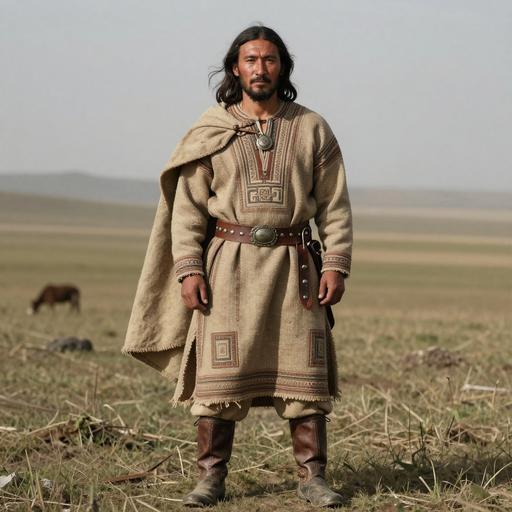
Portrait reconstruction of I10519
Ancient Individual

A man buried in Kazakhstan in the Iron Age era

I10519
500 BCE - 1 BCE
Male
Wusun Culture in Kazakhstan
Kazakhstan
Scroll to begin
Chapter I

Identity

The biological and cultural markers that define this ancient individual

Sample ID

I10519

Date Range

500 BCE - 1 BCE

Biological Sex

Male

mtDNA Haplogroup

HV6

Y-DNA Haplogroup

N-Y147658

Cultural Period

Wusun Culture in Kazakhstan

Chapter II

Place

Where this individual was discovered

Country Kazakhstan
Locality Tian Shan. Central Steppe. Turgen-2
Coordinates 43.0686, 68.2489
Chapter III

Time

When this individual lived in the broader context of human history

I10519 500 BCE - 1 BCE
Chapter IV

Story

The narrative of this ancient life

The Wusun culture represents one of the fascinating narratives of the nomadic steppe cultures that flourished in Central Asia, specifically in the region that is now Kazakhstan. The Wusun were a prominent nomadic confederation that existed from approximately the 3rd century BCE until the 5th century CE. Their legacy is marked by their complex social structure, vibrant trade networks, and interactions with various neighboring cultures and empires.

Historical Background

The Wusun are believed to have originated from the eastern parts of the Eurasian Steppe, possibly descending from early Indo-European speaking groups. According to Chinese historical texts, such as the \Hanshu" and "Shiji," the Wusun were initially allies of the Xiongnu confederation but later shifted their allegiances to become valuable allies of the Han Dynasty. This relationship helped them establish a significant presence in the Ili Valley, located in present-day southeastern Kazakhstan, which became the nerve center of their realm.

Society and Culture

Wusun society was characterized by a nomadic lifestyle, albeit with certain unique attributes. Their economy was predominantly based on pastoralism, relying heavily on horse breeding due to its central role in transportation and warfare. They also raised cattle, sheep, and goats, which were essential for sustenance and trade. The Wusun were known for their strong equestrian skills, which made them formidable warriors and traders.

The social structure of the Wusun was hierarchical, with a ruler known as a Kunbag serving as the supreme leader. Below the Kunbag were nobles who controlled various tribes and groups within the confederation. Despite being nomadic, the Wusun had a degree of political organization, which allowed them to maintain a semblance of order over a vast and often challenging landscape.

Archaeological Insights

Archaeological evidence provides critical insights into the Wusun culture. Excavations in areas around the Ili and Chu Valleys have uncovered burial mounds, grave goods, and remains indicating a rich material culture. These findings include finely crafted pottery, bronze and iron tools, and elaborate jewelry, suggesting advanced metallurgical skills and a connection to Silk Road trade routes.

The burial practices observed involve kurgans, or burial mounds, which often contain horse remains and various goods, pointing towards a belief in the afterlife and the significance of horses in both their life and death rituals. The kurgans range from simple earthen mounds to more sophisticated structures, indicating social stratification within Wusun society.

Interaction with Neighboring Cultures

The Wusun occupied a strategically significant position along the Silk Road, which facilitated interactions with various civilizations, such as the Chinese, Sogdians, and Bactrians. Through these interactions, they absorbed and contributed to the cultural and economic exchanges that characterized the Silk Road era. Valuable goods such as silk, spices, and precious metals likely passed through Wusun territories, enriching their material culture.

The Wusun's alliance with the Han Dynasty was particularly influential. It enabled them to restore their power when conflicts arose with rival nomadic groups like the Xiongnu. Marriages between Wusun nobility and Han princesses were not uncommon, serving both diplomatic and strategic purposes.

Legacy and Influence

The Wusun culture left an indelible mark on the historical tapestry of the Central Asian steppes. Their interactions with major empires of the time, mastery of nomadic life, and involvement in long-distance trade highlight their importance as a cultural and economic bridge across Eurasia. While the exact causes of their decline are not entirely clear, it is likely a combination of internal strife, changing trade dynamics, and pressures from emerging powers.

In modern times, the Wusun are remembered as an integral part of Kazakhstan's heritage. Their history is a testament to the rich cultural interactions and dynamism of nomadic societies on the Central Asian steppes, offering valuable lessons and perspectives on the complexity of ancient civilizations."

Chapter V

Genetics

The genetic ancestry of this ancient individual

Ancient Genetic Admixture

This analysis compares the DNA profile of I10519 with ancient reference populations, showing the genetic composition in terms of prehistoric ancestral groups.

European Hunter-Gatherers 31.3%
Western Steppe Pastoralists 26.7%
Neolithic Farmers 25.3%
Ancient Asians 16.7%

Modern Genetic Admixture

This analysis compares the DNA profile with present-day reference populations, showing what percentage of genetic makeup resembles modern populations from different regions.

Asia 67.4%
Northern West Asian 37.9%
Caucasian 37.9%
Central Asian, Northern Indian & Pakistani 29.4%
Pakistan 22.4%
Central Asian 7.1%
Europe 32.5%
Eastern European 25.1%
Northwestern European 7.4%
Northwestern European 5.8%
English 1.7%

Closest Modern Populations

These are the modern populations showing the closest statistical alignment to A man buried in Kazakhstan in the Iron Age era, ranked by genetic distance. Lower distance values indicate closer statistical similarity.

1
Pamiri Rushan
4.2862
2
Pamiri Shugnan
4.5943
3
Tajik Tajikistan Kulob
4.7335
4
Pamiri Badakhshan
5.0241
5
Tajik Yaghnobi
5.1460
6
Tajik Tajikistan Hisor
5.1980
7
Tajik Tajikistan Ayni
5.3215
8
Pamiri Ishkashim
5.6088
9
Pamiri Wakhi
6.1795
10
Pamiri Sarikoli
6.3144
Chapter VI

Context

Other ancient individuals connected to this sample

Sources

References

Scientific publications and genetic data

Scientific Publication

137 ancient human genomes from across the Eurasian steppes

Authors Damgaard PB, Marchi N, Rasmussen S
Abstract

For thousands of years the Eurasian steppes have been a centre of human migrations and cultural change. Here we sequence the genomes of 137 ancient humans (about 1× average coverage), covering a period of 4,000 years, to understand the population history of the Eurasian steppes after the Bronze Age migrations. We find that the genetics of the Scythian groups that dominated the Eurasian steppes throughout the Iron Age were highly structured, with diverse origins comprising Late Bronze Age herders, European farmers and southern Siberian hunter-gatherers. Later, Scythians admixed with the eastern steppe nomads who formed the Xiongnu confederations, and moved westward in about the second or third century BC, forming the Hun traditions in the fourth-fifth century AD, and carrying with them plague that was basal to the Justinian plague. These nomads were further admixed with East Asian groups during several short-term khanates in the Medieval period. These historical events transformed the Eurasian steppes from being inhabited by Indo-European speakers of largely West Eurasian ancestry to the mostly Turkic-speaking groups of the present day, who are primarily of East Asian ancestry.

G25 Coordinates

The G25 coordinates for sample I10519 can be used for detailed admixture analysis in our G25 Studio tool.

I10519,0.09966942,0.03544662,-0.00772194,0.03845498,-0.04346312,0.01793912,0.00795084,0.00229714,-0.02909786,-0.02991908,0.00362064,-0.0003619,0.00112758,-0.01643004,0.00054238,-0.00536872,-0.00322316,-0.00516528,-0.01258668,-0.00620932,0.00065266,-2.448E-05,-0.00998512,0.0031986,-0.00533297
Analyze in G25 Studio
Use code for 40% off Expires Feb 27