Menu
Store
Blog
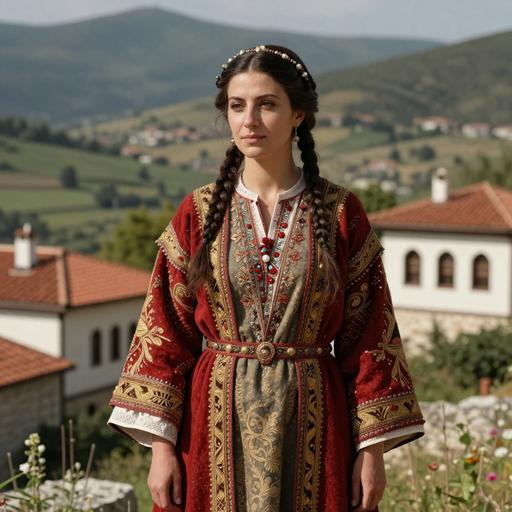
Portrait reconstruction of I13835
Ancient Individual

A woman buried in Albania in the Modern era

I13835
1644 CE - 1797 CE
Female
Albanian Early Modern
Albania
Scroll to begin
Chapter I

Identity

The biological and cultural markers that define this ancient individual

Sample ID

I13835

Date Range

1644 CE - 1797 CE

Biological Sex

Female

mtDNA Haplogroup

U3b1

Cultural Period

Albanian Early Modern

Chapter II

Place

Where this individual was discovered

Country Albania
Locality Barç (Southeast. Korça Basin)
Coordinates 40.6253, 20.8011
Chapter III

Time

When this individual lived in the broader context of human history

I13835 1644 CE - 1797 CE
Chapter IV

Story

The narrative of this ancient life

The Early Modern period in Albania, spanning from the late 15th century to the early 19th century, is a fascinating era marked by significant social, cultural, and political transformations. This period, often contextualized within the broader Balkan region, was characterized by a complex interplay of local traditions, Ottoman influence, and emerging European ideologies.

Historical Context

The Ottoman Empire conquered Albania in the late 15th century, bringing the region under its administrative and cultural ambit. This transition marks the beginning of the Early Modern period in Albania. The Ottomans introduced a new administrative structure, integrating Albania into their vast empire through a system of local governance that incorporated both direct rule and a certain degree of autonomy for local leaders or beys. This era saw the rise of the Ottoman feudal system (timar), significantly influencing Albania's socio-economic landscape.

Society and Economy

Albanian society during this period was primarily agrarian, with the majority of the population engaged in farming and animal husbandry. The Ottoman land tenure system had a profound impact, as land ownership was often linked to military service. The region also engaged in trade, with Albanian ports like Durrës and Vlorë serving as important points of commerce, linking the Ottoman Empire with Italian city-states and beyond.

The social structure was hierarchical, with a distinct division between the landed aristocracy and peasants. Clan-based systems, especially in northern Albania, persisted, with strong ties of kinship and loyalty. The concept of besa, a code of honor, remained a vital component of societal relationships, influencing both social and political interactions.

Religion and Culture

The Ottoman conquest initiated significant religious transformations. While Albanian society was predominantly Christian before the Ottoman rule, the spread of Islam became more pronounced during this period. Conversion to Islam was influenced by a range of factors, including socio-political benefits, such as tax relief and administrative opportunities within the Ottoman system. However, Christianity, particularly in its Orthodox and Roman Catholic forms, persisted, leading to a diverse religious landscape.

Culturally, this era saw the synthesis of Ottoman and local elements, evident in architecture, language, and art. The influence of Ottoman culture introduced new architectural styles and art forms, such as calligraphy and miniature painting. Meanwhile, traditional Albanian folk culture, including music, dance, and oral literature, continued to thrive, preserving the nation’s identity and heritage amid foreign domination.

Language and Literature

The Albanian language began to consolidate its written form during the Early Modern period. The oldest known document written in Albanian, the \Formula e Pagëzimit" (Baptismal Formula), dates to 1462. The development of the Albanian written tradition was slow, primarily due to the lack of a standardized alphabet and the dominance of Ottoman and Latin scripts.

Literature in Albania during this time was primarily oral, with epic poetry playing a central role in preserving historical narratives and cultural values. These epics, often recited by itinerant bards, recounted legendary figures and events, serving as both entertainment and education for the populace.

Political Developments

Albania's political landscape during the Early Modern period was characterized by a tug-of-war between local autonomy and centralized Ottoman control. While some areas, particularly in the north, retained a degree of independence through tribal governance, others were more tightly integrated into the Ottoman administrative framework.

The 18th century saw a rise in local leaders who wielded significant influence, such as Ali Pasha Tepelena, whose semi-autonomous rule reflected the tenuous balance of power between local and imperial authorities. These figures played crucial roles in the political and military affairs of the region, often serving as intermediaries between the Ottoman authorities and local populations.

Conclusion

The Early Modern period in Albania was a time of significant transformation, shaped by the overarching influence of the Ottoman Empire, persistent local traditions, and gradual exposure to wider European currents. This era laid the groundwork for modern Albanian identity, blending diverse religious, cultural, and linguistic elements into a unique tapestry that would come to define the nation in subsequent centuries. Despite external domination, the resilience of Albanian culture and social structures ensured the survival and evolution of a distinct national consciousness that continues to be celebrated today."

Chapter V

Genetics

The genetic ancestry of this ancient individual

Ancient Genetic Admixture

This analysis compares the DNA profile of I13835 with ancient reference populations, showing the genetic composition in terms of prehistoric ancestral groups.

Neolithic Farmers 51.8%
European Hunter-Gatherers 18.8%
Ancient Asians 17.9%
Western Steppe Pastoralists 11.4%

Modern Genetic Admixture

This analysis compares the DNA profile with present-day reference populations, showing what percentage of genetic makeup resembles modern populations from different regions.

Asia 53.8%
Central Asian, Northern Indian & Pakistani 30.8%
Indian 29.4%
Pakistan 1.5%
Northern West Asian 11.9%
Mesopotamian 3.4%
Caucasian 3.4%
Anatolian 3.1%
Cypriot 2.0%
Arab, Egyptian & Levantine 11.1%
Arabian 6.6%
Levantine 4.6%
Europe 44.3%
Southern European 35.7%
Balkan 20.2%
Italian 7.4%
Iberian 7.2%
Sardinian 0.9%
Northwestern European 8.6%
Northwestern European 6.1%
Scandinavian 2.5%
Africa 1.2%
North African 1.2%
North African 1.2%
Oceania 0.6%
Melanesian 0.6%
Papuan 0.6%

Closest Modern Populations

These are the modern populations showing the closest statistical alignment to A woman buried in Albania in the Modern era, ranked by genetic distance. Lower distance values indicate closer statistical similarity.

1
Roma Granada
2.0781
Chapter VI

Context

Other ancient individuals connected to this sample

Sources

References

Scientific publications and genetic data

Scientific Publication

The genetic history of the Southern Arc: A bridge between West Asia and Europe | Science

Authors Lazaridis I, Alpaslan-Roodenberg S, Acar A
Abstract

The period from the Copper Age to the Bronze Age marked major social and economic transformations in West Eurasia. To better understand these changes and their genetic impacts, we generated genome-wide data from 727 individuals who lived between 5000 and 1000 BCE in southeastern Europe and southwestern Asia.

G25 Coordinates

The G25 coordinates for sample I13835 can be used for detailed admixture analysis in our G25 Studio tool.

I13835,0.09229708,0.07311964,-0.05051384,0.01450508,-0.01347494,0.01071766,0.00028602,0.00059796,0.00986898,0.0165087,-0.00033828,0.0017153,-0.0023332,0.00437526,-0.00880328,-0.00230344,0.00360486,-0.0011455,0.00271722,-0.00171988,-0.0028888,-0.00092676,0.00114816,3.374E-05,-0.002002
Analyze in G25 Studio
Use code for 40% off Expires Feb 26