Menu
Store
Blog
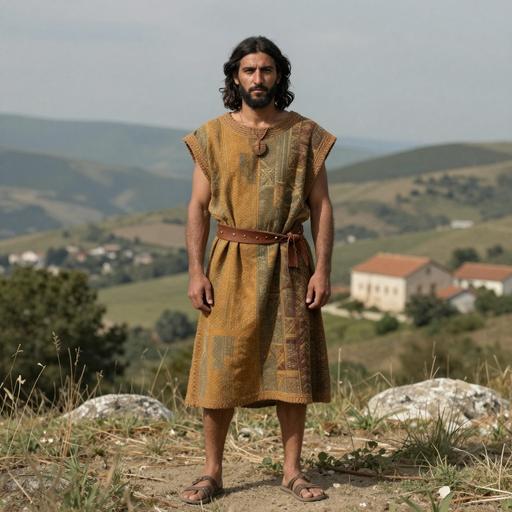
Portrait reconstruction of I14689
Ancient Individual

A man buried in Albania in the Early Bronze Age era

I14689
2663 BCE - 2472 BCE
Male
Early Bronze Age Albania
Albania
Scroll to begin
Chapter I

Identity

The biological and cultural markers that define this ancient individual

Sample ID

I14689

Date Range

2663 BCE - 2472 BCE

Biological Sex

Male

mtDNA Haplogroup

H102

Y-DNA Haplogroup

Not available

Cultural Period

Early Bronze Age Albania

Chapter II

Place

Where this individual was discovered

Country Albania
Locality Çinamak (Norteastern. Kukes District)
Coordinates 42.0206, 20.3886
Chapter III

Time

When this individual lived in the broader context of human history

I14689 2663 BCE - 2472 BCE
Chapter IV

Story

The narrative of this ancient life

The Early Bronze Age in Albania, as part of the broader Balkan Bronze Age, represents a significant period in prehistoric Europe marked by noteworthy advancements in technology, economy, and social organization. This era, approximately dating from 2200 to 1600 BCE, witnessed the transformation of Albanian societies into more complex and organized communities, evidencing a gradual transition from the Neolithic and Chalcolithic periods.

Geography and Environmental Context

Albania, during the Early Bronze Age, was characterized by a diverse landscape featuring coastal plains, rugged mountains, and river valleys. This variety in geography provided different opportunities and challenges for the inhabitants, influencing settlement patterns, subsistence strategies, and trade.

Settlement Patterns and Architecture

The Early Bronze Age saw the establishment of more permanent and fortified settlements. Archaeological evidence suggests that communities began to cluster in strategically advantageous locations, such as elevated areas that offered natural defenses. These settlements often featured stone and mud-brick constructions, which included circular or rectilinear dwellings. The use of timber and thatch was prevalent in building materials, indicating a deep understanding of available resources.

Economy and Subsistence

Agriculture remained the backbone of the economy, with the cultivation of cereals such as wheat and barley, alongside legumes and fruits. Animal husbandry complemented crop farming, with sheep, goats, and cattle being the primary domesticated animals. The advancement of metallurgy during this period led to the production of bronze tools and weapons, which not only improved agricultural productivity but also contributed to local and regional trade networks.

Albanian communities participated in widespread trade networks, exchanging resources like obsidian, flint, and pottery with neighboring regions. The introduction of bronze allowed for the production of more durable and efficient tools and weaponry, which played a crucial role in enhancing agricultural practices and influencing social structures.

Social Organization and Culture

The Early Bronze Age in Albania was marked by increasing social stratification. While evidence for distinct social classes remains limited, grave goods and settlement organization suggest emerging social hierarchies. Burial practices during this period often included tumuli (burial mounds) and cist graves, where the inclusion of personal items such as pottery, tools, and ornaments indicated the status of the deceased.

Cultural expression was evident in pottery styles and decorative motifs, which varied across regions but demonstrated a shared aesthetic with wider Balkan traditions. Pottery was primarily hand-made and featured incised patterns, geometric decorations, and, occasionally, simplistic figurative art.

Technology and Innovations

The hallmark of the Early Bronze Age was the mastering of metallurgy, specifically the alloying of copper and tin to produce bronze. This technological innovation revolutionized tool-making, providing sharper and more resilient instruments for farming, warfare, and daily tasks. The development of metallurgy also encouraged specialization and the growth of crafts, including pottery, weaving, and leatherworking.

Interaction and Influence

Albania's position in the Balkan Peninsula facilitated interactions with neighboring cultures in the Adriatic and the wider Aegean world. Trade relations with these regions were instrumental in introducing new ideas and technologies, such as wheel-made pottery and advanced metallurgical techniques.

Conclusion

The Early Bronze Age in Albania was a dynamic period marked by significant technological, economic, and social developments. These changes laid the foundation for the subsequent Middle and Late Bronze Ages, as Albanian societies continued to evolve within the broader tapestry of the Balkan Bronze Age. The archaeological record from this period provides crucial insights into the ancient past of Albania and its role in the prehistoric Balkans.

Chapter V

Genetics

The genetic ancestry of this ancient individual

Ancient Genetic Admixture

This analysis compares the DNA profile of I14689 with ancient reference populations, showing the genetic composition in terms of prehistoric ancestral groups.

Western Steppe Pastoralists 37.3%
Neolithic Farmers 30.0%
European Hunter-Gatherers 26.6%
Ancient Asians 6.1%

Modern Genetic Admixture

This analysis compares the DNA profile with present-day reference populations, showing what percentage of genetic makeup resembles modern populations from different regions.

Europe 69.7%
Northwestern European 40.6%
English 24.6%
Northwestern European 14.7%
Finnish 0.8%
Scandinavian 0.5%
Eastern European 16.1%
Southern European 13.1%
Balkan 13.1%
Asia 30.3%
Northern West Asian 27.4%
Caucasian 26.2%
Cypriot 1.2%
Central Asian, Northern Indian & Pakistani 2.9%
Pakistan 2.9%

Closest Modern Populations

These are the modern populations showing the closest statistical alignment to A man buried in Albania in the Early Bronze Age era, ranked by genetic distance. Lower distance values indicate closer statistical similarity.

1
Turkish Deliorman
5.3901
2
Moldovan
6.4512
3
Turkish Rumeli
6.5777
4
Afrikaner
7.0221
5
Hungarian
7.0611
6
Gagauz
7.1312
7
Austrian
7.2356
8
Romanian
7.2538
9
Bosnian
7.2643
10
Croatian
7.2845
Chapter VI

Context

Other ancient individuals connected to this sample

Sources

References

Scientific publications and genetic data

Scientific Publication

The genetic history of the Southern Arc: A bridge between West Asia and Europe | Science

Authors Lazaridis I, Alpaslan-Roodenberg S, Acar A
Abstract

The period from the Copper Age to the Bronze Age marked major social and economic transformations in West Eurasia. To better understand these changes and their genetic impacts, we generated genome-wide data from 727 individuals who lived between 5000 and 1000 BCE in southeastern Europe and southwestern Asia.

G25 Coordinates

The G25 coordinates for sample I14689 can be used for detailed admixture analysis in our G25 Studio tool.

I14689,0.11726414,0.09980558,0.0234554,0.03002208,0.00060636,0.01492216,0.0066802,0.0019858,-0.02308028,-0.02142478,-0.00130828,0.00140446,-0.0057215,-0.00278698,0.01081962,-0.00124266,-0.00993878,0.00245778,-0.00078966,-0.00326106,-0.00012034,0.00251336,0.00217154,0.0122307,0.00095571
Analyze in G25 Studio
Use code for 40% off Expires Feb 26