Menu
Store
Blog
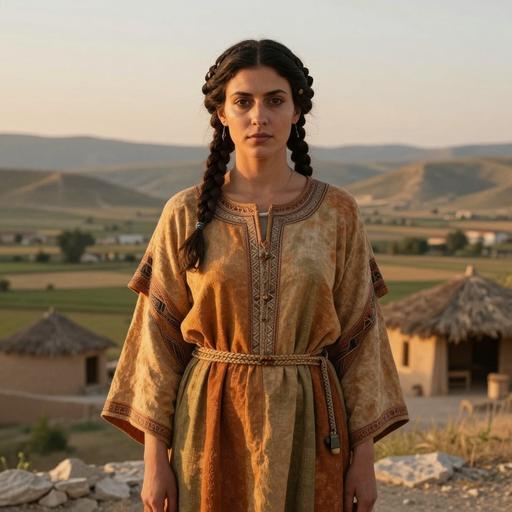
Portrait reconstruction of I14767
Ancient Individual

A woman buried in Turkey in the Early Iron Age era

I14767
1396 BCE - 1218 BCE
Female
Early Iron Age Turkey
Turkey
Scroll to begin
Chapter I

Identity

The biological and cultural markers that define this ancient individual

Sample ID

I14767

Date Range

1396 BCE - 1218 BCE

Biological Sex

Female

mtDNA Haplogroup

H14a+146

Cultural Period

Early Iron Age Turkey

Chapter II

Place

Where this individual was discovered

Country Turkey
Locality Muradiye (East. Van)
Coordinates 38.9800, 43.7500
Chapter III

Time

When this individual lived in the broader context of human history

I14767 1396 BCE - 1218 BCE
Chapter IV

Story

The narrative of this ancient life

The Early Iron Age in Turkey, particularly within the region of Anatolia, marks a critical period of transition and transformation, spanning approximately from 1200 to 600 BCE. This era is characterized by significant societal shifts, technological advancements, and the emergence and interactions of diverse cultures and civilizations in a landscape that would later become a bridge between East and West.

Historical Context

The collapse of the Bronze Age civilizations around 1200 BCE, particularly the fall of the Hittite Empire, ushered in a period of instability and restructuring in Anatolia. The reasons for this collapse are manifold and debated, including possible climate change, natural disasters, invasions by the so-called Sea Peoples, or internal revolts. The resultant power vacuum paved the way for new cultures to emerge and evolve.

Sociopolitical Landscape

  1. Disintegration of Central Authority: With the disintegration of the Hittite state, smaller principalities and city-states emerged throughout Anatolia. These included Phrygia in the west and central parts, Lydia in the west, and Urartu in the east, among others. Each of these regions developed distinctive political structures often characterized by a more localized and less centralized governance.

  2. Phrygian Expansion: Notably, the Phrygians, possibly of Balkan origins, rose to prominence in central Anatolia during the Early Iron Age. Their capital, Gordion, became a cultural and political hub. Midas, the legendary king of Phrygia, is one of the most famous figures of this period - his reign marked both legendary wealth and the civilization's eventual downfall to the Cimmerians.

  3. Lydia and Early Monetary Systems: Lydia, on the other hand, is credited with the development of early coinage, which significantly influenced trade and economic practices. Sardis, their capital, played a crucial role in regional economics.

  4. Urartian Kingdom: To the northeast, the Urartians established a kingdom that was heavily fortified and characterized by advanced architectural and engineering achievements, including the construction of extensive irrigation systems and fortified centers like Tushpa (modern Van).

Cultural and Technological Developments

  1. Iron Metallurgy: The most defining technological advancement of the period was the widespread adoption of iron metallurgy. Iron, being more prevalent and durable than bronze, revolutionized both agricultural implements and weaponry. This advancement contributed to significant agricultural surplus and population growth.

  2. Art and Architecture: The art and architecture of this era in Anatolia bear witness to a mix of native trends and external influences due to increased interactions with neighboring regions. Monumental stone architecture, intricate metalwork, and elaborate burial practices highlight the era's sophistication. Phrygian rock-cut architecture and Urartian fortresses are particularly notable.

  3. Religious Practices: Religious continuity and change are observed with the worship of a complex pantheon of gods. The Phrygians, for instance, worshipped the goddess Cybele, reflecting matriarchal religious traditions. Similarly, the Urartians incorporated local deities with influences from neighboring Mesopotamian cultures.

Economic Exchanges and Interactions

  1. Trade Networks: With the advent of coinage and increased metal production, trade networks expanded significantly. Anatolia became a nexus of trade linking the Aegean, the Near East, and beyond. This position facilitated cultural exchanges and the spread of technological innovations.

  2. Cultural Interactions: The Early Iron Age was marked by interactions and exchanges among different cultures within and outside Anatolia, leading to a rich tapestry of linguistic, artistic, and technological phenomena. For example, the influences from the Greek world began to permeate western Anatolia during this time.

Conclusion

The Early Iron Age in Turkey's Anatolia is a testament to human resilience and adaptability. As societies recovered from a period of collapse, they forged new political entities, technological advancements, and cultural expressions that laid crucial foundations for the later developments in the region. The period serves as a bridge not only geographically but also temporally, setting the stage for the classical civilizations that would follow.

Chapter V

Genetics

The genetic ancestry of this ancient individual

Ancient Genetic Admixture

This analysis compares the DNA profile of I14767 with ancient reference populations, showing the genetic composition in terms of prehistoric ancestral groups.

Neolithic Farmers 73.8%
European Hunter-Gatherers 21.7%
Ancient Asians 2.3%
Western Steppe Pastoralists 2.2%

Modern Genetic Admixture

This analysis compares the DNA profile with present-day reference populations, showing what percentage of genetic makeup resembles modern populations from different regions.

Asia 90.5%
Northern West Asian 53.7%
Mesopotamian 28.7%
Caucasian 20.7%
Anatolian 2.8%
Cypriot 1.5%
Arab, Egyptian & Levantine 36.7%
Levantine 23.7%
Arabian 13.0%
Europe 9.5%
Southern European 9.5%
Italian 6.8%
Balkan 1.8%
Sardinian 0.9%

Closest Modern Populations

These are the modern populations showing the closest statistical alignment to A woman buried in Turkey in the Early Iron Age era, ranked by genetic distance. Lower distance values indicate closer statistical similarity.

1
Georgian Jew
1.3170
2
Assyrian
1.7203
3
Mountain Jew Dagestan
1.7630
4
Armenian Ararat
1.9390
5
Armenian Erzurum
1.9622
6
Armenian Urfa
2.0717
7
Armenian Aintab
2.1700
8
Armenian Gesaria
2.1990
9
Armenian Gurin
2.3343
10
Mountain Jew Azerbaijan
2.4005
Chapter VI

Context

Other ancient individuals connected to this sample

Sources

References

Scientific publications and genetic data

Scientific Publication

The genetic history of the Southern Arc: A bridge between West Asia and Europe | Science

Authors Lazaridis I, Alpaslan-Roodenberg S, Acar A
Abstract

The period from the Copper Age to the Bronze Age marked major social and economic transformations in West Eurasia. To better understand these changes and their genetic impacts, we generated genome-wide data from 727 individuals who lived between 5000 and 1000 BCE in southeastern Europe and southwestern Asia.

G25 Coordinates

The G25 coordinates for sample I14767 can be used for detailed admixture analysis in our G25 Studio tool.

I14767,0.0945863,0.13413218,-0.05759084,-0.06232926,-0.02939756,-0.01552832,0.00300272,-0.0068828,-0.02046224,-0.00642852,0.00526638,-0.00030976,0.00271448,0.00095316,-0.0031384,0.0036255,0.00133822,0.00038284,-5.83E-05,0.0029926,0.00449514,0.00471766,-0.00232952,-0.00408786,-0.00316105
Analyze in G25 Studio
Use code for 40% off Expires Feb 26