Menu
Store
Blog
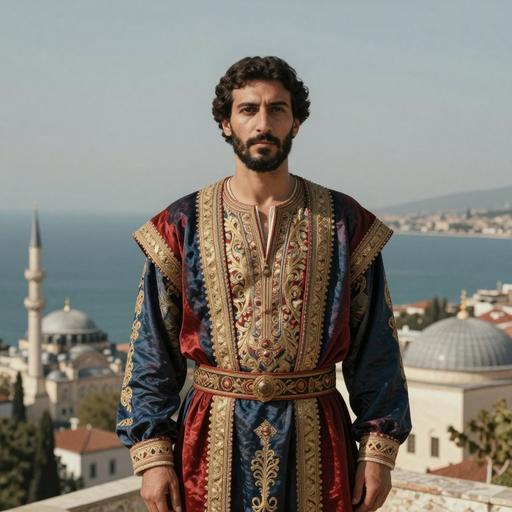
Portrait reconstruction of I14823
Ancient Individual

A man buried in Turkey in the Middle Ages era

I14823
1515 CE - 1652 CE
Male
Ottoman Turkey
Turkey
Scroll to begin
Chapter I

Identity

The biological and cultural markers that define this ancient individual

Sample ID

I14823

Date Range

1515 CE - 1652 CE

Biological Sex

Male

mtDNA Haplogroup

T1a2

Y-DNA Haplogroup

Not available

Cultural Period

Ottoman Turkey

Chapter II

Place

Where this individual was discovered

Country Turkey
Locality Zeytinliada (Marmara. Balikesir. Erdek)
Coordinates 40.3900, 27.7900
Chapter III

Time

When this individual lived in the broader context of human history

I14823 1515 CE - 1652 CE
Chapter IV

Story

The narrative of this ancient life

The era referred to as the \Ottoman Turkey of the Islamic Golden Age" is a confluence of two significant historical periods: the Islamic Golden Age and the rise of the Ottoman Empire. It's important to note that these two periods don't exactly coincide. The Islamic Golden Age is generally considered to have occurred between the 8th and 14th centuries, characterized by major advancements in sciences, arts, and culture across the Islamic world. The Ottoman Empire, on the other hand, rose to prominence later, from the late 13th century, and established itself as a major global power by the 15th century.

Formation and Rise of the Ottoman Empire:

The Ottoman Empire emerged in the late 13th century under the leadership of Osman I in northwestern Anatolia in the town of Söğüt. The Ottomans started as a small principality under the declining Seljuk Sultanate of Rûm and expanded their territory significantly over the next two centuries. By the 15th century, they had captured vast territories in the Balkans, Anatolia, and eventually, the Byzantine capital of Constantinople in 1453 under Sultan Mehmed II, marking the end of the Byzantine Empire and the rise of the Ottomans as a dominant power.

Governance and Society:

The Ottomans established a sophisticated administrative system that combined elements of their Turkic heritage with Islamic governance principles and Byzantine administrative practices. The sultan, as the absolute ruler, was at the top of this hierarchy, and under him, a highly structured bureaucracy managed the empire's vast territories.

The society was organized according to the millet system, where religious communities were granted a degree of autonomy to govern themselves in exchange for loyalty to the empire. This system facilitated peaceful coexistence among Muslims, Christians, Jews, and other groups, allowing for a rich tapestry of cultural exchanges and interactions.

Culture and Contributions:

Although the Ottoman Empire rose after the peak of the Islamic Golden Age, it became a cultural and scientific hub in its own right, particularly during the 16th century under Suleiman the Magnificent. The Ottomans were patrons of the arts, architecture, music, and literature. The renowned architect Mimar Sinan, for instance, left a profound legacy with his architectural masterpieces like the Süleymaniye Mosque and the Selimiye Mosque.

In terms of scientific achievements, the Ottomans contributed significantly to cartography and astronomy. Piri Reis, an Ottoman admiral and cartographer, created the famous Piri Reis map, one of the earliest world maps showing the Americas.

Trade and Economy:

The strategic location of the Ottoman Empire at the crossroads of Europe and Asia made it a central player in international trade. The Ottomans controlled key trade routes and were instrumental in the spice trade, among others. The economic policies were supported by a strong and sophisticated monetary system which facilitated commerce across the empire's vast territories.

Legacy:

The legacy of the Ottoman Empire is evident in the cultural, architectural, and religious landmarks that dot the landscape of modern-day Turkey and the Balkans. The empire's longest-lasting contribution may be its role as a bridge between Eastern and Western worlds, fostering a unique blend of cultural influences that continue to shape the region.

In conclusion, the "Ottoman Turkey of the Islamic Golden Age" may not denote a historically precise period, but rather highlights the cultural and intellectual currents that passed through Ottoman lands during its rise. While the Ottoman Empire itself came into prominence after the Islamic Golden Age, it carried forward many of its intellectual and cultural traditions, offering a rich era of cultural synthesis and innovation."

Chapter V

Genetics

The genetic ancestry of this ancient individual

Ancient Genetic Admixture

This analysis compares the DNA profile of I14823 with ancient reference populations, showing the genetic composition in terms of prehistoric ancestral groups.

Neolithic Farmers 49.6%
European Hunter-Gatherers 34.6%
Western Steppe Pastoralists 15.8%

Modern Genetic Admixture

This analysis compares the DNA profile with present-day reference populations, showing what percentage of genetic makeup resembles modern populations from different regions.

Europe 58.1%
Southern European 57.7%
Balkan 20.5%
Iberian 19.1%
Italian 18.1%
Asia 39.3%
Northern West Asian 27.8%
Mesopotamian 18.0%
Caucasian 6.7%
Cypriot 2.5%
Anatolian 0.6%
Arab, Egyptian & Levantine 11.5%
Levantine 11.2%
Africa 2.6%
North African 2.6%
Egyptian 2.6%

Closest Modern Populations

These are the modern populations showing the closest statistical alignment to A man buried in Turkey in the Middle Ages era, ranked by genetic distance. Lower distance values indicate closer statistical similarity.

1
Ashkenazi Belarussia
1.8518
2
Ashkenazi Russia
1.8911
3
Ukrainian Zhytomyr O
1.9459
4
Ashkenazi Lithuania
2.0512
5
Ashkenazi Ukraine
2.0771
6
Greek Izmir
2.1470
7
Greek South Tsakonia
2.2172
8
Ashkenazi Poland
2.2325
9
Greek East Taygetos
2.2749
10
Greek Crete Chania
2.3344
Chapter VI

Context

Other ancient individuals connected to this sample

Sources

References

Scientific publications and genetic data

Scientific Publication

The genetic history of the Southern Arc: A bridge between West Asia and Europe | Science

Authors Lazaridis I, Alpaslan-Roodenberg S, Acar A
Abstract

The period from the Copper Age to the Bronze Age marked major social and economic transformations in West Eurasia. To better understand these changes and their genetic impacts, we generated genome-wide data from 727 individuals who lived between 5000 and 1000 BCE in southeastern Europe and southwestern Asia.

G25 Coordinates

The G25 coordinates for sample I14823 can be used for detailed admixture analysis in our G25 Studio tool.

I14823,0.1057328,0.13731182,-0.00362012,-0.03070218,0.00792052,-0.01060396,0.00187666,0.00088646,-0.00186346,0.01016434,-0.00047148,0.0027831,9.21E-05,0.0035623,-0.00605516,-0.00189064,0.00197466,-0.00107078,0.0005524,0.00261818,-0.00253286,0.00109324,0.00036382,-4.02E-06,-0.00171486
Analyze in G25 Studio
Use code for 40% off Expires Feb 26