Menu
Store
Blog
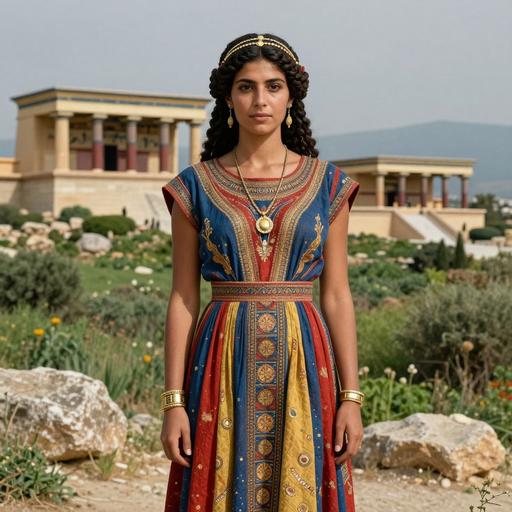
Portrait reconstruction of I14916
Ancient Individual

A woman buried in Greece in the Bronze Age era

I14916
1894 BCE - 1744 BCE
Female
Middle Minoan Crete
Greece
Scroll to begin
Chapter I

Identity

The biological and cultural markers that define this ancient individual

Sample ID

I14916

Date Range

1894 BCE - 1744 BCE

Biological Sex

Female

mtDNA Haplogroup

H

Cultural Period

Middle Minoan Crete

Chapter II

Place

Where this individual was discovered

Country Greece
Locality Crete. Zakros. Karaviadaina
Coordinates 35.0858, 26.2478
Chapter III

Time

When this individual lived in the broader context of human history

I14916 1894 BCE - 1744 BCE
Chapter IV

Story

The narrative of this ancient life

The Middle Minoan period, spanning approximately from 2000 to 1550 BCE, marks a remarkable phase in the history of ancient Crete and is central to what is known as the Minoan civilization. This era is characterized by significant developments in art, architecture, trade, and social organization, establishing the foundations for what would later be recognized as one of the most advanced civilizations in the Bronze Age Aegean.

Architecture and Urban Development

One of the most prominent features of the Middle Minoan period is the construction of large, complex palatial structures, the most famous being the Palace of Knossos, along with others such as Phaistos, Malia, and Kato Zakros. These palaces served not only as royal residences but also as administrative and religious centers. Architecturally, they were impressive, featuring multi-storied buildings with spacious courtyards, intricate drainage and water systems, and beautifully decorated rooms with frescoes.

The urban settlement surrounding these palaces grew significantly, with the development of organized towns characterized by wide roads, public spaces, and sophisticated housing, reflecting an advanced urban planning sensibility. The use of ashlar masonry and the development of columns and polychrome decoration highlight the Minoans’ architectural prowess.

Art and Iconography

The Middle Minoan period is renowned for its artistic achievements, especially in pottery, frescoes, and the creation of seals. Minoan pottery, including the distinctive Kamares ware, is known for its vibrant colors and dynamic, naturalistic designs, featuring motifs such as spirals, flora, and fauna. Frescoes, discovered primarily at palace sites, display a love for nature, human activity, and religious ceremonies, and are noted for their fluidity and vivid coloration.

Seals and sealings were commonly used for administrative purposes and often depicted intricate scenes and symbolic motifs, providing insight into Minoan religious practices and societal hierarchies.

Economy and Trade

The Middle Minoan period witnessed the expansion of a robust trade network, which extended throughout the Aegean and into the Near East and Egypt. Crete's geographical position allowed it to become a pivotal maritime hub, engaging in the exchange of goods such as pottery, textiles, bronze artifacts, and precious materials. This trade contributed to the prosperity and cultural exchange that characterized the Middle Minoan era, facilitating the spread of Minoan influence across the region.

Religion and Society

Religious practices during the Middle Minoan period revolved around numerous deities, with a strong emphasis on goddess worship. Religious activities were closely tied to nature and agricultural cycles, often taking place in sanctuaries and peak sanctuaries located on mountain tops. Iconography from this era suggests rituals involving processions, feasts, and possibly bull-leaping, which may have had religious or ceremonial significance.

The social structure of Middle Minoan Crete was likely hierarchical, with a ruling elite residing in the palaces overseeing the administration, trade, and religious activities. The presence of sophisticated administrative systems, such as the use of Linear A script, indicates a complex bureaucracy.

Conclusion

The Middle Minoan period in Crete was a time of considerable cultural and economic flourishing. Through its architectural innovations, artistic achievements, and extensive trade networks, the Minoan civilization laid the groundwork for its influence on later Greek cultures and its enduring legacy in the ancient Mediterranean world. Despite the lack of deciphered written records from this era, the wealth of archaeological discoveries continues to offer invaluable insights into this enigmatic and dynamic civilization.

Chapter V

Genetics

The genetic ancestry of this ancient individual

Ancient Genetic Admixture

This analysis compares the DNA profile of I14916 with ancient reference populations, showing the genetic composition in terms of prehistoric ancestral groups.

Neolithic Farmers 81.5%
European Hunter-Gatherers 16.3%
Western Steppe Pastoralists 2.3%

Modern Genetic Admixture

This analysis compares the DNA profile with present-day reference populations, showing what percentage of genetic makeup resembles modern populations from different regions.

Asia 51.8%
Northern West Asian 29.7%
Mesopotamian 15.3%
Cypriot 12.8%
Anatolian 1.6%
Arab, Egyptian & Levantine 22.1%
Levantine 15.2%
Arabian 7.0%
Europe 48.2%
Southern European 48.2%
Sardinian 22.9%
Italian 18.2%
Balkan 7.0%

Closest Modern Populations

These are the modern populations showing the closest statistical alignment to A woman buried in Greece in the Bronze Age era, ranked by genetic distance. Lower distance values indicate closer statistical similarity.

1
Italian Jew
3.9669
2
Romaniote Jew
4.1808
3
Turkish Sabbatean
4.2228
4
Turkish Jew
4.4316
5
Ashkenazi Germany
4.5055
6
Ashkenazi France
4.5073
7
Algerian Jew
4.5872
8
Bulgarian Jew
4.6166
9
Sephardic Jew
4.6536
10
Italian Calabria
4.7695
Chapter VI

Context

Other ancient individuals connected to this sample

Sources

References

Scientific publications and genetic data

Scientific Publication

The genetic history of the Southern Arc: A bridge between West Asia and Europe | Science

Authors Lazaridis I, Alpaslan-Roodenberg S, Acar A
Abstract

The period from the Copper Age to the Bronze Age marked major social and economic transformations in West Eurasia. To better understand these changes and their genetic impacts, we generated genome-wide data from 727 individuals who lived between 5000 and 1000 BCE in southeastern Europe and southwestern Asia.

G25 Coordinates

The G25 coordinates for sample I14916 can be used for detailed admixture analysis in our G25 Studio tool.

I14916,0.09963528,0.15229712,-0.0217245,-0.06947336,0.0192215,-0.03252048,-0.00189444,-0.004226,0.02464314,0.0400415,0.0020139,0.00133056,-0.00713758,-0.0066758,-0.01372252,0.00982812,0.00516544,0.00150892,0.00157298,-0.00235494,0.0016491,0.00653462,-0.00681646,-0.0095853,0.00267615
Analyze in G25 Studio
Use code for 40% off Expires Feb 26