Menu
Store
Blog
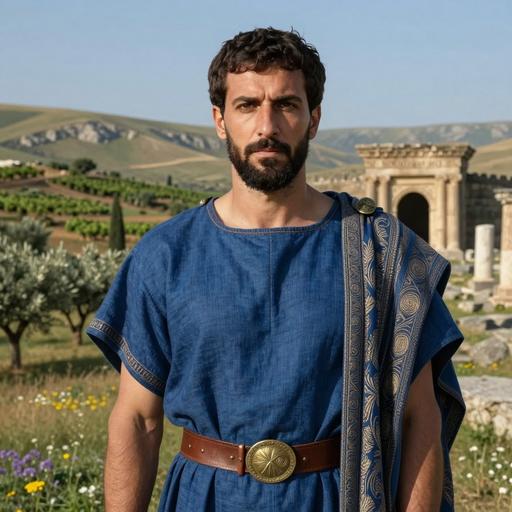
Portrait reconstruction of I1636
Ancient Individual

A man buried in Armenia in the Iron Age era

I1636
72 BCE - 60 CE
Male
Late Hellenistic Armenia
Armenia
Scroll to begin
Chapter I

Identity

The biological and cultural markers that define this ancient individual

Sample ID

I1636

Date Range

72 BCE - 60 CE

Biological Sex

Male

mtDNA Haplogroup

W3a1

Y-DNA Haplogroup

Not available

Cultural Period

Late Hellenistic Armenia

Chapter II

Place

Where this individual was discovered

Country Armenia
Locality Aghitu
Coordinates 39.5490, 45.0780
Chapter III

Time

When this individual lived in the broader context of human history

I1636 72 BCE - 60 CE
Chapter IV

Story

The narrative of this ancient life

The Late Hellenistic period in Armenia, spanning approximately from the 2nd century BCE to the 1st century CE, is an intricate era marked by the intersections of local traditions and the broader Hellenistic civilization. This epoch followed the conquests of Alexander the Great and the subsequent division of his empire among his generals, leading to the spread of Greek culture across a vast region that included Armenia. As neighboring Hellenistic kingdoms emerged, Armenia found itself at the crossroads of Eastern and Western cultural and political influences.

Political Landscape

Armenia during the Late Hellenistic period was primarily characterized by the emergence of powerful local dynasties, such as the Artaxiad dynasty, which ruled from 189 BCE until around the beginning of the 1st century CE. The Artaxiads capitalized on the declining power of the Seleucid Empire and positioned Armenia as a significant regional power. Under rulers like Artaxias I, Armenia expanded its territories, controlling regions that correspond to modern-day eastern Turkey, Azerbaijan, northwestern Iran, and Armenia itself.

The kingdom navigated complex diplomatic relationships with the Roman Republic and its Eastern rivals, including the Parthian Empire. Artaxias I famously fortified the capital city of Artaxata, making it a center of power and culture. His successors, like Tigranes the Great, further extended the kingdom’s influence, bringing Armenia to its zenith.

Cultural Syncretism

The Late Hellenistic period in Armenia was profoundly defined by cultural syncretism. Armenian culture absorbed and amalgamated Greek artistic, architectural, and philosophical ideas while maintaining firm roots in indigenous traditions. Hellenistic features became prominent in Armenian art, architecture, coinage, and even religion, creating a unique blend that reflected both Greek and local influences.

Tigranes the Great, for instance, founded the city of Tigranocerta as a new capital, modeled on Hellenistic urban planning. This city, along with others like Artaxata, became hubs of cultural activity, drawing artisans, philosophers, and traders from across the Hellenistic world. Public buildings, theaters, and agoras reflected Greek architectural styles, and the use of Greek language and inscriptions became common, especially among the elite.

Economy and Trade

Trade flourished during this period, with Armenia occupying a strategic position along the Silk Road. This facilitated not only the exchange of goods but also the transmission of ideas and cultural practices. Armenia traded luxury goods such as textiles, ceramics, and metalwork, contributing to its prosperity. The presence of Hellenistic coins suggests robust economic activities and the integration of Armenia into the wider Hellenistic economic sphere.

Religion and Philosophy

Religious life in Late Hellenistic Armenia was characterized by a mix of traditional Armenian deities and Greek gods. Mithraism, a mystery religion that originated in Persia, also gained prominence. The Armenians exhibited religious flexibility, often assimilating foreign gods into their pantheon with relative ease, which mirrored Hellenistic religious practices across the region.

Philosophically, Armenian society was exposed to Greek ideas, but much of the indigenous belief system remained intact due to its deep-rooted significance. However, centers such as Tigranocerta played significant roles in the dissemination of philosophical thoughts and ideas.

Legacy

The Late Hellenistic period laid the foundations for subsequent developments during the Roman and early Christian eras in Armenia. The cultural syncretism and political institutions established during this time had lasting impacts on Armenian identity and its role in the region. Armenia's ability to blend foreign influences into its own cultural framework became a defining characteristic that enabled it to navigate the complexities of subsequent periods.

In summary, Late Hellenistic Armenia represents a dynamic and transformative era where local and Hellenic influences coalesced, creating a rich, multifaceted culture. It was an age marked by political ambition, cultural flourishing, and economic prosperity, forging a legacy that endures in Armenian cultural memory.

Chapter V

Genetics

The genetic ancestry of this ancient individual

Ancient Genetic Admixture

This analysis compares the DNA profile of I1636 with ancient reference populations, showing the genetic composition in terms of prehistoric ancestral groups.

Neolithic Farmers 68.6%
European Hunter-Gatherers 21.9%
Ancient Asians 5.2%
Western Steppe Pastoralists 4.3%

Modern Genetic Admixture

This analysis compares the DNA profile with present-day reference populations, showing what percentage of genetic makeup resembles modern populations from different regions.

Asia 94.7%
Northern West Asian 71.2%
Mesopotamian 33.1%
Caucasian 23.3%
Anatolian 9.6%
Cypriot 5.2%
Arab, Egyptian & Levantine 23.5%
Levantine 14.1%
Arabian 9.5%
Europe 3.1%
Southern European 3.1%
Sardinian 2.2%
Balkan 0.9%
Africa 2.2%
North African 2.2%
Egyptian 2.2%

Closest Modern Populations

These are the modern populations showing the closest statistical alignment to A man buried in Armenia in the Iron Age era, ranked by genetic distance. Lower distance values indicate closer statistical similarity.

1
Georgian Jew
2.3244
2
Armenian Syunik
2.4318
3
Georgian Meskheti
2.4638
4
Kurd Kurmanji Turkey O
2.4827
5
Armenian Gurin
2.6398
6
Udi
2.6494
7
Armenian Erzurum
2.7126
8
Assyrian
2.7267
9
Turkish Erzurum
2.7687
10
Armenian Ararat
2.8018
Chapter VI

Context

Other ancient individuals connected to this sample

Sources

References

Scientific publications and genetic data

Scientific Publication

The genetic history of the Southern Arc: A bridge between West Asia and Europe | Science

Authors Lazaridis I, Alpaslan-Roodenberg S, Acar A
Abstract

The period from the Copper Age to the Bronze Age marked major social and economic transformations in West Eurasia. To better understand these changes and their genetic impacts, we generated genome-wide data from 727 individuals who lived between 5000 and 1000 BCE in southeastern Europe and southwestern Asia.

G25 Coordinates

The G25 coordinates for sample I1636 can be used for detailed admixture analysis in our G25 Studio tool.

I1636,0.09954384,0.12896018,-0.05921974,-0.05474418,-0.03431086,-0.01129358,0.00647128,-0.01076872,-0.02798086,-0.01278446,0.00123076,0.0012795,-0.00171386,-0.00059302,0.00532516,0.0092061,0.006547,-3.332E-05,-5.832E-05,0.0037962,0.0069926,0.00391958,0.00225728,-0.00336052,2.91E-05
Analyze in G25 Studio
Use code for 40% off Expires Feb 26