Menu
Store
Blog
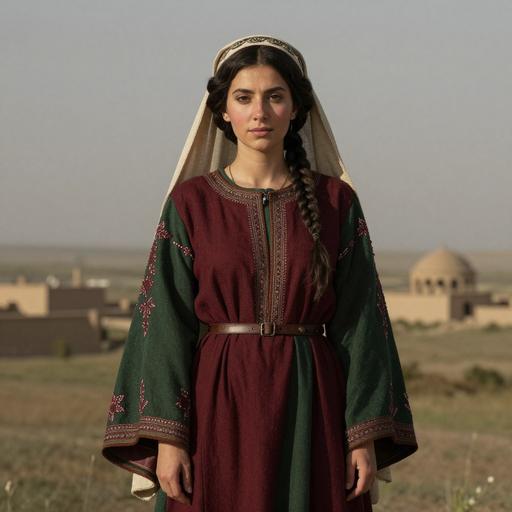
Portrait reconstruction of I1660
Ancient Individual

A woman buried in Armenia in the Early Medieval era

I1660
1100 CE - 1300 CE
Female
Early Medieval Armenia
Armenia
Scroll to begin
Chapter I

Identity

The biological and cultural markers that define this ancient individual

Sample ID

I1660

Date Range

1100 CE - 1300 CE

Biological Sex

Female

mtDNA Haplogroup

T

Cultural Period

Early Medieval Armenia

Chapter II

Place

Where this individual was discovered

Country Armenia
Locality Agarak
Coordinates 38.8650, 46.1990
Chapter III

Time

When this individual lived in the broader context of human history

I1660 1100 CE - 1300 CE
Chapter IV

Story

The narrative of this ancient life

The Early Medieval period in Armenian history, particularly under the influence of the Byzantine Empire, is a fascinating era marked by cultural, political, and religious developments. This period roughly spans from the 4th to the 9th century, a time when Armenia was frequently a point of contention between the Byzantine Empire and the Sassanian Empire, and later the Islamic Caliphate.

Historical Context

The early part of this era began following Armenia’s conversion to Christianity in 301 AD, which made it one of the first Christian nations in the world. This conversion was spearheaded by St. Gregory the Illuminator and King Tiridates III, establishing a distinct Armenian Christian identity. The Armenian Church developed its unique branch of Christianity, independent of both Roman and Eastern Orthodox practices, which was solidified through the creation of the Armenian alphabet by Mesrop Mashtots in the early 5th century. This literary development facilitated the translation of religious texts and fostered a blossoming of Armenian literature and scholarship.

Political Landscape

Throughout the Early Medieval period, Armenia was geopolitically strategic and contested by the Byzantine and Persian Empires. The Treaty of 387 AD saw Armenia divided between these two powers, with Byzantium exerting influence over Western Armenia and Persia over the Eastern half. This division often resulted in shifting allegiances and a complex political landscape.

The Byzantine Empire, seeking to secure its eastern frontier and counter Persian influence, often intervened in Armenian affairs both militarily and diplomatically. Despite the political instability, Armenian nobility, known as the Nakharars, maintained a degree of autonomy and played pivotal roles in the regional dynamics. These noble families often had shifting allegiances to preserve their power and influence.

Cultural and Religious Developments

Armenia’s Christianization brought about profound cultural changes. The invention of the Armenian script by Mashtots was a cultural milestone that led to the golden age of Armenian literature. This included religious texts, histories, and commentaries, notably \The History of Armenia" by Movses Khorenatsi, which provides invaluable insights into the region’s history and culture.

Religiously, Armenia was not always aligned with the Chalcedonian creed espoused by the Byzantine Empire. The Armenian Apostolic Church rejected the Council of Chalcedon in 451, a decision that led to doctrinal divergence. This religious independence reinforced a distinct Armenian identity, even as it operated under the shadows of two powerful neighboring empires.

Architectural and Artistic Achievements

The Early Medieval period saw significant advancements in Armenian architecture and art. The development of unique styles of church architecture, characterized by their domed basilicas and intricate stone carvings, flourished during this period. Many of Armenia's medieval churches and monasteries, such as those found at Etchmiadzin Cathedral and the monasteries of Haghpat and Sanahin, began to take their enduring forms.

The art of manuscript illumination reached new heights, merging intricate geometric patterns with vivid imagery often drawn from biblical scenes. This art form not only enriched religious texts but also preserved Armenian heritage and laid the foundation for future artistic endeavors.

Economic and Social Structures

Armenia's economy during the Early Medieval period was primarily agrarian, but its location along the Silk Road also facilitated trade and cultural exchange. This economic activity was regulated by both local rulers and outside imperial forces, with taxes and tribute forms as common means of imperial control. Socially, Armenia was structured around the Nakharar system, which consisted of clans led by noble families that held significant power and land holdings. This aristocracy often dictated the social and economic dynamics in Armenian society.

Conclusion

The Early Medieval period in Armenia, under the influence of the Byzantine Empire, was marked by a rich and complex tapestry of cultural, religious, and political history. Despite external pressures and internal strife, this era laid the groundwork for a resilient Armenian cultural identity that has persisted through the centuries. The architectural, literary, and religious achievements from this period continue to be celebrated as pillars of Armenian heritage."

Chapter V

Genetics

The genetic ancestry of this ancient individual

Ancient Genetic Admixture

This analysis compares the DNA profile of I1660 with ancient reference populations, showing the genetic composition in terms of prehistoric ancestral groups.

Neolithic Farmers 66.3%
European Hunter-Gatherers 21.8%
Western Steppe Pastoralists 8.7%
Ancient Asians 3.2%

Modern Genetic Admixture

This analysis compares the DNA profile with present-day reference populations, showing what percentage of genetic makeup resembles modern populations from different regions.

Asia 86.7%
Northern West Asian 64.3%
Mesopotamian 32.0%
Caucasian 20.6%
Anatolian 8.0%
Cypriot 3.7%
Arab, Egyptian & Levantine 22.5%
Levantine 22.5%
Europe 13.3%
Southern European 12.5%
Italian 12.5%
Northwestern European 0.8%

Closest Modern Populations

These are the modern populations showing the closest statistical alignment to A woman buried in Armenia in the Early Medieval era, ranked by genetic distance. Lower distance values indicate closer statistical similarity.

1
Turkish Erzurum
2.1675
2
Armenian Syunik
2.5068
3
Armenian Artsakh
2.5150
4
Ahiska
2.7812
5
Armenian Parspatunik
2.8529
6
Greek Trabzon
2.8535
7
Georgian Kart
2.8622
8
Armenian Gesaria
2.9420
9
Georgian Samtckhe
2.9639
10
Armenian Hemsheni
2.9960
Chapter VI

Context

Other ancient individuals connected to this sample

Sources

References

Scientific publications and genetic data

Scientific Publication

The genetic history of the Southern Arc: A bridge between West Asia and Europe | Science

Authors Lazaridis I, Alpaslan-Roodenberg S, Acar A
Abstract

The period from the Copper Age to the Bronze Age marked major social and economic transformations in West Eurasia. To better understand these changes and their genetic impacts, we generated genome-wide data from 727 individuals who lived between 5000 and 1000 BCE in southeastern Europe and southwestern Asia.

G25 Coordinates

The G25 coordinates for sample I1660 can be used for detailed admixture analysis in our G25 Studio tool.

I1660,0.09790168,0.12986474,-0.05067736,-0.05273986,-0.02896788,-0.01335838,0.00438152,-0.00435372,-0.03482198,-0.01084948,-0.0007387,0.00502026,-0.00675216,0.00596622,0.0043539,-0.01225548,-0.00136466,-0.00182174,-0.0027031,0.01000158,0.0087523,0.00098712,-0.00086088,-0.00732454,-0.00189986
Analyze in G25 Studio
Use code for 40% off Expires Feb 26