Menu
Store
Blog
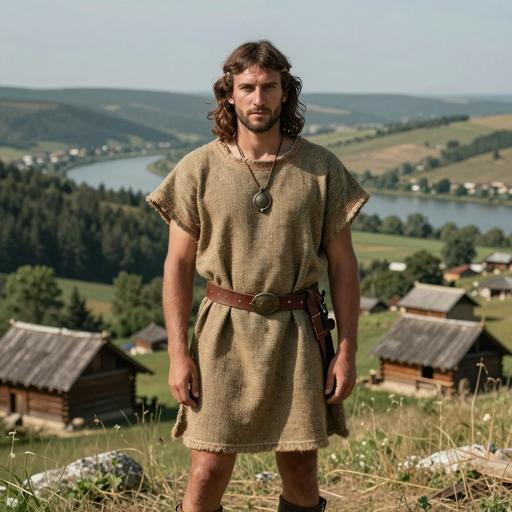
Portrait reconstruction of I16814
Ancient Individual

A man buried in Serbia in the Late Bronze Age era

I16814
1011 BCE - 901 BCE
Male
Late Bronze Age Serbia
Serbia
Scroll to begin
Chapter I

Identity

The biological and cultural markers that define this ancient individual

Sample ID

I16814

Date Range

1011 BCE - 901 BCE

Biological Sex

Male

mtDNA Haplogroup

H1e

Y-DNA Haplogroup

Not available

Cultural Period

Late Bronze Age Serbia

Chapter II

Place

Where this individual was discovered

Country Serbia
Locality Ostojicevo
Coordinates 45.8881, 20.1667
Chapter III

Time

When this individual lived in the broader context of human history

I16814 1011 BCE - 901 BCE
Chapter IV

Story

The narrative of this ancient life

The Late Bronze Age in the region of what is now modern-day Serbia, part of the broader Balkan Bronze Age, is a period marked by significant cultural, social, and technological developments. This era, approximately spanning from the 16th century BCE to the 12th century BCE, witnessed the transformation of small, tribal societies into more complex and hierarchical structures that laid the groundwork for later historical cultures such as the Thracians, Illyrians, and Dacians.

Geographical and Environmental Context

The geographical landscape of Late Bronze Age Serbia was diverse and included fertile plains, dense forests, and mountainous regions. The region's environment was generally conducive to agriculture, which was the primary economic activity. The Danube River, along with its tributaries, served as crucial waterways that facilitated trade and cultural exchange not only within the Balkans but also with more distant regions.

Cultural Influences and Interactions

Serbia during the Late Bronze Age was a melting pot of various cultural influences. It was situated at the crossroads of different cultural spheres, including the Mycenaean world to the south, the Central European Urnfield cultures to the northwest, and the Anatolian cultures to the southeast. This strategic position facilitated the exchange of goods, ideas, and technologies, leading to a dynamic and syncretic cultural landscape.

Archaeological Evidence

Archaeological findings from this period provide valuable insights into the life and culture of Late Bronze Age Serbia. Settlements were typically fortified, reflecting a need for defense and indicating a degree of social organization and cooperation. Excavations have revealed the presence of various types of dwellings, storage pits, and workshops, suggesting a community-based lifestyle with specialized economic activities.

Grave sites and burial practices indicate a relatively hierarchical society. The presence of grave goods such as pottery, weapons, and ornaments points to social stratification, with elite members of society being interred with more elaborate offerings. Personal ornaments made from bronze and gold highlight the skills of local craftsmen and the wealth of these communities.

Economy and Technology

The economy of Late Bronze Age Serbia was predominantly agrarian, with farming and animal husbandry playing crucial roles. The domestication of animals such as cattle, sheep, and goats provided food, clothing, and tools. Metallurgy was also a prominent industry, with bronze being the most important metal. Local craftsmen were skilled in producing a range of tools, weapons, and decorative items, which were not only used locally but also traded with neighboring regions.

Trade played a significant role in the economy. The exchange of raw materials such as copper, tin, and gold, as well as finished goods, connected these communities with distant lands. Items such as Mycenaean pottery and Eastern Mediterranean imports found in the region illustrate these extensive trade networks.

Social and Political Organization

Society during the Late Bronze Age in Serbia was becoming increasingly complex. Evidence points to the emergence of social hierarchies, with chieftains or local leaders wielding power over larger groups. These leaders likely played a role in organizing labor for large-scale agricultural production, defense, and trade. The construction of fortified settlements also implies some form of coordinated community effort and leadership.

The political landscape was likely characterized by tribal confederations or loose alliances between different groups. While there is limited direct evidence of formal political structures, the interactions between these groups and their neighbors suggest a degree of diplomatic engagement and conflict management.

Religion and Ritual

Understanding the religious beliefs and practices of Late Bronze Age Serbia is challenging due to the lack of written records. However, archaeological findings, such as the presence of ritual sites or objects with religious significance, provide some clues. Burial practices indicate beliefs in an afterlife, and the inclusion of grave goods suggests a culture that valued and commemorated its deceased members.

Conclusion

The Late Bronze Age in Serbia was a period of dynamic change and development. Situated at a cultural crossroads, the region absorbed and contributed to broader trends in technology, trade, and social organization. This era laid the foundation for the complex societies that would emerge in the Iron Age and ultimately shape the historical trajectory of the Balkans. The legacy of this period is evident in the archaeological record and provides valuable insights into the early history of the region.

Chapter V

Genetics

The genetic ancestry of this ancient individual

Ancient Genetic Admixture

This analysis compares the DNA profile of I16814 with ancient reference populations, showing the genetic composition in terms of prehistoric ancestral groups.

Neolithic Farmers 41.7%
European Hunter-Gatherers 31.5%
Western Steppe Pastoralists 24.0%
Ancient Asians 2.8%

Modern Genetic Admixture

This analysis compares the DNA profile with present-day reference populations, showing what percentage of genetic makeup resembles modern populations from different regions.

Europe 88.4%
Southern European 63.5%
Italian 35.4%
Balkan 20.4%
Iberian 7.8%
Northwestern European 24.4%
English 12.7%
Northwestern European 7.6%
Finnish 4.2%
Asia 9.2%
Northern West Asian 9.2%
Mesopotamian 5.5%
Caucasian 2.7%
Cypriot 1.0%
Africa 2.4%
North African 2.4%
North African 2.4%

Closest Modern Populations

These are the modern populations showing the closest statistical alignment to A man buried in Serbia in the Late Bronze Age era, ranked by genetic distance. Lower distance values indicate closer statistical similarity.

1
Italian Northeast
1.9433
2
Romanian
2.2105
3
Bulgarian
2.3138
4
Gagauz
2.5831
5
Italian Veneto
2.6474
6
Swiss Italian
2.6872
7
French Provence
2.7876
8
Italian Trentino Alto Adige
2.8165
9
Macedonian
2.8949
10
Montenegrin
2.9304
Chapter VI

Context

Other ancient individuals connected to this sample

Sources

References

Scientific publications and genetic data

Scientific Publication

The genetic history of the Southern Arc: A bridge between West Asia and Europe | Science

Authors Lazaridis I, Alpaslan-Roodenberg S, Acar A
Abstract

The period from the Copper Age to the Bronze Age marked major social and economic transformations in West Eurasia. To better understand these changes and their genetic impacts, we generated genome-wide data from 727 individuals who lived between 5000 and 1000 BCE in southeastern Europe and southwestern Asia.

G25 Coordinates

The G25 coordinates for sample I16814 can be used for detailed admixture analysis in our G25 Studio tool.

I16814,0.11977328,0.1343102,0.0307714,0.00123848,0.02744398,0.00342546,0.00412782,0.00339302,0.00269608,0.01135034,-0.00328726,0.0042593,-0.00951866,0.00098222,-0.00364328,-0.00167094,0.00446862,0.00049408,0.00209494,0.00380252,7.08E-05,-0.000783,0.00112546,-0.00226418,-0.00165006
Analyze in G25 Studio
Use code for 40% off Expires Feb 26