Menu
Store
Blog
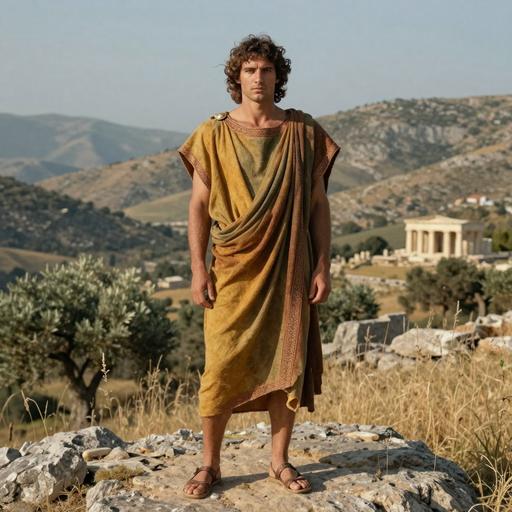
Portrait reconstruction of I17959
Ancient Individual

A man buried in Greece in the Iron Age era

I17959
800 BCE - 500 BCE
Male
Iron Age Delphi, Greece
Greece
Scroll to begin
Chapter I

Identity

The biological and cultural markers that define this ancient individual

Sample ID

I17959

Date Range

800 BCE - 500 BCE

Biological Sex

Male

mtDNA Haplogroup

J1c

Y-DNA Haplogroup

Not available

Cultural Period

Iron Age Delphi, Greece

Chapter II

Place

Where this individual was discovered

Country Greece
Locality Kastrouli (Desfina. Phokis. near Delphi)
Coordinates 38.3991, 22.5750
Chapter III

Time

When this individual lived in the broader context of human history

I17959 800 BCE - 500 BCE
Chapter IV

Story

The narrative of this ancient life

Iron Age Delphi marks an essential period in ancient Greek history, beginning around the 12th century BCE and transitioning through the early stages of the first millennium BCE. This era, pivotal for the development of Greek culture and society, laid the foundational stones for the classical period of Greek history.

Geography and Setting

Delphi is located on the steep slopes of Mount Parnassus in central Greece, a place that held significant geographical and strategic importance. The rugged terrain not only provided a natural defense but also contributed to the mysticism associated with the site. The surrounding topography included the sacred Corycian Cave and the Castalian Spring, further enhancing its intrinsic religious sensitivity.

Cultural and Religious Significance

Delphi is perhaps best known for its Oracle, considered the most important oracle in the Greek world. Initially dedicated to Gaea, the Earth goddess, the temple became the sanctuary of Apollo during the Iron Age. Apollo, the god of prophecy, music, and healing, played a central role in Greek religious life. This transition coincides with a broader cultural shift in Greek thought, moving from more primitive religious practices to the established pantheon seen in classical Greek culture.

The Pythia, the high priestess of the Temple of Apollo, provided oracular statements and prophecy, attracting pilgrims and dignitaries from across the Greek world and beyond. Consulting the Oracle of Delphi became a pivotal cultural and political ritual, influencing decisions from colonization to war, grounding Delphi's position as a nucleus of the spiritual and sociopolitical world.

Political Influence

The unique combination of its religious power and strategic location endowed Delphi with considerable political influence. The Amphictyonic League, a religious association of tribes, administered the sanctuary and managed the Pythian Games, which were one of the Panhellenic Games of ancient Greece. Delphi's influence extended to being a center of diplomacy and cultural exchange, with treaties and alliances often solidified under its auspices.

Art and Architecture

The artifacts and architectural remnants from Iron Age Delphi narrate a transformation in Greek art. This period witnessed advancements in pottery, such as the Geometric style, characterized by meander patterns and motifs. These artifacts provide crucial insights into the trade connections and cultural exchanges between Delphi and other Mediterranean regions.

Development of monumental architecture, including treasuries constructed by various city-states, signaled a shift toward expressing wealth and piety through public works. These treasuries not only held offerings to Apollo but also served as political statements about power and pride. The \Siphnian Treasury" and "Athenian Treasury" exemplify such developments and reflect the competitive nature of the city-states.

Economic Aspects

Delphi's economy thrived on its religious significance, bolstered by offerings and the influx of visitors attending oracular consultations and games. These gatherings encouraged trade, with merchants and craftsmen supplying goods and services to visitors, as well as facilitating an exchange of ideas and cultural practices.

Social Dynamics

The societal structure during this era in Delphi was predominantly dictated by its religious roles, yet expanded due to economic interactions. The priesthood and associated religious functions provided an organized system of governance and social order complemented by the Amphictyonic League's oversight.

Intellectual Growth

Delphi during the Iron Age was much more than a religious center; it was a hub of intellectual discourse. Philosophers, poets, and politicians alike visited the Oracle and contributed to the cultural and intellectual ferment that defined Greece in this era. The temple's walls bore inscriptions of maxims attributed to the Seven Sages, such as "Know Thyself" and "Nothing in Excess," reflecting the philosophical undercurrents that would later flourish in classical Greece.

In summary, Iron Age Delphi was a crucible where religion, politics, art, and commerce intersected, forging a legacy that would resonate through the ages in Greek culture and beyond. As the center for oracular prophecy, Delphi's profound impact on social, political, and cultural aspects of life in ancient Greece was unparalleled, setting the stage for the forthcoming classic period."

Chapter V

Genetics

The genetic ancestry of this ancient individual

Ancient Genetic Admixture

This analysis compares the DNA profile of I17959 with ancient reference populations, showing the genetic composition in terms of prehistoric ancestral groups.

Neolithic Farmers 42.8%
European Hunter-Gatherers 28.1%
Western Steppe Pastoralists 22.0%
Ancient Asians 4.4%
Ancient Africans 2.8%

Modern Genetic Admixture

This analysis compares the DNA profile with present-day reference populations, showing what percentage of genetic makeup resembles modern populations from different regions.

Europe 38.0%
Southern European 33.6%
Sardinian 21.9%
Balkan 11.7%
Northwestern European 4.4%
Scandinavian 3.6%
Northwestern European 0.8%
Asia 31.4%
Northern West Asian 25.7%
Mesopotamian 19.3%
Cypriot 6.4%
Arab, Egyptian & Levantine 5.7%
Arabian 5.7%
Africa 30.6%
North African 29.4%
Egyptian 22.1%
North African 7.3%
West African 1.2%
Senegambian & Guinean 1.2%

Closest Modern Populations

These are the modern populations showing the closest statistical alignment to A man buried in Greece in the Iron Age era, ranked by genetic distance. Lower distance values indicate closer statistical similarity.

1
Belmonte Jew
3.1634
2
Maltese
3.7382
3
Sicilian West
3.7651
4
Sicilian East
4.4273
5
Italian Calabria
4.6579
6
Ashkenazi Germany
4.6614
7
Ashkenazi France
4.7125
8
Ashkenazi Austria
4.7667
9
Ashkenazi Ukraine
4.7723
10
Italian Campania
4.8217
Chapter VI

Context

Other ancient individuals connected to this sample

Sources

References

Scientific publications and genetic data

Scientific Publication

The genetic history of the Southern Arc: A bridge between West Asia and Europe | Science

Authors Lazaridis I, Alpaslan-Roodenberg S, Acar A
Abstract

The period from the Copper Age to the Bronze Age marked major social and economic transformations in West Eurasia. To better understand these changes and their genetic impacts, we generated genome-wide data from 727 individuals who lived between 5000 and 1000 BCE in southeastern Europe and southwestern Asia.

G25 Coordinates

The G25 coordinates for sample I17959 can be used for detailed admixture analysis in our G25 Studio tool.

I17959,0.07268582,0.14362652,0.0027996,-0.03703042,0.02853708,-0.0171051,-0.00694968,0.00192868,0.0184427,0.03595514,-0.00193316,0.00627324,-0.00836976,-0.00730982,-0.00299388,0.00299302,0.00343402,0.00033622,0.00135388,-0.00306684,0.00137394,0.0027704,-0.00601892,-0.00468172,0.00080419
Analyze in G25 Studio
Use code for 40% off Expires Feb 26