Menu
Store
Blog
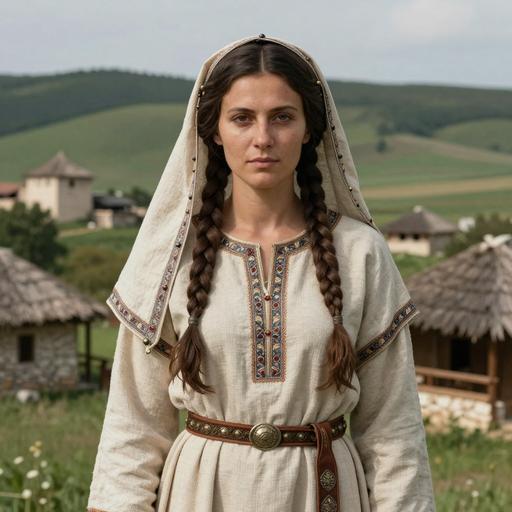
Portrait reconstruction of I17980
Ancient Individual

A woman buried in Bulgaria in the Middle Ages era

I17980
1051 CE - 1217 CE
Female
Medieval Bulgaria
Bulgaria
Scroll to begin
Chapter I

Identity

The biological and cultural markers that define this ancient individual

Sample ID

I17980

Date Range

1051 CE - 1217 CE

Biological Sex

Female

mtDNA Haplogroup

U2e2a1a

Cultural Period

Medieval Bulgaria

Chapter II

Place

Where this individual was discovered

Country Bulgaria
Locality Ryahovets (Gorna Oryahovitsa. Veliko Tarnovo)
Coordinates 43.1200, 25.6800
Chapter III

Time

When this individual lived in the broader context of human history

I17980 1051 CE - 1217 CE
Chapter IV

Story

The narrative of this ancient life

Medieval Bulgaria, spanning approximately from the 7th to the late 14th century, was a period of significant cultural, military, and political development on the Balkan Peninsula. During this era, Bulgaria emerged as a formidable power in the region, often in contention with the Byzantine Empire. Understanding Medieval Bulgaria requires examining its geographic, cultural, religious, and political contexts.

Early Foundations

The First Bulgarian Empire was established in 681 AD by Asparuh, a Khan of the Bulgars, who migrated south of the Danube. This establishment marked the beginning of a distinct Bulgarian identity characterized by the fusion of Slavic, Bulgar, and Thracian elements. The Bulgars were initially a Turkic semi-nomadic warrior tribe, but they settled and mixed with the local Slavic population, creating a powerful kingdom.

Political Structure and Expansion

Medieval Bulgaria was initially organized in a khanate system but later adopted a more centralized form of monarchy. The ruler, or Tsar (a title derived from ‘Caesar’), wielded significant power, balancing relations with powerful aristocrats known as boyars. Throughout the 9th and 10th centuries, Bulgaria expanded its borders under leaders like Khan Krum (803-814) and Tsar Simeon I (893-927), who extended Bulgarian territory from the Black Sea to the Adriatic and threatened the Byzantine capital, Constantinople.

Cultural and Religious Flourishing

One of the most monumental influences on medieval Bulgarian culture was the Christianization of Bulgaria in 864 AD under Boris I. The adoption of Eastern Orthodox Christianity had profound cultural implications, aligning Bulgaria closely with the Byzantine Orthodox world while still functioning as a rival power. The conversion also facilitated the development of the Old Church Slavonic language, which became a liturgical language of the Bulgarian Orthodox Church, thanks in part to the work of the Byzantine missionaries Saints Cyril and Methodius and their disciples, who created the Cyrillic alphabet.

Bulgarian culture flourished during the reign of Tsar Simeon I, often referred to as the \Golden Age of Bulgarian Culture." This period saw the establishment of literary schools, with major centers at Preslav and Ohrid, which produced a wealth of theological, historical, and literary works. This cultural renaissance included the construction of monumental architecture in the form of churches and fortresses, and advancements in art, particularly in iconography and fresco painting.

Military Conflicts and Relations with Byzantium

Bulgaria's relationship with the Byzantine Empire was characterized by both fierce military conflicts and periods of peace with complex diplomatic marriages and alliances. The major conflict during this period was the long-standing Bulgarian-Byzantine Wars, which included decisive battles such as the Battle of Pliska in 811, where Khan Krum famously defeated and killed the Byzantine Emperor Nicephorus I.

Despite occasional defeats, Bulgaria remained an influential power in the Balkans. However, internal strife, such as dynastic disputes and rebellion, coupled with external pressures, notably from the Byzantine Empire and later the emerging threat from the Hungarian and Pecheneg tribes, put increasing strain on the Bulgarian state.

The Fall of the First Bulgarian Empire

The First Bulgarian Empire eventually fell to Byzantium in 1018 after the prolonged campaigns of Emperor Basil II, known as the "Bulgar Slayer." However, Bulgarian identity and culture persisted, fueling rebellions and leading to the establishment of the Second Bulgarian Empire in 1185.

The Second Bulgarian Empire

The Second Bulgarian Empire (1185–1396) was founded following a successful uprising against Byzantine rule led by the brothers Asen and Peter. Despite its initial successes and the revitalization of Bulgarian culture and power, this empire faced numerous difficulties, including invasions by Mongolian forces and internal fragmentation.

This period saw significant cultural developments, including the art and literature of the Tarnovo Literary School, which promoted theological literature and revised the Cyrillic script. Orthodox Christianity continued to play a crucial role in cultural unity and national identity.

Decline and Fall

The Second Bulgarian Empire struggled with internal divisions and external threats, particularly from the expanding Ottoman Empire. The decisive blow came with the fall of Tarnovo in 1393 and the final Bulgarian stronghold at Vidin in 1396, marking the end of Medieval Bulgaria and the beginning of Ottoman rule.

Conclusion

Medieval Bulgaria was a time of profound transformation, marked by powerful rulers, military conflicts, and significant cultural and religious developments. The intricate relationship with the Byzantine Empire alternated between war and cultural exchanges, which influenced Bulgaria's identity and legacy. Despite the fall of its empires, the foundations laid during the medieval period helped preserve Bulgarian culture and identity through centuries of foreign domination."

Chapter V

Genetics

The genetic ancestry of this ancient individual

Ancient Genetic Admixture

This analysis compares the DNA profile of I17980 with ancient reference populations, showing the genetic composition in terms of prehistoric ancestral groups.

Neolithic Farmers 48.6%
European Hunter-Gatherers 29.0%
Western Steppe Pastoralists 17.1%
Ancient Asians 5.2%

Modern Genetic Admixture

This analysis compares the DNA profile with present-day reference populations, showing what percentage of genetic makeup resembles modern populations from different regions.

Europe 68.7%
Southern European 58.4%
Balkan 34.5%
Italian 17.9%
Sardinian 4.0%
Iberian 2.0%
Northwestern European 10.3%
Scandinavian 5.9%
Northwestern European 4.3%
Asia 29.7%
Northern West Asian 21.4%
Caucasian 7.8%
Mesopotamian 7.5%
Anatolian 4.7%
Cypriot 1.4%
Arab, Egyptian & Levantine 7.3%
Levantine 7.3%
Central Asian, Northern Indian & Pakistani 1.0%
Pakistan 1.0%
Africa 0.9%
North African 0.9%
Egyptian 0.9%
America 0.8%
America 0.8%
Native American 0.8%

Closest Modern Populations

These are the modern populations showing the closest statistical alignment to A woman buried in Bulgaria in the Middle Ages era, ranked by genetic distance. Lower distance values indicate closer statistical similarity.

1
Greek West Taygetos
2.2339
2
Greek Elis
2.2517
3
Greek East Taygetos
2.2913
4
Greek Izmir
2.4127
5
Greek North Tsakonia
2.4345
6
Greek South Tsakonia
2.4356
7
Greek Messenia
2.4395
8
Greek Achaea
2.4492
9
Greek Argolis
2.4561
10
Greek Arcadia
2.4585
Chapter VI

Context

Other ancient individuals connected to this sample

Sources

References

Scientific publications and genetic data

Scientific Publication

The genetic history of the Southern Arc: A bridge between West Asia and Europe | Science

Authors Lazaridis I, Alpaslan-Roodenberg S, Acar A
Abstract

The period from the Copper Age to the Bronze Age marked major social and economic transformations in West Eurasia. To better understand these changes and their genetic impacts, we generated genome-wide data from 727 individuals who lived between 5000 and 1000 BCE in southeastern Europe and southwestern Asia.

G25 Coordinates

The G25 coordinates for sample I17980 can be used for detailed admixture analysis in our G25 Studio tool.

I17980,0.11379182,0.13468012,-0.0021502,-0.01922336,0.00737966,-0.00571796,0.00111136,-0.00203344,-0.00472682,0.00986284,-0.00105734,0.00324988,-0.00330868,0.00587576,-0.00958736,0.0004417,0.00527326,-0.00093432,0.00299612,-0.00202948,-0.00351606,-0.00165274,0.00085418,-0.00105932,-0.00057914
Analyze in G25 Studio
Use code for 40% off Expires Feb 26