Menu
Store
Blog
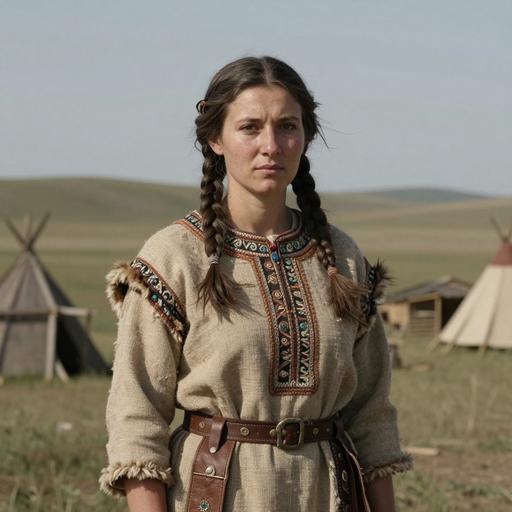
Portrait reconstruction of I1917
Ancient Individual

A woman buried in Ukraine in the Early Bronze Age era

I1917
3096 BCE - 2913 BCE
Female
Early Bronze Age Yamnaya Culture, Ozera, Ukraine
Ukraine
Scroll to begin
Chapter I

Identity

The biological and cultural markers that define this ancient individual

Sample ID

I1917

Date Range

3096 BCE - 2913 BCE

Biological Sex

Female

mtDNA Haplogroup

R0a1

Cultural Period

Early Bronze Age Yamnaya Culture, Ozera, Ukraine

Chapter II

Place

Where this individual was discovered

Country Ukraine
Locality Ozera. OAE-99
Coordinates 48.9912, 33.9505
Chapter III

Time

When this individual lived in the broader context of human history

I1917 3096 BCE - 2913 BCE
Chapter IV

Story

The narrative of this ancient life

The Early Bronze Age Yamnaya Culture, particularly in the context of the Ozera region in Ukraine, represents a significant and influential period in the prehistoric development of Eastern Europe. The Yamnaya Culture, dating from approximately 3300 to 2600 BCE, is often highlighted for its role in the spread of Proto-Indo-European languages and its contributions to the formation of early European societies.

Geography and Environment

Ozera, located in present-day Ukraine, represents a strategic area for studying the Yamnaya Culture. This region features a landscape of steppe grasslands, which were pivotal to the lifestyle and mobility of the Yamnaya people. The abundance of open terrain facilitated nomadic pastoralism, the primary subsistence strategy of the culture. The steppe environment, with its rich resources and strategic location, acted as a corridor for migrations, influencing other cultures and subsequently the development of European civilizations.

Social Structure and Lifestyle

The Yamnaya Culture was characterized by its semi-nomadic lifestyle, centered around herding cattle, sheep, and goats. This pastoral economy necessitated a mobile existence, allowing the Yamnaya people to exploit vast regions of the steppe. They lived in temporary settlements, often marked by circular or oval pit-houses and seasonal campsites. The social structure of Yamnaya communities was likely hierarchical, with evidence suggesting the presence of elite individuals who wielded significant authority, possibly derived from control over livestock and trade networks.

Burial Practices and Rituals

One of the most distinctive features of the Yamnaya Culture is its burial practices. The Yamnaya are known for their kurgans—large burial mounds that dominate the landscape of the Eurasian steppe. These mounds typically contain single or small group interments, with bodies placed in a supine position and oriented toward the cardinal directions. The interments were often accompanied by grave goods, such as pottery, weaponry, ornaments, and animal remains, indicating beliefs in an afterlife and the social status of the deceased. These burial practices underscore their sophisticated spiritual beliefs and complex social organization.

Material Culture and Technology

Yamnaya material culture includes a repertoire of pottery, tools, and ornaments. The pottery is generally simple, with corded ware decorations reflecting the influence of neighboring cultures. The technological advancements of the Yamnaya included metallurgy, seen in the presence of copper and bronze tools and weapons. The introduction and use of the wheel and horse domestication were critical innovations attributed to the Yamnaya, significantly impacting transport and trade.

Language and Cultural Influence

The Yamnaya Culture is often associated with the Proto-Indo-European language family—a precursor to many modern languages spoken across Europe and parts of Asia. This hypothesis, known as the Kurgan Hypothesis, suggests that the Yamnaya played a central role in the diffusion of Indo-European languages through migratory and genetic exchanges. The culture's influence can be traced in various European archaeological cultures, including the Corded Ware and Bell Beaker cultures, demonstrating their lasting impact on European prehistory.

Genetic and Archaeological Evidence

Recent genetic studies have provided insights into the movements and genetic makeup of the Yamnaya people. Analysis of ancient DNA has revealed a mixture of Eastern European Hunter-Gatherers and Caucasus-related populations, supporting theories of migration and cultural amalgamation. Archaeological evidence from the Ozera region, with its numerous burial sites and artifacts, provides a rich tapestry for understanding the complexities of the Yamnaya Culture.

Conclusion

The Early Bronze Age Yamnaya Culture in the Ozera region of Ukraine represents a cornerstone in the study of prehistoric Europe. Their advancements in technology, pastoral lifestyle, and burial practices highlight the complexity and adaptability of the Yamnaya people. The Yamnaya's potential role in spreading Indo-European languages underscores their significance in shaping ancient European cultural landscapes. As research continues, the Yamnaya Culture remains a focal point for understanding the interconnectedness of prehistoric societies and their legacies that echo into the present day.

Chapter V

Genetics

The genetic ancestry of this ancient individual

Ancient Genetic Admixture

This analysis compares the DNA profile of I1917 with ancient reference populations, showing the genetic composition in terms of prehistoric ancestral groups.

Western Steppe Pastoralists 36.1%
Neolithic Farmers 34.2%
European Hunter-Gatherers 22.8%
Ancient Asians 6.9%

Modern Genetic Admixture

This analysis compares the DNA profile with present-day reference populations, showing what percentage of genetic makeup resembles modern populations from different regions.

Asia 55.3%
Northern West Asian 51.6%
Caucasian 51.4%
Central Asian, Northern Indian & Pakistani 3.7%
Pakistan 3.7%
Europe 44.7%
Northwestern European 26.9%
English 17.5%
Scandinavian 8.2%
Northwestern European 1.1%
Eastern European 17.8%

Closest Modern Populations

These are the modern populations showing the closest statistical alignment to A woman buried in Ukraine in the Early Bronze Age era, ranked by genetic distance. Lower distance values indicate closer statistical similarity.

1
Lezgin
3.3970
2
Tabasaran
3.7589
3
Lak
3.8176
4
Kaitag
3.8672
5
Andian B
3.9228
6
Avar
4.0376
7
Kumyk
4.2348
8
Akhvakh
4.2940
9
Darginian
4.3098
10
Tat Dagestan Dzhalgan
4.3265
Chapter VI

Context

Other ancient individuals connected to this sample

Sources

References

Scientific publications and genetic data

Scientific Publication

The genomic history of southeastern Europe

Authors Mathieson I, Alpaslan-Roodenberg S, Posth C
Abstract

Farming was first introduced to Europe in the mid-seventh millennium bc, and was associated with migrants from Anatolia who settled in the southeast before spreading throughout Europe. Here, to understand the dynamics of this process, we analysed genome-wide ancient DNA data from 225 individuals who lived in southeastern Europe and surrounding regions between 12000 and 500 bc. We document a west-east cline of ancestry in indigenous hunter-gatherers and, in eastern Europe, the early stages in the formation of Bronze Age steppe ancestry. We show that the first farmers of northern and western Europe dispersed through southeastern Europe with limited hunter-gatherer admixture, but that some early groups in the southeast mixed extensively with hunter-gatherers without the sex-biased admixture that prevailed later in the north and west. We also show that southeastern Europe continued to be a nexus between east and west after the arrival of farmers, with intermittent genetic contact with steppe populations occurring up to 2,000 years earlier than the migrations from the steppe that ultimately replaced much of the population of northern Europe.

G25 Coordinates

The G25 coordinates for sample I1917 can be used for detailed admixture analysis in our G25 Studio tool.

I1917,0.10729058,0.08715218,-0.0096651,0.01904626,-0.02696584,0.01424932,0.0101677,-0.00081524,-0.04071026,-0.0323374,-0.00122012,0.00287398,-0.00367204,-0.00186292,0.0079773,0.00318842,-0.00164902,0.0013052,0.00093394,-0.00363492,-5.812E-05,0.00022094,0.00504624,0.01081234,0.00028194
Analyze in G25 Studio
Use code for 40% off Expires Feb 27