Menu
Store
Blog
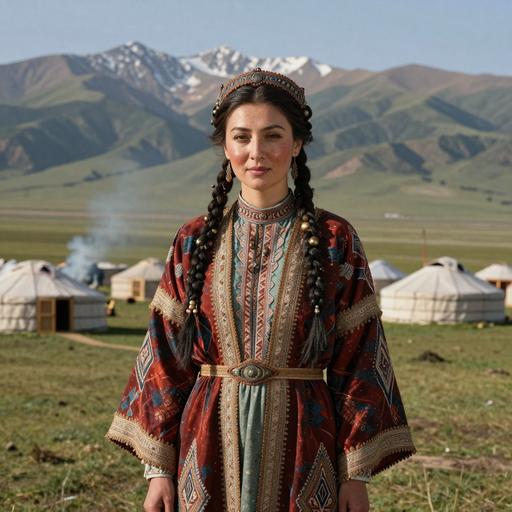
Portrait reconstruction of I25832
Ancient Individual

A woman buried in Kazakhstan in the Middle Ages era

I25832
800 CE - 1100 CE
Female
Karakhanid Period Kazakhstan
Kazakhstan
Scroll to begin
Chapter I

Identity

The biological and cultural markers that define this ancient individual

Sample ID

I25832

Date Range

800 CE - 1100 CE

Biological Sex

Female

mtDNA Haplogroup

Not available

Cultural Period

Karakhanid Period Kazakhstan

Chapter II

Place

Where this individual was discovered

Country Kazakhstan
Locality Tian Shan. Central Steppe. Butakty
Coordinates 43.2025, 76.9817
Chapter III

Time

When this individual lived in the broader context of human history

I25832 800 CE - 1100 CE
Chapter IV

Story

The narrative of this ancient life

The Karakhanid period, stretching from the late 9th century to the early 13th century, marks a significant chapter in the history of Central Asia, particularly in what is modern-day Kazakhstan. This era is notable for the consolidation and expansion of Turkic influence, as well as the spread of Islam in the region. The Karakhanid Empire, also known as the Karakhanid Khanate, represents a period where Turkic culture, politics, and religion underwent profound transformations, leaving a lasting legacy in Central Asia.

Historical Context

The Karakhanid dynasty was founded in the late 9th century by the Karluks, a confederation of Turkic tribes. The rise of the Karakhanids came after the decline of the Uyghur Khaganate and the fragmentation of power that followed. They emerged as a unifying force in the region, bringing various Turkic tribes under their control. At its height, the Karakhanid Empire extended over parts of modern-day Kazakhstan, Kyrgyzstan, Uzbekistan, Turkmenistan, and China’s Xinjiang region.

Political Structure

The Karakhanid government was organized as a khanate, with power centered around the ruling dynasty and extended through a feudal-like system of local chieftains and nobility. The khans ruled from a centralized authority, but local governance was typically managed by members of the ruling family, often given control over specific provinces. This semi-decentralized system allowed for both strong central control and the flexibility required to govern the diverse and sprawling territories of Central Asia.

Society and Culture

The Karakhanid period saw a significant transition in cultural and religious practices, largely due to the introduction and adoption of Islam. Previously, the region had been a melting pot of various religions, including Tengriism, Buddhism, and Zoroastrianism. However, the Karakhanids were instrumental in spreading Islam among the Turkic peoples, facilitating the religion’s expansion through patronage of Islamic scholars and the establishment of religious infrastructure such as mosques and madrasas.

Culturally, the Karakhanid era was marked by the flourishing of literature, art, and architecture. The Turkic language, written in the Arabic script, became the primary medium for literature, with works like the \Kutadgu Bilig" (Wisdom of Royal Glory) by Yūsuf Balasaguni, a notable example. This period also saw the construction of impressive architectural feats, such as the mausoleum of Aisha Bibi near Taraz, which showcase intricate Islamic design and artwork.

Economy

The Karakhanid era was characterized by a vibrant economy based on agriculture, trade, and the production of crafts. The region's strategic location along the Silk Road facilitated extensive trade networks, connecting China, the Middle East, and Europe. This trade brought prosperity and cultural exchange, enabling the Karakhanids to access goods, ideas, and technologies from across the known world.

The empire’s economy was also supported by a complex irrigation system, which enhanced agricultural productivity and supported large urban centers. These urban centers became hubs of commercial and cultural activity, attracting scholars, traders, and artisans.

Military

The Karakhanid military was a formidable force composed primarily of mounted cavalry, a staple of Central Asian warfare. Their ability to quickly mobilize and move across vast distances allowed them to maintain control over their expansive territories and to protect their trade routes. The military prowess of the Karakhanids was crucial in their defense against both internal and external threats, helping to maintain the stability and longevity of their rule.

Decline

The decline of the Karakhanid Empire began in the late 11th century due to internal strife and external pressures. Infighting among the ruling family weakened the central authority, while the rise of rival powers, such as the Seljuks and later the Khwarazmian Empire, eroded the Karakhanids' territorial holdings. The final blow came in the early 13th century when the empire became a vassal to the rising Mongol Empire under Genghis Khan.

Legacy

Despite their eventual decline, the legacy of the Karakhanids remains significant in Central Asia. They were instrumental in the Islamization of the Turkic peoples, which has had lasting cultural and religious impacts on the region. Moreover, the period is remembered for its contributions to Turkic culture, language, and literature. The architectural and cultural advancements of the Karakhanid era continue to be celebrated as part of the region's rich historical heritage. Today, the Karakhanid period is studied as a pivotal time that helped shape the cultural and political landscapes of Central Asia."

Chapter V

Context

Other ancient individuals connected to this sample

Sources

References

Scientific publications and genetic data

Scientific Publication

137 ancient human genomes from across the Eurasian steppes

Authors Damgaard PB, Marchi N, Rasmussen S
Abstract

For thousands of years the Eurasian steppes have been a centre of human migrations and cultural change. Here we sequence the genomes of 137 ancient humans (about 1× average coverage), covering a period of 4,000 years, to understand the population history of the Eurasian steppes after the Bronze Age migrations. We find that the genetics of the Scythian groups that dominated the Eurasian steppes throughout the Iron Age were highly structured, with diverse origins comprising Late Bronze Age herders, European farmers and southern Siberian hunter-gatherers. Later, Scythians admixed with the eastern steppe nomads who formed the Xiongnu confederations, and moved westward in about the second or third century BC, forming the Hun traditions in the fourth-fifth century AD, and carrying with them plague that was basal to the Justinian plague. These nomads were further admixed with East Asian groups during several short-term khanates in the Medieval period. These historical events transformed the Eurasian steppes from being inhabited by Indo-European speakers of largely West Eurasian ancestry to the mostly Turkic-speaking groups of the present day, who are primarily of East Asian ancestry.

Use code for 40% off Expires Feb 27