Menu
Store
Blog
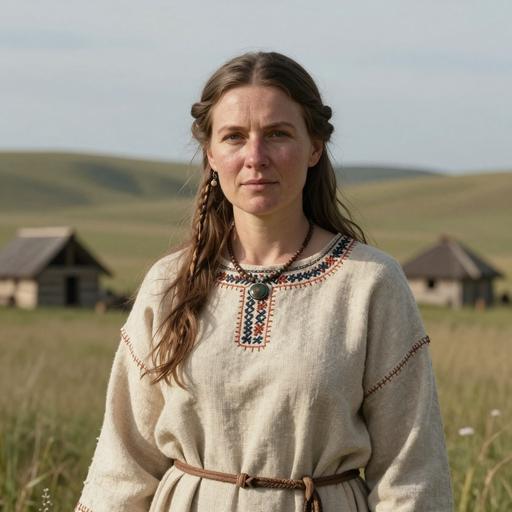
Portrait reconstruction of I4110
Ancient Individual

A woman buried in Ukraine in the Late Neolithic era

I4110
3509 BCE - 3356 BCE
Female
Eneolithic Ukraine
Ukraine
Scroll to begin
Chapter I

Identity

The biological and cultural markers that define this ancient individual

Sample ID

I4110

Date Range

3509 BCE - 3356 BCE

Biological Sex

Female

mtDNA Haplogroup

J2b1

Cultural Period

Eneolithic Ukraine

Chapter II

Place

Where this individual was discovered

Country Ukraine
Locality Dereivka I
Coordinates 48.9142, 33.7649
Chapter III

Time

When this individual lived in the broader context of human history

I4110 3509 BCE - 3356 BCE
Chapter IV

Story

The narrative of this ancient life

The Eneolithic period, also known as the Chalcolithic or Copper Age, represents a transitional phase between the Neolithic, characterized by the use of stone tools, and the Bronze Age, marked by the introduction of metalworking. In the context of Ukraine, especially the Pontic-Caspian Steppe, the Eneolithic era is a fascinating period that highlights the development of early farming societies, complex social structures, and the advent of metallurgy. This discussion delves into the key aspects of this era in what is now Ukraine.

Geographic and Chronological Context

The Pontic-Caspian Steppe spans a vast area, encompassing parts of modern Ukraine, southern Russia, and Kazakhstan. This expansive grassland region provided a diverse environment that supported various cultures and innovations. The Eneolithic period in this region is generally dated from around 4500 to 3500 BCE, although these dates can slightly vary based on specific local archaeological contexts.

Cultural Complexes

During the Eneolithic era, several cultural groups and complexes emerged in the Pontic-Caspian Steppe, each contributing uniquely to the cultural landscape of the region:

  1. Trypillia-Cucuteni Culture: Although predominantly associated with the forest-steppe zone of Ukraine and Moldova, the Trypillia (or Cucuteni-Trypillia) culture influenced the southern steppe regions. Known for their large, densely populated settlements called \mega-sites," intricate pottery, and agricultural practices, they represent one of the most complex societies of the Eneolithic.

  2. Sredny Stog Culture: Located in the Dnieper River region, the Sredny Stog culture played a crucial role in the cultural and technological developments of the area. They are credited with early horse domestication and the development of innovative burial practices, often involving pit graves.

  3. Khvalynsk Culture: Situated along the middle and lower Volga River, this culture overlapped with the eastern part of the Pontic-Caspian Steppe. Recognized for their distinctive burial mounds called "kurgans," the Khvalynsk people engaged in pastoralism and social stratification, evident by rich graves containing personal ornaments and status symbols.

Economy and Subsistence

Inhabitants of the Pontic-Caspian Steppe during the Eneolithic period practiced a mixed economy comprising agriculture, pastoralism, and hunting-gathering. The fertile lands of the steppe supported the cultivation of cereals and legumes, while the vast grasslands provided excellent pasturage for livestock, including cattle, sheep, goats, and horses.

One of the revolutionary developments of this era was the domestication of the horse, an innovation attributed to the Sredny Stog culture. This domestication not only transformed mobility and trade but also laid the groundwork for future developments in warfare and transportation.

Technological and Artistic Achievements

The Eneolithic period in Ukraine saw the emergence of metallurgy, although it was in its infancy compared to subsequent periods. Copper tools, weapons, and ornaments began to supplement traditional stone implements, marking a significant technological leap.

Pottery from this era is particularly notable. The Trypillia culture, for example, is renowned for its intricately decorated ceramics, which often featured complex geometric patterns and anthropomorphic or zoomorphic motifs. Such pottery not only served practical purposes but also held cultural and ritual significance.

Social and Ritual Practices

Social structures in Eneolithic Ukraine were becoming increasingly complex. The presence of large settlements, particularly among the Trypillia culture, suggests organized community life with emerging social hierarchies. The construction and use of kurgans, particularly associated with the Khvalynsk culture, indicate emerging social stratification and the importance of ancestor worship.

Ritual life during the Eneolithic period was rich and diverse. Burial practices varied widely, with some cultures practicing elaborate grave goods depositions, while others, like the Sredny Stog, were characterized by simpler interments. The variety of burial practices reflects a range of beliefs concerning life, death, and the afterlife.

Influence and Legacy

The Eneolithic cultures of Ukraine and the Pontic-Caspian Steppe laid the groundwork for significant cultural transformations that would follow in the Bronze Age. The technological innovations, social structures, and cultural practices from this era influenced future cultures within the region and beyond. Notably, the domestication of the horse and initial steps toward metallurgy set the stage for the dynamic developments of the Bronze Age.

In summary, the Eneolithic period in the Pontic-Caspian Steppe was a time of significant transition and innovation. It witnessed the interplay of various cultural groups that shaped the social, economic, and technological landscapes of ancient Ukraine, leaving a rich legacy for future civilizations to build upon."

Chapter V

Genetics

The genetic ancestry of this ancient individual

Ancient Genetic Admixture

This analysis compares the DNA profile of I4110 with ancient reference populations, showing the genetic composition in terms of prehistoric ancestral groups.

Western Steppe Pastoralists 50.3%
European Hunter-Gatherers 30.4%
Neolithic Farmers 16.9%
Ancient Asians 2.5%

Modern Genetic Admixture

This analysis compares the DNA profile with present-day reference populations, showing what percentage of genetic makeup resembles modern populations from different regions.

Europe 100.0%
Northwestern European 59.6%
Scandinavian 28.7%
English 22.1%
Finnish 5.8%
Northwestern European 3.1%
Eastern European 27.6%
Southern European 12.8%
Iberian 12.8%

Closest Modern Populations

These are the modern populations showing the closest statistical alignment to A woman buried in Ukraine in the Late Neolithic era, ranked by genetic distance. Lower distance values indicate closer statistical similarity.

1
Finnish Southwest
3.0627
2
Swedish
3.1714
3
Polish Kashubian
3.2076
4
Polish
3.3020
5
Czech
3.4174
6
German East
3.5212
7
German Hamburg
3.5290
8
Ukrainian Dnipro
3.5712
9
Russian Orel
3.6231
10
Cossack Ukrainian
3.6414
Chapter VI

Context

Other ancient individuals connected to this sample

Sources

References

Scientific publications and genetic data

Scientific Publication

The genomic history of southeastern Europe

Authors Mathieson I, Alpaslan-Roodenberg S, Posth C
Abstract

Farming was first introduced to Europe in the mid-seventh millennium bc, and was associated with migrants from Anatolia who settled in the southeast before spreading throughout Europe. Here, to understand the dynamics of this process, we analysed genome-wide ancient DNA data from 225 individuals who lived in southeastern Europe and surrounding regions between 12000 and 500 bc. We document a west-east cline of ancestry in indigenous hunter-gatherers and, in eastern Europe, the early stages in the formation of Bronze Age steppe ancestry. We show that the first farmers of northern and western Europe dispersed through southeastern Europe with limited hunter-gatherer admixture, but that some early groups in the southeast mixed extensively with hunter-gatherers without the sex-biased admixture that prevailed later in the north and west. We also show that southeastern Europe continued to be a nexus between east and west after the arrival of farmers, with intermittent genetic contact with steppe populations occurring up to 2,000 years earlier than the migrations from the steppe that ultimately replaced much of the population of northern Europe.

G25 Coordinates

The G25 coordinates for sample I4110 can be used for detailed admixture analysis in our G25 Studio tool.

I4110,0.1295433,0.1143372,0.07063902,0.06324946,0.03787776,0.02138324,0.00994258,0.01230488,0.00066866,-0.01649944,-0.0006849,-0.00264826,0.00539152,0.00759622,0.00825684,-0.00874134,-0.0122301,-4.582E-05,0.00112666,-0.00153662,0.0001161,-0.00022884,-0.00109762,0.0026414,-0.00205126
Analyze in G25 Studio
Use code for 40% off Expires Feb 27