Menu
Store
Blog
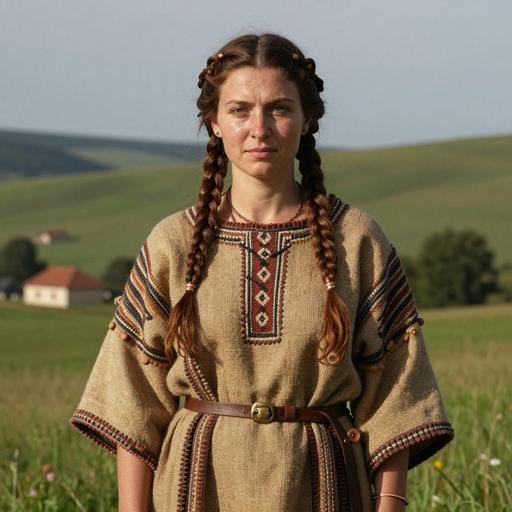
Portrait reconstruction of I6186
Ancient Individual

A woman buried in Romania in the Middle Late Bronze Age era

I6186
1615 BCE - 1506 BCE
Female
Middle to Late Bronze Age Romania
Romania
Scroll to begin
Chapter I

Identity

The biological and cultural markers that define this ancient individual

Sample ID

I6186

Date Range

1615 BCE - 1506 BCE

Biological Sex

Female

mtDNA Haplogroup

J1

Cultural Period

Middle to Late Bronze Age Romania

Chapter II

Place

Where this individual was discovered

Country Romania
Locality Trestiana
Coordinates 46.1896, 27.6695
Chapter III

Time

When this individual lived in the broader context of human history

I6186 1615 BCE - 1506 BCE
Chapter IV

Story

The narrative of this ancient life

The Middle to Late Bronze Age in Romania, roughly spanning from 2000 to 1200 BCE, represents a critical era in the development of European prehistoric societies. This period, often associated with the Indo-European migrations, was marked by significant cultural, technological, and social transformations across what is modern-day Romania, which was then part of a larger region known for its diverse Bronze Age cultures.

Geographical and Environmental Context

Romania's landscape, characterized by the Carpathian Mountains, the Danube River, and expansive plains such as the Wallachian Plain and Transylvanian Plateau, provided a diverse environment that supported various human activities. The terrain and climate influenced agricultural practices, settlement patterns, and trade routes, forming a vital link between Central Europe, the Balkans, and the eastern steppes.

Cultural Groups and Archaeological Cultures

The Middle to Late Bronze Age in Romania saw the emergence and interaction of several archaeological cultures, each with distinct traits:

  1. The Otomani-Füzesabony Culture: Predominantly located in northwestern Romania and eastern Hungary, this culture is noted for its fortified settlements and complex social structures. Archaeological evidence, such as pottery and metalwork, indicates advanced craftsmanship.

  2. The Wietenberg Culture: Centered in the Transylvania region, the Wietenberg culture is renowned for its artistic pottery, metallurgy, and the development of hilltop settlements. The use of bronze tools and weapons is a hallmark of this culture.

  3. The Monteoru Culture: Found mainly in the Subcarpathian areas of southeast Romania, the Monteoru culture was characterized by its burial customs, including tumulus burials, and its distinctive ceramics decorated with spiral motifs.

  4. The Tei Culture: Located in the southern part of Romania, it is known for its fortified sites and distinct pottery styles, featuring both utilitarian and ceremonial objects.

These cultures, along with others like the Noua, Sabatinovka, and Glina cultures, interacted through trade, warfare, and migration, contributing to the dynamic cultural landscape of the Bronze Age in this region.

Economy and Society

The economy during this period was primarily agrarian, supplemented by hunting, gathering, and fishing. The use of the ard, a primitive plow, alongside crop cultivation of wheat, barley, and millet, supported sustained agricultural growth. Domesticated animals, such as cattle, sheep, and goats, were integral for meat, milk, and wool.

Metallurgy played a critical role in the socio-economic structure, with bronze becoming the predominant material for tools, weapons, and ornaments. The mastery of metalwork by local artisans led to increased trade, with bronze objects often serving as trade items. Gold and copper resources in the region were increasingly exploited, creating wealth and status differentials within communities.

Society was likely organized into tribal structures with emerging class stratification. The presence of fortified settlements indicates a need for defense and centralized control, suggesting the development of petty chiefdoms or proto-kingdoms.

Religion and Rituals

Religious practices during the Middle to Late Bronze Age in Romania were complex and varied across different cultures. Burial customs provide significant insight, with tumulus graves, inhumations, and cremations suggesting beliefs in an afterlife. The inclusion of grave goods like pottery, weapons, and ornaments implies a ritualistic significance and possibly status markers.

Artifacts and structures such as stone circles, altars, and offerings of metalwork in rivers or hoards indicate ceremonial practices and reverence for natural elements.

Legacy and Influence

The Romanian Middle to Late Bronze Age cultures contributed to the gradual diffusion of Indo-European languages and cultural practices across Europe. The innovations in metallurgy and societal organization set the stage for subsequent developments during the Iron Age.

The era's archaeological heritage provides valuable insights into the complexities of prehistoric human societies and their ability to adapt and thrive in diverse environments. Continued research and excavations in Romania and surrounding areas promise to further illuminate the intricate tapestry of Bronze Age life in this pivotal region.

Chapter V

Genetics

The genetic ancestry of this ancient individual

Ancient Genetic Admixture

This analysis compares the DNA profile of I6186 with ancient reference populations, showing the genetic composition in terms of prehistoric ancestral groups.

Western Steppe Pastoralists 46.5%
European Hunter-Gatherers 29.6%
Neolithic Farmers 19.2%
Ancient Native Americans 4.8%

Modern Genetic Admixture

This analysis compares the DNA profile with present-day reference populations, showing what percentage of genetic makeup resembles modern populations from different regions.

Europe 97.1%
Northwestern European 70.7%
English 39.7%
Northwestern European 14.1%
Scandinavian 9.0%
Finnish 8.0%
Eastern European 26.4%
Asia 1.7%
Central Asian, Northern Indian & Pakistani 1.7%
Pakistan 1.7%
America 1.3%
America 1.3%
Native American 1.3%

Closest Modern Populations

These are the modern populations showing the closest statistical alignment to A woman buried in Romania in the Middle Late Bronze Age era, ranked by genetic distance. Lower distance values indicate closer statistical similarity.

1
German Hamburg
3.7915
2
Afrikaner
3.8992
3
Shetlandic
3.9785
4
German
4.0140
5
Dutch
4.0223
6
German Erlangen
4.0424
7
Swedish
4.0816
8
Norwegian
4.1352
9
Scottish
4.1597
10
Orcadian
4.1658
Chapter VI

Context

Other ancient individuals connected to this sample

Sources

References

Scientific publications and genetic data

Scientific Publication

The genetic history of the Southern Arc: A bridge between West Asia and Europe | Science

Authors Lazaridis I, Alpaslan-Roodenberg S, Acar A
Abstract

The period from the Copper Age to the Bronze Age marked major social and economic transformations in West Eurasia. To better understand these changes and their genetic impacts, we generated genome-wide data from 727 individuals who lived between 5000 and 1000 BCE in southeastern Europe and southwestern Asia.

G25 Coordinates

The G25 coordinates for sample I6186 can be used for detailed admixture analysis in our G25 Studio tool.

I6186,0.1302394,0.11296956,0.046152,0.04671172,0.02390028,0.02174408,0.00568964,0.0056142,-0.00612348,-0.01355344,-0.00542848,0.00544072,0.00101508,-0.00788736,0.01078084,-0.00010052,-0.00906528,0.00101224,-0.0024826,-0.00171228,0.00469512,0.0040954,0.00052616,0.00974572,-0.00146676
Analyze in G25 Studio
Use code for 40% off Expires Feb 26