Menu
Store
Blog
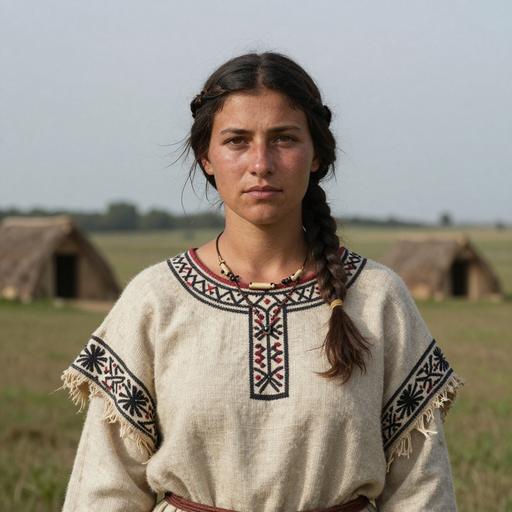
Portrait reconstruction of I6661
Ancient Individual

A woman buried in Romania in the Early Neolithic era

I6661
5621 BCE - 5482 BCE
Female
Early Neolithic Romania
Romania
Scroll to begin
Chapter I

Identity

The biological and cultural markers that define this ancient individual

Sample ID

I6661

Date Range

5621 BCE - 5482 BCE

Biological Sex

Female

mtDNA Haplogroup

Not available

Cultural Period

Early Neolithic Romania

Chapter II

Place

Where this individual was discovered

Country Romania
Locality Carcea
Coordinates 44.2600, 23.9000
Chapter III

Time

When this individual lived in the broader context of human history

I6661 5621 BCE - 5482 BCE
Chapter IV

Story

The narrative of this ancient life

The Early Neolithic period in Romania, approximately dated between 6000 and 4500 BCE, marks a significant transformation in human history, characterized by the adoption of agriculture, animal husbandry, and the establishment of permanent settlements. This era overlaps with the broader Neolithic Revolution that took place across parts of Europe, heralding changes so profound that they have often been described as the first major revolution in human history. The cultural landscape of Early Neolithic Romania was intricately tied to the wider Neolithic European cultures, particularly those along the Danube River, which acted as a conduit for the transmission of new technologies and ideas.

Agriculture and Livestock

Agriculture was the cornerstone of Early Neolithic life in Romania. Communities began cultivating cereals such as wheat and barley, which had been domesticated in the Near East and gradually disseminated into Southeast Europe. The cultivation of legumes and various fruits also found its place in these early agricultural economies. Alongside crop cultivation, animal domestication played a crucial role. Cattle, sheep, goats, and pigs were domesticated, providing a reliable source of meat, milk, hides, and wool. This mix of agriculture and animal husbandry supported a more sedentary lifestyle, allowing for population growth and the development of more complex societal structures.

Settlements

Permanent settlements began to appear during this era, with evidence of villages characterized by rectangular, wattle-and-daub houses. The settlements were often strategically located in fertile river valleys—areas that were well suited for agriculture. The presence of fortified settlements and evidence of communal structures suggests a degree of social organization and cooperation among these early communities.

Material Culture

The material culture of the Early Neolithic in Romania exhibits significant advancement, reflected in pottery, tools, and ornaments. Pottery, often decorated with intricate geometric patterns and painted in various colors, became a defining feature of Neolithic cultures. This era saw the development of distinct ceramic styles, such as those associated with the Starčevo-Körös-Criș cultural complex, which is one of the earliest groups of Neolithic cultures in the region.

Toolmaking also advanced significantly with the widespread use of polished stone tools, which were more efficient than their predecessors. Flint, obsidian, and other locally available materials were commonly used for tool production. In addition, bone and antler tools offer insight into the daily lives and subsistence activities of these communities.

Social Organization and Beliefs

The transition to a more sedentary lifestyle likely facilitated the development of more complex social structures. Although definitive evidence of social hierarchies is sparse, the construction of communal facilities and the existence of trade networks suggest emerging social differentiation. Spiritual and religious beliefs of these early communities may be inferred from burial practices, figurines, and other symbolic artifacts. The presence of figurines, often representing human or animal forms, hints at spiritual or ritualistic practices, though their exact significance remains a matter of scholarly interpretation.

Interaction and Exchange

Early Neolithic communities in Romania were not isolated. Trade networks facilitated the exchange of goods and ideas, as evidenced by the movement of materials like obsidian and the proliferation of certain pottery styles across large areas. Such exchange networks were integral to the diffusion of agricultural practices and innovations throughout the region.

Environmental and Technological Challenges

The adoption of agriculture and settled life brought new challenges. Early Neolithic communities had to contend with environmental changes, soil fertility issues, and resource management. This necessitated innovations in farming techniques, including the development of crop rotation practices and the clearance of forested areas for farmland.

In summary, the Early Neolithic period in Romania was a time of groundbreaking change and adaptation. It laid the foundations for future cultural developments and saw the emergence of early agricultural societies with complex social structures, vibrant material cultures, and extensive interaction within the broader Neolithic European context. As part of the wider Neolithic Revolution, these changes had long-lasting impacts, shaping the course of human development in Romania and beyond.

Chapter V

Genetics

The genetic ancestry of this ancient individual

Ancient Genetic Admixture

This analysis compares the DNA profile of I6661 with ancient reference populations, showing the genetic composition in terms of prehistoric ancestral groups.

Neolithic Farmers 61.8%
Ancient Asians 22.9%
Western Steppe Pastoralists 11.1%
Ancient Native Americans 4.3%

Modern Genetic Admixture

This analysis compares the DNA profile with present-day reference populations, showing what percentage of genetic makeup resembles modern populations from different regions.

Asia 91.3%
Northern West Asian 65.8%
Mesopotamian 46.9%
Anatolian 12.9%
Cypriot 6.0%
Central Asian, Northern Indian & Pakistani 20.8%
Indian 20.8%
Chinese & Southeast Asian 4.8%
Indonesian Khmer Thai Myanma 4.8%
Africa 8.7%
North African 8.7%
Egyptian 8.7%

Closest Modern Populations

These are the modern populations showing the closest statistical alignment to A woman buried in Romania in the Early Neolithic era, ranked by genetic distance. Lower distance values indicate closer statistical similarity.

1
Abkhasian
2.0017
2
Georgian Svaneti
2.2277
3
Abkhasian Gudauta
2.7801
4
Georgian Megr
3.0375
5
Georgian Lechkhumi
3.0501
6
Ossetian
3.2900
7
Georgian West
3.3875
8
Georgian Imer
3.4430
9
Georgian Ratcha
3.5634
10
Georgian Ajar
3.7475
Chapter VI

Context

Other ancient individuals connected to this sample

Sources

References

Scientific publications and genetic data

Scientific Publication

The genetic history of the Southern Arc: A bridge between West Asia and Europe | Science

Authors Lazaridis I, Alpaslan-Roodenberg S, Acar A
Abstract

The period from the Copper Age to the Bronze Age marked major social and economic transformations in West Eurasia. To better understand these changes and their genetic impacts, we generated genome-wide data from 727 individuals who lived between 5000 and 1000 BCE in southeastern Europe and southwestern Asia.

G25 Coordinates

The G25 coordinates for sample I6661 can be used for detailed admixture analysis in our G25 Studio tool.

I6661,0.10649606,0.11044246,-0.0506778,-0.03958142,-0.0458692,-0.00900472,0.01157098,-0.00556936,-0.06296644,-0.0274156,-0.00357258,0.00781384,-0.01974514,0.00597158,0.00886834,-0.01873118,0.0190693,-0.00693614,-0.00956434,0.01635612,0.01210932,-0.00062466,0.0075824,-0.00961412,-0.00562087
Analyze in G25 Studio
Use code for 40% off Expires Feb 26