Menu
Store
Blog
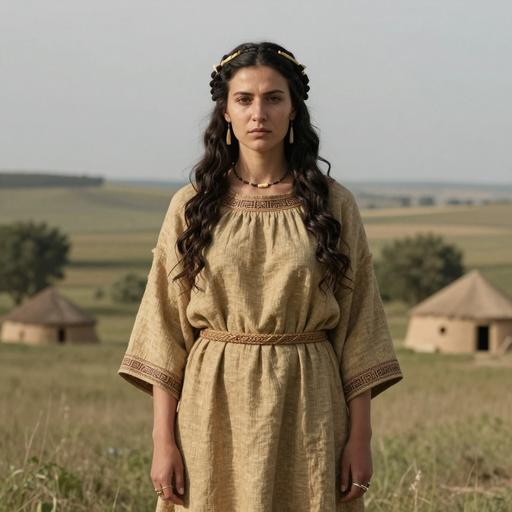
Portrait reconstruction of ILK003
Ancient Individual

A woman buried in Ukraine in the Bronze Age era

ILK003
2901 BCE - 2703 BCE
Female
Globular Amphora Culture, Ukraine
Ukraine
Scroll to begin
Chapter I

Identity

The biological and cultural markers that define this ancient individual

Sample ID

ILK003

Date Range

2901 BCE - 2703 BCE

Biological Sex

Female

mtDNA Haplogroup

J1c

Cultural Period

Globular Amphora Culture, Ukraine

Chapter II

Place

Where this individual was discovered

Country Ukraine
Locality Ilatka
Coordinates 49.5578, 27.6886
Chapter III

Time

When this individual lived in the broader context of human history

ILK003 2901 BCE - 2703 BCE
Chapter IV

Story

The narrative of this ancient life

The Globular Amphora Culture (GAC) is a fascinating prehistoric archaeological culture that emerged during the late Neolithic to early Bronze Age period, approximately between 3400 to 2800 BCE, mainly in central and eastern Europe, including parts of what is now Ukraine. The culture is named after its distinctive pottery, characterized by globular-shaped vessels with various decorative patterns.

Geographical Spread

The Globular Amphora Culture is primarily found in the regions that now comprise Poland, eastern Germany, and extends into Ukraine, particularly in its western territory. This distribution places the culture in an area of rich loess soil, which was ideal for the farming practices upon which these communities largely depended.

Cultural Characteristics

Pottery

The defining feature of the Globular Amphora Culture is its pottery. Vessels are round-bodied (globular) and often have prominent necks and simple rims. Decorations include incised patterns, cord impressions, and sometimes painted lines or motifs. These pots were likely used for both everyday domestic purposes and ceremonial functions.

Economy and Subsistence

The economy of the Globular Amphora Culture was predominantly based on agriculture and animal husbandry. They grew crops like wheat and barley and raised animals such as cattle, pigs, sheep, and goats. Cattle, in particular, played a significant role not only as a food resource but also in the culture's social rituals and possibly as a form of wealth.

Settlements

Settlements of this culture were typically small and dispersed, comprising only a few extended family units. While there is limited architectural evidence, it is presumed that these communities lived in simple wooden or wattle-and-daub structures. Their settlements were often strategically located near rivers and fertile lands to support their agrarian lifestyle.

Rituals and Burial Practices

Burial practices offer a window into the beliefs and social structures of the Globular Amphora Culture. They practiced inhumation, often burying the deceased in a crouched position. Notably, large stone-covered burial mounds, known as tumuli, have been discovered, suggesting a society with hierarchical elements or a focus on ancestor worship. Grave goods, including pottery and tools, have been found within these sites, indicating a belief in an afterlife where such objects would be useful.

There is also evidence of ritual feasting and perhaps animal sacrifices, as seen in burial sites where cattle skulls and bones have been arranged or deposited alongside human remains.

Interaction with Other Cultures

The Globular Amphora Culture was contemporaneous with several other Neolithic groups, including the Corded Ware and Funnelbeaker cultures. Interactions ranged from trade and cultural exchange to possible conflict. Artifacts such as stone tools, weapons, and pottery found in GAC sites often show influences or shared characteristics with neighboring cultures, implying a level of interaction and mobility among these ancient peoples.

Linguistic and Genetic Aspects

As part of the broader Indo-European spread, the Globular Amphora Culture is significant in the study of prehistoric population movements and language development. While direct linguistic evidence is unavailable, genetic studies on remains have provided insights into the migration patterns and interactions of these early Indo-European groups. The GAC appears to have played a role in the cultural and genetic exchanges that were occurring during this dynamic period in European prehistory.

Conclusion

The Globular Amphora Culture provides a critical piece of the puzzle in understanding the complex mosaic of Neolithic and early Bronze Age societies in Europe. Through their distinctive pottery, burial practices, and subsistence strategies, they offer valuable insights into the technological, social, and ritualistic life of early Indo-European communities. As archaeological methodologies advance, new discoveries promise to further unravel the mysteries of this intriguing culture.

Chapter V

Genetics

The genetic ancestry of this ancient individual

Ancient Genetic Admixture

This analysis compares the DNA profile of ILK003 with ancient reference populations, showing the genetic composition in terms of prehistoric ancestral groups.

Neolithic Farmers 46.2%
European Hunter-Gatherers 32.4%
Western Steppe Pastoralists 21.4%

Modern Genetic Admixture

This analysis compares the DNA profile with present-day reference populations, showing what percentage of genetic makeup resembles modern populations from different regions.

Europe 100.0%
Southern European 93.6%
Iberian 40.8%
Sardinian 24.4%
Italian 20.2%
Balkan 8.2%
Northwestern European 6.4%
Northwestern European 6.1%

Closest Modern Populations

These are the modern populations showing the closest statistical alignment to A woman buried in Ukraine in the Bronze Age era, ranked by genetic distance. Lower distance values indicate closer statistical similarity.

1
Spanish La Rioja
4.0228
2
Basque Soule
4.3350
3
Spanish Burgos
4.4079
4
Spanish Castilla La Mancha
4.4417
5
Spanish Navarra
4.4541
6
Spanish Pirineu
4.4555
7
Spanish Aragon
4.4800
8
Spanish Castello
4.5140
9
Spanish Cantabria
4.5245
10
Basque Navarre Center
4.5347
Chapter VI

Context

Other ancient individuals connected to this sample

Sources

References

Scientific publications and genetic data

Scientific Publication

The genomic history of southeastern Europe

Authors Mathieson I, Alpaslan-Roodenberg S, Posth C
Abstract

Farming was first introduced to Europe in the mid-seventh millennium bc, and was associated with migrants from Anatolia who settled in the southeast before spreading throughout Europe. Here, to understand the dynamics of this process, we analysed genome-wide ancient DNA data from 225 individuals who lived in southeastern Europe and surrounding regions between 12000 and 500 bc. We document a west-east cline of ancestry in indigenous hunter-gatherers and, in eastern Europe, the early stages in the formation of Bronze Age steppe ancestry. We show that the first farmers of northern and western Europe dispersed through southeastern Europe with limited hunter-gatherer admixture, but that some early groups in the southeast mixed extensively with hunter-gatherers without the sex-biased admixture that prevailed later in the north and west. We also show that southeastern Europe continued to be a nexus between east and west after the arrival of farmers, with intermittent genetic contact with steppe populations occurring up to 2,000 years earlier than the migrations from the steppe that ultimately replaced much of the population of northern Europe.

G25 Coordinates

The G25 coordinates for sample ILK003 can be used for detailed admixture analysis in our G25 Studio tool.

ILK003,0.12089148,0.15939132,0.03806074,-0.01934578,0.05681152,-0.01101696,-0.00150692,0.00662304,0.03503556,0.05740706,-0.0068183,0.0141332,-0.02490624,-0.0112522,7.444E-05,0.00293576,-0.00204058,-0.00127546,-0.00125746,-0.00256542,0.00359206,0.00592738,-0.01171956,-0.0165789,0.00399041
Analyze in G25 Studio
Use code for 40% off Expires Feb 27