Menu
Store
Blog
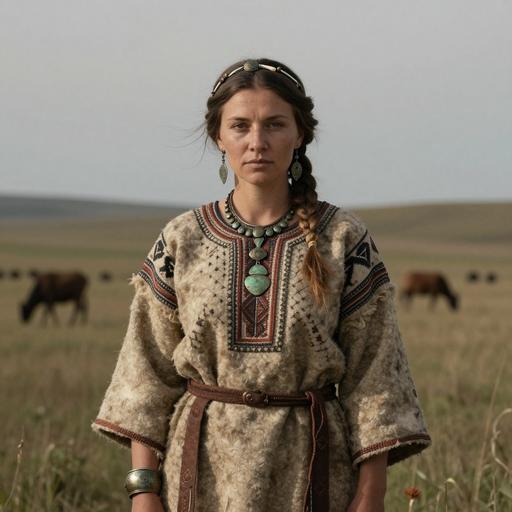
Portrait reconstruction of RISE505
Ancient Individual

A woman buried in Russia in the Bronze Age era

RISE505
1862 BCE - 1612 BCE
Female
Andronovo Culture, Russia
Russia
Scroll to begin
Chapter I

Identity

The biological and cultural markers that define this ancient individual

Sample ID

RISE505

Date Range

1862 BCE - 1612 BCE

Biological Sex

Female

mtDNA Haplogroup

U4a1b

Cultural Period

Andronovo Culture, Russia

Chapter II

Place

Where this individual was discovered

Country Russia
Locality Kytmanovo
Coordinates 53.4560, 85.4470
Chapter III

Time

When this individual lived in the broader context of human history

RISE505 1862 BCE - 1612 BCE
Chapter IV

Story

The narrative of this ancient life

The Andronovo culture, primarily recognized for its significant contribution to the development of Indo-European groups, was a complex of archaeological cultures that thrived in the steppes of Central Asia and the southern parts of Siberia from approximately 2000 to 900 BCE. It spans a geographical region that includes parts of modern-day Russia, Kazakhstan, Tajikistan, and Uzbekistan. This culture is often associated with the Indo-Iranian branch of the Indo-European language family, considered to be the forebears of later Iranian and Indian groups.

Geographical and Chronological Context

The Andronovo culture is named after the village of Andronovo in the Minusinsk Basin of Siberia, where the first significant archaeological evidence was uncovered in the early 20th century. The culture extended across the vast steppe regions, which provided rich pastures for the pastoral lifestyle that characterized the Andronovo way of life. Chronologically, it fits into the Bronze Age and showcases a high level of metallurgical development.

Settlement Patterns

Andronovo settlements were typically compact and fortified, often located near water sources such as rivers or lakes. They consisted mostly of semi-subterranean or rectangular surface houses built with timber and mud-brick. Settlement sizes varied, indicating a range of small hamlets to larger fortified communities. The presence of larger settlements suggests a degree of social organization and possibly hierarchical leadership structures.

Economy and Subsistence

The economy of the Andronovo culture was primarily based on agro-pastoralism. The Andronovo people were skilled in animal husbandry, primarily raising cattle, sheep, and horses. This is evidenced by the remains of corrals and abundance of animal bones found at habitation sites. Agricultural activities, though of secondary importance, included the cultivation of wheat, barley, and millet. The proficiency in metallurgy is also a notable feature, with evidence of bronze tools, weapons, and ornaments showcasing their advanced skills in metalwork.

Burial Practices

Burial practices are a prominent aspect of Andronovo archaeology, providing rich insights into their social structures and beliefs. The dead were typically buried in kurgans, which are mound-like structures, with the bodies placed in stone cists or simple pit graves. These burials often include grave goods, such as pottery, weapons, and ornaments, indicating the belief in an afterlife and the importance of social status. Occasional evidence of chariot burials suggests the significance of horse-driven vehicles, which may have played a part in warfare and ritual.

Cultural and Artistic Aspects

The Andronovo culture is distinguished by its pottery, which is typically hand-made and decorated with geometric patterns and cord impressions. These patterns reflect a shared aesthetic and perhaps symbolic language across the Andronovo tribes. Artistic expressions can also be seen in metallurgy, particularly in the crafting of intricately designed bronze ornaments and tools.

Linguistic and Ethnic Identity

The Andronovo culture is often linked with the early Indo-Iranian languages based on linguistic, genetic, and archaeological evidence. This connection is crucial for understanding the migrations and expansions of Indo-Iranian groups across the Eurasian steppes. Despite the vast territory they occupied, the linguistic unity is suggested by the spread of Indo-Iranian languages and shared features in material culture.

Interaction and Influence

The Andronovo culture interacted with neighboring cultures, such as the Bactria-Margiana Archaeological Complex (BMAC) to the south, exchanging goods and cultural influences. These interactions may have facilitated the spread of Indo-Iranian languages and contributed to the cultural syncretism observed in subsequent regional cultures.

Decline and Legacy

By the end of the 2nd millennium BCE, the Andronovo culture began to fragment, giving way to successor cultures such as the Srubna and Karasuk cultures. The cultural and technological innovations of the Andronovo people, particularly in metallurgy and pastoralism, left a lasting legacy in the Eurasian steppes. They are considered a crucial part of the prehistory of Central Asia and play a significant role in understanding the Indo-European expansions.

In modern historical and archaeological discourse, the Andronovo culture is pivotal for comprehending the complex web of cultural, linguistic, and genetic exchanges among ancient Eurasian populations. It serves as a foundational framework for the ongoing study of the prehistoric Indo-European communities that shaped the historical trajectories of Europe, Asia, and beyond.

Chapter V

Genetics

The genetic ancestry of this ancient individual

Ancient Genetic Admixture

This analysis compares the DNA profile of RISE505 with ancient reference populations, showing the genetic composition in terms of prehistoric ancestral groups.

Western Steppe Pastoralists 54.8%
European Hunter-Gatherers 27.7%
Neolithic Farmers 9.2%
Ancient Asians 8.4%

Modern Genetic Admixture

This analysis compares the DNA profile with present-day reference populations, showing what percentage of genetic makeup resembles modern populations from different regions.

Europe 74.5%
Eastern European 40.8%
Northwestern European 33.7%
English 27.2%
Finnish 6.5%
Asia 23.8%
Northern West Asian 22.2%
Caucasian 22.2%
Central Asian, Northern Indian & Pakistani 1.6%
Indian 1.1%
America 1.0%
America 1.0%
Native American 1.0%
Africa 0.7%
Northern East African 0.7%
Eastern African 0.7%

Closest Modern Populations

These are the modern populations showing the closest statistical alignment to A woman buried in Russia in the Bronze Age era, ranked by genetic distance. Lower distance values indicate closer statistical similarity.

1
Moksha
4.0458
2
Mordovian
4.2488
3
Erzya
4.3172
4
Russian Kostroma
4.6703
5
Russian Krasnoborsky
5.0317
6
Russian Ryazan
5.2004
7
Moldovan O
5.4365
8
Finnish Southwest
5.4512
9
Tatar Mishar
5.5435
10
Finnish Central
5.5567
Chapter VI

Context

Other ancient individuals connected to this sample

Sources

References

Scientific publications and genetic data

Scientific Publication

Population genomics of Bronze Age Eurasia

Authors Allentoft ME, Sikora M, Sjögren KG
Abstract

The Bronze Age of Eurasia (around 3000-1000 BC) was a period of major cultural changes. However, there is debate about whether these changes resulted from the circulation of ideas or from human migrations, potentially also facilitating the spread of languages and certain phenotypic traits. We investigated this by using new, improved methods to sequence low-coverage genomes from 101 ancient humans from across Eurasia. We show that the Bronze Age was a highly dynamic period involving large-scale population migrations and replacements, responsible for shaping major parts of present-day demographic structure in both Europe and Asia. Our findings are consistent with the hypothesized spread of Indo-European languages during the Early Bronze Age. We also demonstrate that light skin pigmentation in Europeans was already present at high frequency in the Bronze Age, but not lactose tolerance, indicating a more recent onset of positive selection on lactose tolerance than previously thought.

G25 Coordinates

The G25 coordinates for sample RISE505 can be used for detailed admixture analysis in our G25 Studio tool.

RISE505,0.1248012,0.08457608,0.04943092,0.0587951,0.0116305,0.01692474,0.01166252,0.01126904,-0.00820454,-0.02203342,-0.00365764,-0.00461714,0.00524808,0.00217534,-0.00073148,-0.00828236,-0.01047352,0.00146286,-0.00493704,-0.00146414,-0.0046815,0.00352206,-0.00087438,0.0056945,-0.00436191
Analyze in G25 Studio
Use code for 40% off Expires Feb 26