Menu
Currency
Main
Store
Blog

Loading Report

Preparing your ancestry journey

Connecting to ancient matches...

Preparing your report

Skip to main content
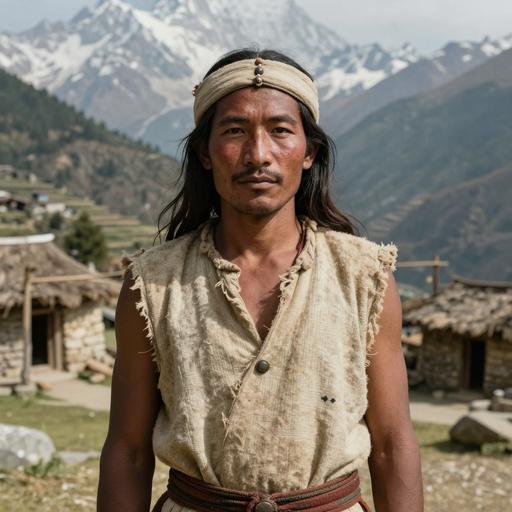
Portrait reconstruction of A man buried in Nepal in the Late Iron Age era
Ancient Individual

A man buried in Nepal in the Late Iron Age era

A man buried in Nepal during the Late Iron Age Nepal

A fragment of the ancient world, preserved across millennia in strands of DNA.

KM4
800 BCE - 1 BCE
Male
Nepal
Scroll to begin
Chapter I

Identity

The biological and cultural markers that define this ancient individual

Sample ID

KM4

Date Range

800 BCE - 1 BCE

Cultural Period

Late Iron Age Nepal

Biological Sex

Male

mtDNA Haplogroup

F1c1a1a

Y-DNA Haplogroup

O2a2b1a1a6

Chapter II

Place

Where this individual was discovered

Country Nepal
Locality Manang. Kyang
Coordinates 28.7300, 84.2700
Chapter III

Time

When this individual lived in the broader context of human history

KM4 800 BCE - 1 BCE
Chapter IV

Story

The narrative of this ancient life

The Late Iron Age in Nepal, particularly in the region of Manang and the village of Kyang, represents a fascinating intersection of indigenous Himalayan culture and Tibetan Buddhist influence. This era, spanning roughly from 500 BCE to the early centuries CE, is marked by significant developments in social organization, metallurgy, trade, and spiritual practices.

Geographical Context

Manang is situated in the remote high-altitude region of north-central Nepal, making it naturally fortified and isolated. This geographical setting fostered a unique cultural evolution, where communities were sustained by agriculture, pastoralism, and long-distance trade routes linking India to Tibet.

Social and Political Structure

During the Late Iron Age, the society in the Manang region was primarily agrarian, with a social hierarchy that likely included chieftains or local leaders overseeing various clans. The society was organized around kinship ties, with landholding families forming the basic social units. The emergence of fortified settlements indicates a need for defense and centralized control, possibly in response to external threats or to assert dominance over key trade routes.

Metallurgy and Material Culture

Iron tools and weapons began to replace bronze, indicating advancements in metallurgy. The production of iron implements like plows, sickles, and weapons allowed for more efficient agriculture and improved defense capabilities. Artifacts such as pottery, textiles, and metalwork reveal a sophisticated material culture. Decorative motifs often featured local flora and fauna, reflecting a close relationship with the natural environment.

Trade and Economic Activity

Manang’s strategic position on trans-Himalayan trade routes facilitated economic exchanges with Tibet and the Indian subcontinent. This period saw the movement of goods such as salt, wool, grains, and metal artifacts. Trade not only enriched the local economy but also introduced new cultural and religious ideas, particularly from Tibetan traders and pilgrims.

Religious and Spiritual Life

The Late Iron Age in Manang is significant for the assimilation and adaptation of Tibetan Buddhism, which coexisted with indigenous shamanistic and animistic practices. Local deities and nature spirits were worshiped alongside Buddhist rituals, reflecting a syncretic spiritual landscape. The introduction of Buddhist iconography and monastic traditions began to take root, influencing local art and architecture.

Art and Architecture

The artistic expressions from this period exhibit a blend of indigenous styles and Tibetan Buddhist influences. Early stupas, shrines, and rock carvings provide evidence of the growing Buddhist presence. Murals and sculptures often depicted Buddhist deities, bodhisattvas, and symbolic motifs such as the lotus and the wheel of dharma.

Cultural Legacy

The cultural synthesis in Late Iron Age Manang left a lasting legacy on Nepalese art, religion, and social structure. The integration of Tibetan Buddhist practices enriched the spiritual fabric of the region, laying the groundwork for the flourishing of Buddhism in subsequent centuries. The adaptive strategies developed during this period, in response to the demanding Himalayan environment, continue to influence the lifestyle and resilience of communities in Manang today.

Conclusion

In summary, the Late Iron Age in the Manang region of Nepal was a dynamic era characterized by technological advancements, vibrant trade, and the gradual integration of Tibetan Buddhist traditions. This period laid the foundational cultural and social structures that have persisted and evolved into the present, highlighting the enduring nature of this remote Himalayan civilization.

Context

Related Samples

This individual exists within a broader network of ancient samples. No ancient genome stands alone.

Sample ID Culture/Period Date Location Action
C2 Iron Age Nepal 850 BCE Mustang. Chokhopani, Nepal View
C3 Iron Age Nepal 850 BCE Mustang. Chokhopani, Nepal View
CNE1 Iron Age Nepal 850 BCE Mustang. Chokhopani, Nepal View
KM4 Late Iron Age Nepal 800 BCE Manang. Kyang, Nepal View
KS20_KS25 Late Iron Age Nepal 800 BCE Manang. Kyang, Nepal View
KS21_KS23_KS4 Late Iron Age Nepal 800 BCE Manang. Kyang, Nepal View
KS26 Late Iron Age Nepal 800 BCE Manang. Kyang, Nepal View
KS5 Late Iron Age Nepal 800 BCE Manang. Kyang, Nepal View
KS8 Late Iron Age Nepal 800 BCE Manang. Kyang, Nepal View
KS9 Late Iron Age Nepal 800 BCE Manang. Kyang, Nepal View
L1 Early Iron Age Nepal 1300 BCE Mustang. Lubrak, Nepal View
L2 Early Iron Age Nepal 1300 BCE Mustang. Lubrak, Nepal View
M2113 Late Iron Age to Early Middle Kingdoms Mebrak, Mustang, Nepal 800 BCE Mustang. Mebrak, Nepal View
M241 Late Iron Age to Early Middle Kingdoms Mebrak, Mustang, Nepal 800 BCE Mustang. Mebrak, Nepal View
M295 Late Iron Age to Early Middle Kingdoms Mebrak, Mustang, Nepal 800 BCE Mustang. Mebrak, Nepal View
M354 Late Iron Age to Early Middle Kingdoms Mebrak, Mustang, Nepal 800 BCE Mustang. Mebrak, Nepal View
M368 Late Iron Age to Early Middle Kingdoms Mebrak, Mustang, Nepal 800 BCE Mustang. Mebrak, Nepal View
M4580 Late Iron Age to Early Middle Kingdoms Mebrak, Mustang, Nepal 800 BCE Mustang. Mebrak, Nepal View
M4681 Late Iron Age to Early Middle Kingdoms Mebrak, Mustang, Nepal 800 BCE Mustang. Mebrak, Nepal View
M63_M339_M359 Late Iron Age to Early Middle Kingdoms Mebrak, Mustang, Nepal 800 BCE Mustang. Mebrak, Nepal View
M3490 Late Iron Age to Early Middle Kingdoms Mebrak, Mustang, Nepal 800 BCE Mustang. Mebrak, Nepal View
R2_R7 Iron Age Mustang, Nepal 850 BCE Mustang. Rhirhi, Nepal View
S10_S13 Mustang Samdzong Middle Kingdoms 350 CE Mustang. Samdzong, Nepal View
S143_S173 Mustang Samdzong Middle Kingdoms 350 CE Mustang. Samdzong, Nepal View
S153_S183 Mustang Samdzong Middle Kingdoms 350 CE Mustang. Samdzong, Nepal View
S18_S20_S21_S22 Mustang Samdzong Middle Kingdoms 350 CE Mustang. Samdzong, Nepal View
S29_S30 Mustang Samdzong Middle Kingdoms 350 CE Mustang. Samdzong, Nepal View
S36 Mustang Samdzong Middle Kingdoms 350 CE Mustang. Samdzong, Nepal View
S8 Mustang Samdzong Middle Kingdoms 350 CE Mustang. Samdzong, Nepal View
U1 Late Chalcolithic Nepal 1550 BCE Mustang. Suila, Nepal View
U2 Late Chalcolithic Nepal 1550 BCE Mustang. Suila, Nepal View
S16 Mustang Samdzong Middle Kingdoms 350 CE Mustang. Samdzong, Nepal View
S163 Mustang Samdzong Middle Kingdoms 350 CE Mustang. Samdzong, Nepal View
Sample ID Culture/Period Date Location Action
KM4 Late Iron Age Nepal 800 BCE Manang. Kyang, Nepal View
KS20_KS25 Late Iron Age Nepal 800 BCE Manang. Kyang, Nepal View
KS21_KS23_KS4 Late Iron Age Nepal 800 BCE Manang. Kyang, Nepal View
KS26 Late Iron Age Nepal 800 BCE Manang. Kyang, Nepal View
KS5 Late Iron Age Nepal 800 BCE Manang. Kyang, Nepal View
KS8 Late Iron Age Nepal 800 BCE Manang. Kyang, Nepal View
KS9 Late Iron Age Nepal 800 BCE Manang. Kyang, Nepal View
Sources

References

Scientific publications and genetic data that inform this profile.

Scientific Publication

Ancient genomes from the Himalayas illuminate the genetic history of Tibetans and their Tibeto-Burman speaking neighbors

Authors Liu CC, Witonsky D, Gosling A, Lee JH, Ringbauer H et al.
Abstract

Present-day Tibetans have adapted both genetically and culturally to the high altitude environment of the Tibetan Plateau, but fundamental questions about their origins remain unanswered. Recent archaeological and genetic research suggests the presence of an early population on the Plateau within the past 40 thousand years, followed by the arrival of subsequent groups within the past 10 thousand years. Here, we obtain new genome-wide data for 33 ancient individuals from high elevation sites on the southern fringe of the Tibetan Plateau in Nepal, who we show are most closely related to present-day Tibetans. They derive most of their ancestry from groups related to Late Neolithic populations at the northeastern edge of the Tibetan Plateau but also harbor a minor genetic component from a distinct and deep Paleolithic Eurasian ancestry. In contrast to their Tibetan neighbors, present-day non-Tibetan Tibeto-Burman speakers living at mid-elevations along the southern and eastern margins of the Plateau form a genetic cline that reflects a distinct genetic history. Finally, a comparison between ancient and present-day highlanders confirms ongoing positive selection of high altitude adaptive alleles.

Use code for 25% off Expires Jul 12