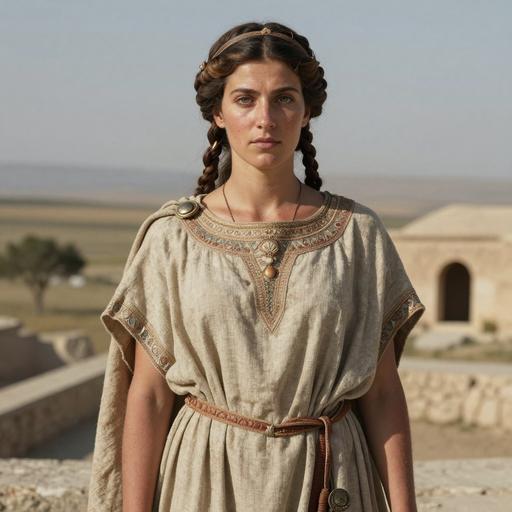
Nevalı Çori during the Roman period would be an intriguing amalgamation of various cultural influences, although historical accuracy would necessitate some careful considerations. Nevalı Çori itself is a prehistoric archaeological site located in modern-day Turkey, primarily occupied during the Pre-Pottery Neolithic era. It was abandoned long before the Roman Empire arose. Nonetheless, in a hypothetical scenario where Nevalı Çori persisted into the Roman period, we can imagine what such a cultural fusion might look like.
Geographic Context
Located in the southeastern part of what is now Turkey, Nevalı Çori would be situated in the Roman province of Asia Minor. During the Roman Empire, this area was a rich tapestry of cultures due to its position at the crossroads between Europe and the Middle East. It would have access to major Roman roads, facilitating trade and cultural exchanges across the empire.
Cultural and Social Dynamics
Roman Influence:
Architecture: Roman architectural techniques such as the use of concrete, arches, and vaulted ceilings would likely be evident in public buildings, such as forums, baths, and possibly an amphitheater for gladiatorial games. However, given Nevalı Çori's original architectural significance, some blending with Neolithic designs might persist in domestic architecture.
Religion: The dominant religion would be Greco-Roman polytheism before gradually transitioning to Christianity, particularly after the Edict of Milan in 313 AD. Temples and altars dedicated to Roman gods might coexist with localized deities from Anatolian traditions.
Language: Latin and Greek would be the administrative and literary languages, although locals likely spoke various Anatolian dialects. Bilingualism or multilingualism would be common, given the necessity for trade and governance.
Economy: The economy would be integrated into the Roman trade networks. Nevalı Çori might have specialized in unique local crafts or products, contributing to the wider Roman economy. Common goods would include Roman pottery, olive oil, wine, and textiles.
Local and Prehistoric Influences:
Cultural Resilience: Elements of prehistoric culture, especially those relating to agriculture and social structure, might persist. Rituals and social customs from the Neolithic period could blend with Roman practices, creating unique cultural expressions.
Art: Neolithic artistic traditions, particularly in sculptural motifs, might influence Roman style frescoes or mosaics with abstract and symbolic imagery. The artistic expression might reflect a blend of Roman realism with abstract motifs from the prehistoric past.
Social Structure: While the Roman system of patricians and plebeians would be dominant, local clan structures and tribal affiliations might continue to play a role in social organization. This could lead to a complex hierarchy, combining Roman and local governing methods.
Daily Life
Clothing: Roman styles such as tunics and togas would be prevalent among the populace, but with possible adaptations using local textiles and dyes. There might be a synthesis of Roman and indigenous clothing styles, especially among the rural populace.
Cuisine: The diet would incorporate staples of Roman cuisine such as bread, olive oil, and wine, enriched with local ingredients like regional spices, grains, and fruits. Communal feasting, a staple of Roman social life, might be combined with Neolithic traditions of communal gatherings.
Festivals and Entertainment: Roman festivals like Saturnalia and Lupercalia might be celebrated, potentially merging with local rites and seasonal festivals. Roman theatrical performances and gladiatorial games could exist alongside local storytelling traditions and music.
Conclusion
Envisioning Nevalı Çori during the Roman period is a fascinating exercise in cultural syncretism. While it requires imaginative leaps due to the chronological incongruities, such a scenario underscores how Roman expansionism often resulted in the coexistence and blending of diverse cultural traditions. This hypothetical Nevalı Çori would exemplify the intricate tapestry of Roman imperial society, weaving together threads of ancient prehistoric heritage with the grandeur of Roman civilization.