Introduction
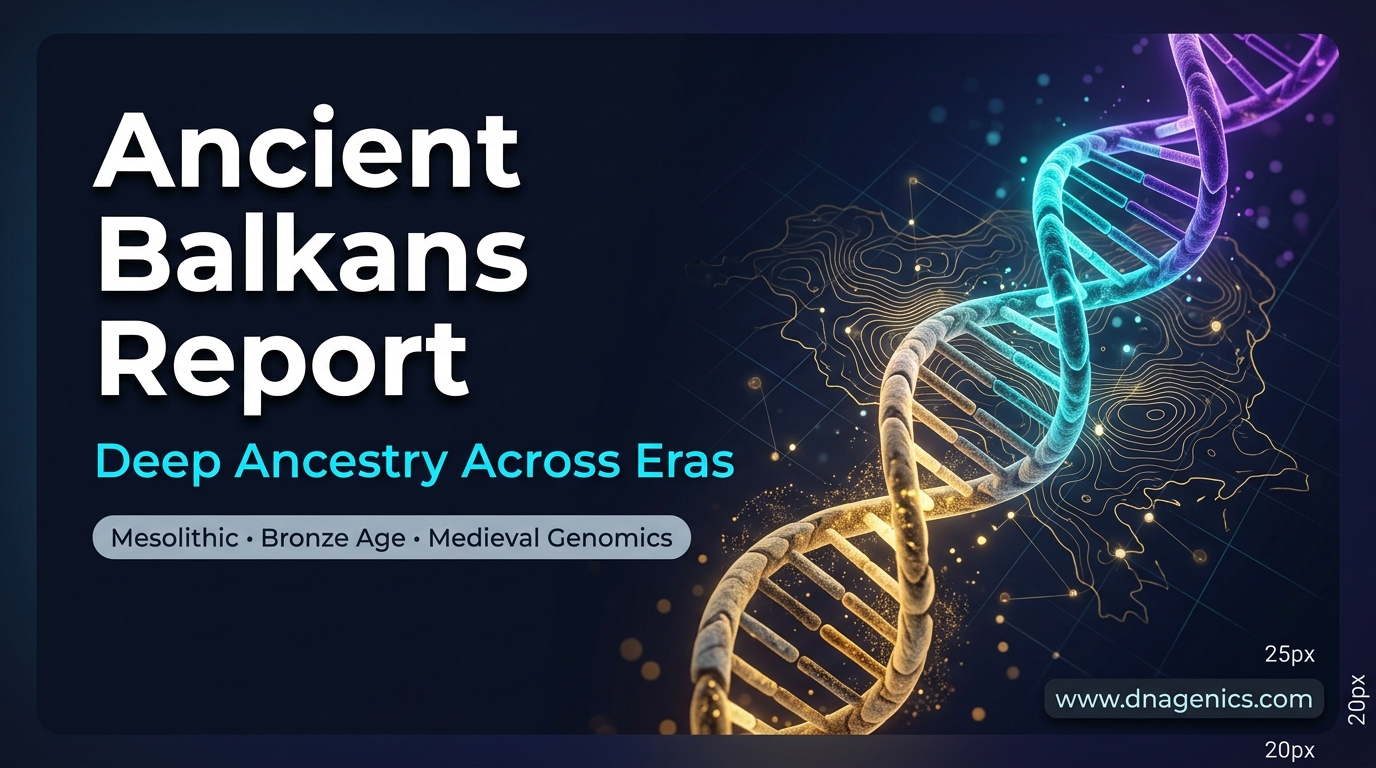
The Balkans have long been one of Europe’s most complex and important crossroads. Populations in this region interacted with communities from Central Europe, the Near East, and the Mediterranean over thousands of years, leaving a rich genetic record that can still be studied today. For people with Southeast European roots, or anyone curious about deep ancestry, the Ancient Balkans report offers a structured way to explore those connections.
This report is designed for users who have uploaded raw DNA and want to compare it with ancient individuals from the Balkans across multiple historical periods. Rather than relying on a single statistic, it combines several kinds of evidence into one composite score, helping users understand not just where their strongest similarities appear, but also what kind of evidence supports them. Produced by DNAGENICS, the report is built for both beginners and experienced genealogy enthusiasts who want a clearer view of ancient genetic continuity and population movement.
Key Takeaways
- The Ancient Balkans report compares your DNA to ancient individuals from the Balkans across a very broad time span, from Mesolithic hunter-gatherers through the medieval era.
- The main result is a composite Balkans Index, which combines shared DNA segment matching, admixture distance, and a best-fit population model.
- Each ancient individual is labeled by evidence type, including Shares DNA, Shared lineage branch, Best-fit model, or Reference sample, so you can distinguish direct matching from statistical similarity.
- The report includes a reference-fixed PCA chart, closest ancient matches, a period-by-period breakdown, haplogroup matching, and an interactive map.
- This report is especially useful for people with Balkan, Greek, Romanian, Bulgarian, or broader Southeast European heritage, as well as deep-ancestry researchers comparing regional signals.
Understanding the Ancient Balkans Report
The Ancient Balkans report is an ancestry report focused on deep-time genetic similarity to ancient people from a historically important region of Europe. It covers a long sequence of cultural periods, including the Mesolithic, Neolithic, Bronze Age, Iron Age, Classical, and medieval eras. This makes it useful for users who want to see how their DNA relates to ancient populations across several major transitions in human history.
The report does not claim to identify a specific ancestor or prove a modern national identity. Instead, it looks for patterns of genetic connections and similarity to ancient individuals from the Balkans. Because the region sat at a crossroads of migration and interaction, it often shows blended signals that can be informative for people whose family lines come from nearby areas or whose broader deep ancestry includes Southeast Europe.
A key strength of the report is that it does not depend on one method alone. Instead, it combines three complementary forms of analysis into a single composite score. That approach is intended to make the result more stable and informative than any one calculation on its own.
How the Composite Balkans Index Works
The central result in the report is the Balkans Index, a composite score built from three methods. First, it considers shared DNA segment matching, which looks for segments of DNA that overlap with those found in ancient individuals. This is one of the strongest forms of evidence because it reflects actual shared genetic material, although it still does not identify a specific ancestor.
Second, the report uses admixture distance. In simple terms, this measures how closely your DNA profile resembles the mixture of genetic components seen in ancient reference individuals. This is a similarity-based method, so it helps identify broad patterns even when direct segment sharing is limited.
Third, the report includes a statistical best-fit population model. This model asks which combination of ancient reference individuals from the region best explains your DNA. The result is a population-level fit, not a claim of direct descent from any named person.
These three methods are combined to produce the final composite result. The report also includes a reference-fixed PCA chart, which shows where your sample sits among the reference individuals. PCA, or principal component analysis, is a visual way to display genetic similarity patterns. In this context, it helps you see how your DNA relates to ancient Balkan samples in a broader landscape, rather than in isolated pairwise comparisons.
What You See in the Report
One of the most useful features of the Ancient Balkans report is its layered presentation of evidence. You are shown your closest genetic connections among ancient individuals from the region, and these are displayed with portraits, locations, and estimated dates. This makes the results easier to interpret because you can connect the genetics to time and place.
The report also provides a breakdown of your genetic affinity by cultural period. That means you can see whether your strongest signal appears in the Mesolithic, Neolithic, Bronze Age, Iron Age, Classical, or medieval sections. A “journey through the ages” view then traces how those connections change over time, which can reveal whether your results lean more strongly toward one historical era than another.
Another important feature is the shared-DNA-segment analysis. This section explains what is driving your score, especially where segment matching plays a role. Because not every high-scoring period will contain many individuals who share DNA segments with you, this analysis helps clarify the difference between direct evidence and statistical similarity.
You also get a shareable Heritage Summary, which is useful if you want a concise way to present your results to family members or other researchers. Finally, the report includes a plain-language guide that explains how to interpret the findings without requiring advanced genetics knowledge.
Evidence Labels and Period Scoring
The report is careful to separate different kinds of evidence, which is important for accurate interpretation. Every ancient individual is tagged by the kind of link it has to your results. If an individual is marked Shares DNA, that means there are shared DNA segments. If the label is Shared lineage branch, the match is based on the same or a closely related maternal or paternal haplogroup branch. If the person appears as part of the Best-fit model, that means they contribute to the statistical population mix that best fits your DNA, but this is similarity only, not shared DNA. A Reference sample is included for context and does not imply a match.
This distinction matters because period scores and individual evidence are related, but not identical. A period can score highly even if only a few individuals within it share DNA segments with you. That is because period scores come from the ancient reference individuals included in your best-fitting admixture model, and each one can contribute points to the overall score. In other words, the score reflects the combined statistical fit for that time period, while the individual labels show which specific type of evidence is present.
The report’s “Show” filter also helps users focus on one type of evidence at a time. If you want to examine only shared DNA, only lineage branches, or only reference samples, you can narrow the view. That makes it easier to move from broad patterns to specific evidence without mixing the categories together.
Why the Balkans Are Especially Informative
The Balkans are especially valuable in deep-ancestry analysis because they sit at a geographic and historical intersection. Over many millennia, the region connected communities from Central Europe, the Near East, and the Mediterranean. That means ancient Balkan samples often contain signals that reflect movement, interaction, and long-term mixture across neighboring regions.
For users, that can make the report both interesting and complex. A signal in the Ancient Balkans report does not necessarily mean recent family history from the Balkans, and it does not confirm a particular ethnic or national identity. Instead, it suggests that your DNA shares some similarity with ancient populations from this region, which may reflect population history far older than written genealogy.
This is also why the report pairs naturally with other ancient regional reports and haplogroup reports. When viewed together, these tools can offer a fuller picture of your deep ancestry. A Balkan signal may align with related patterns in nearby ancient regions, or it may stand out as a distinct signal worth investigating further.
Who the Report Is For
The Ancient Balkans report is especially relevant for people with known or suspected Balkan, Greek, Romanian, Bulgarian, or broader Southeast European heritage. It is also useful for users whose family history is incomplete, unclear, or geographically mixed. Because the report spans so many historical periods, it can help place modern DNA in a deeper regional context.
Deep-ancestry hobbyists may also find it valuable as a comparison tool. If you are already exploring multiple ancient European reports, the Balkans report can help you compare the strength and nature of your regional signals. Because it uses the same rigorous composite scoring standard as other regional ancient reports on the platform, it is designed for consistent cross-report interpretation.
The report supports raw DNA files from 23andMe, AncestryDNA, MyHeritage, FamilyTreeDNA, Living DNA, and Nebula Genomics. Once your data is uploaded and processed, the report is typically ready within minutes. It also includes lifetime access and does not require a subscription, which makes it a convenient one-time purchase for users who want long-term access to their results.
Practical Implications
If you are planning to use the Ancient Balkans report, the most important thing is to interpret it as a similarity-based deep ancestry tool, not as proof of a specific lineage or identity. Look first at the composite Balkans Index, then at the individual evidence labels, and finally at the period-by-period breakdown. That sequence will help you separate direct shared DNA evidence from broader statistical matching.
It can also be helpful to compare this report with other ancient regional reports and your haplogroup results. If the same regions or time periods appear across multiple tools, that may strengthen your understanding of your broader ancestral pattern. If different reports point in different directions, that can also be informative, because it may reflect the mixed and layered history of Eurasian populations over time.
Conclusion
The Ancient Balkans report offers a detailed, balanced way to explore deep genetic similarity to ancient populations from one of Europe’s most historically important regions. By combining shared DNA segments, admixture distance, and a best-fit population model, it gives users a more nuanced picture than a single metric could provide. For anyone interested in Southeast European deep ancestry, it is a practical and informative way to see how their DNA connects to the ancient Balkans across time.
References / Further Reading
- DNAGENICS Ancient Balkans report, product information provided in the source content
- General methods referenced in the report: PCA, admixture analysis, shared DNA segment matching, and haplogroup analysis