Introduction
For a long time, the battle of Himera in 480 BC was told as a straightforward Greek victory over Carthage in Sicily. Ancient writers focused on the leaders, the city, and the politics of the moment. But when researchers studied the soldiers themselves, a more complex story emerged, one that changes how we think about ancient DNA, warfare, and identity in the classical Mediterranean.
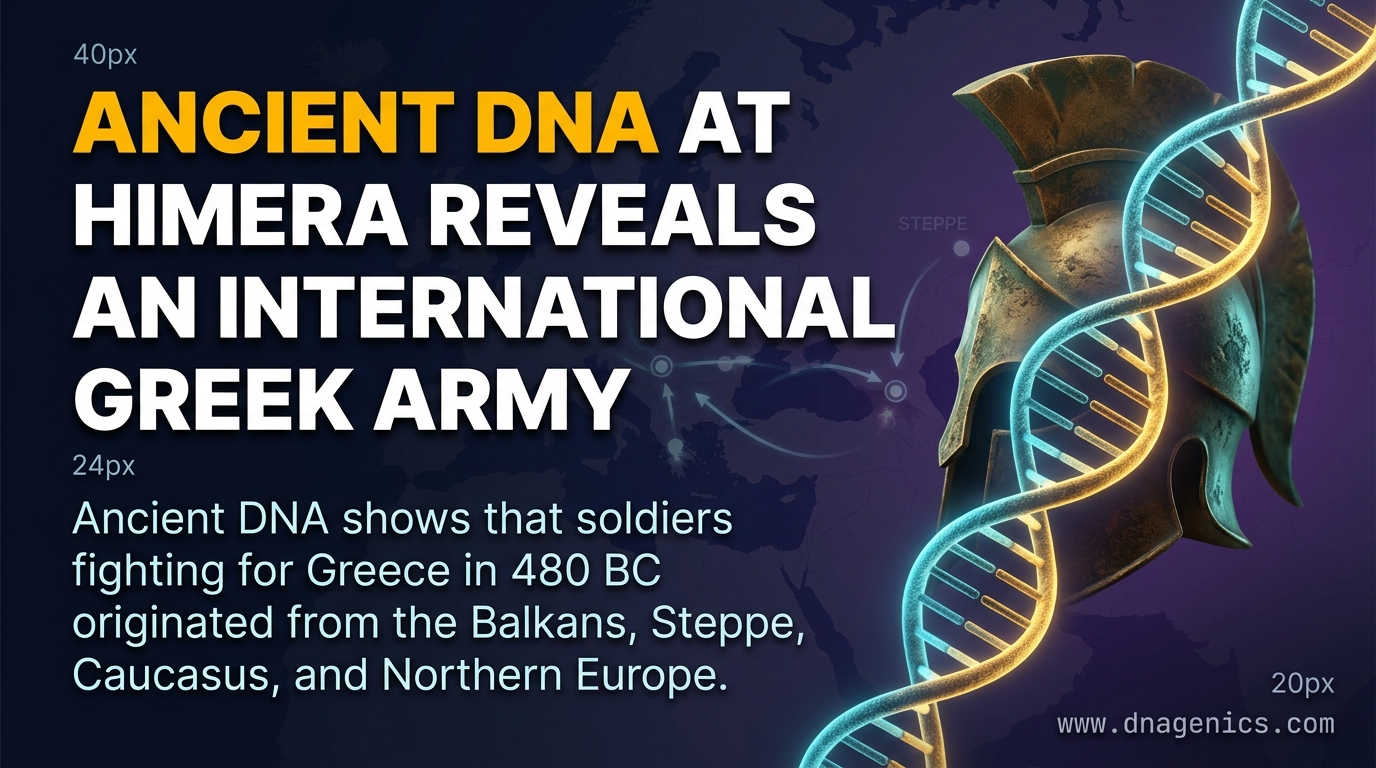
The genomes and tooth chemistry from the Himera mass graves show that many of the men who fought on the Greek side were not local Sicilians or mainland Greeks. Instead, they had ancestry linking them to the Balkans, northeastern Europe, the Eurasian steppe, and the Caucasus. That matters because it gives us a rare biological window into migration, military recruitment, and the movement of people across the ancient world.
Key Discoveries / Main Points
- Ancient DNA from soldiers buried at Himera shows that more than half of the men sampled from the 480 BC battle were not local Greeks by ancestry.
- The foreign-born soldiers came from several different regions, including the northern Balkans, northeastern Europe, the steppe, and the Caucasus.
- Isotope analysis of teeth matched the genomic evidence, showing that these men grew up far from Sicily, while most of the 409 BC soldiers were local.
- The 480 BC dead were buried in separate mass graves, and the genetic outsiders were younger on average, which fits the idea of mercenaries.
- The 409 BC battle tells a different story, with the sampled soldiers appearing genetically Aegean and locally raised, suggesting a more community-based defense force.
What This Means for Your DNA
If you are interested in your own ancestry, the Himera study is a good reminder that DNA does not map neatly onto ancient labels like “Greek,” “Sicilian,” or “Carthaginian.” People in the ancient Mediterranean moved, married, served in armies, and settled far from their birthplace. A person could be culturally Greek, serve a Greek ruler, and still carry ancestry from a very different part of Eurasia.
For modern DNA testing, the big lesson is statistical, not personal. When scientists compare a genome to ancient reference populations, they are identifying genetic similarity to groups from the past, not proving identity in a modern sense. In ancestry analysis, that means your results may reflect long histories of movement and mixing rather than a single origin point. The Himera soldiers show how varied those histories could be, even within one army and one cemetery.
This also helps explain why some people see unexpected regions in their ancestry reports. Ancient populations were not isolated, and soldiers, traders, and migrants carried DNA across huge distances. A modern ancestry profile may contain traces of these older population layers, especially across the Mediterranean, the Balkans, and West Eurasia.
Historical and Archaeological Context
Himera was founded on the north coast of Sicily around 648 BC, in a zone where Greek settlers, indigenous Sicani, and Phoenician-Carthaginian interests all met. That location made the city strategically important and politically vulnerable. By 480 BC, it had become the site of a major conflict between Greek rulers in Sicily and Carthage, with Greek forces led by Gelon of Syracuse and Theron of Akragas defeating the Carthaginian army under Hamilcar.
The archaeological context is unusually rich. Excavations in the West Necropolis uncovered more than 10,000 graves, including mass burials linked to both the 480 BC and 409 BC battles. This gives historians and geneticists a rare opportunity to compare two military episodes separated by about 70 years. The earlier battle appears to have involved a much more diverse force, while the later one seems to have been fought largely by local men.
That contrast fits broader historical patterns. Greek cities in Sicily often relied on alliances, hired troops, and shifting political coalitions. Ancient texts mention mercenaries in passing, but the Himera graves make those references concrete. They also highlight how much of ancient military history has been written from the perspective of elites, not ordinary soldiers.
The Science Behind It
Researchers combined several lines of evidence: skeletal analysis, strontium and oxygen isotopes from teeth, and genome-wide ancient DNA. Tooth enamel forms in childhood and retains chemical signatures from local water and geology, so it can indicate where a person grew up. Ancient genomes then provide a deeper look at population affinity by comparing each individual to Bronze Age and Iron Age reference groups.
In the Himera study, the results lined up strongly. The soldiers from 480 BC separated into two broad genetic clusters. One group matched Aegean-related populations, while the other matched populations from other parts of Eurasia. The non-Aegean men also carried Y-chromosome lineages associated with the Balkans, northern Europe, the steppe, and the Caucasus, which reinforced the broader ancestry signal.
In Simple Terms: Scientists tested the soldiers’ teeth and DNA to find out where they grew up and what ancient populations they were most genetically similar to. The results showed that many men in the Greek army came from far outside Sicily.
A useful way to understand this is to think of ancient DNA as a comparison tool. It does not say, “this man was exactly from modern Serbia” or “this man was Greek in the modern sense.” Instead, it says his genome is statistically closer to certain ancient reference groups than to others. That is why population genetics is so powerful, but also why it must be interpreted carefully.
The burial pattern matters too. The foreign-ancestry soldiers were concentrated in specific mass graves and tended to be younger, while the Aegean-related soldiers were older and, in some cases, buried with more care. This kind of spatial and biological clustering is important because it supports the historical interpretation of a mixed military force rather than a random assortment of unrelated individuals.
Why It Matters
The Himera study is important because it shows how ancient DNA can revise a familiar historical narrative without overturning the basic event itself. The battle still happened, and Greek forces still won. But the human makeup of that army was more international than ancient literary sources suggested. That is a major insight for historians, archaeologists, and anyone studying population genetics in the Mediterranean.
It also points to the future of archaeological science. As more mass graves, cemeteries, and battlefield sites are studied, researchers will be able to reconstruct migration and military recruitment with much greater precision. For ancestry research, this means the past will increasingly look less like isolated ethnic blocks and more like a network of mobile, mixed populations moving across large regions.
References / Further Reading
- Ancient DNA and isotopic analyses from the Himera battlefield graves, 2021 to 2022 findings
- Excavations of the West Necropolis of Himera
- Classical historical accounts by Herodotus and Diodorus, as summarized in the study context