Introduction
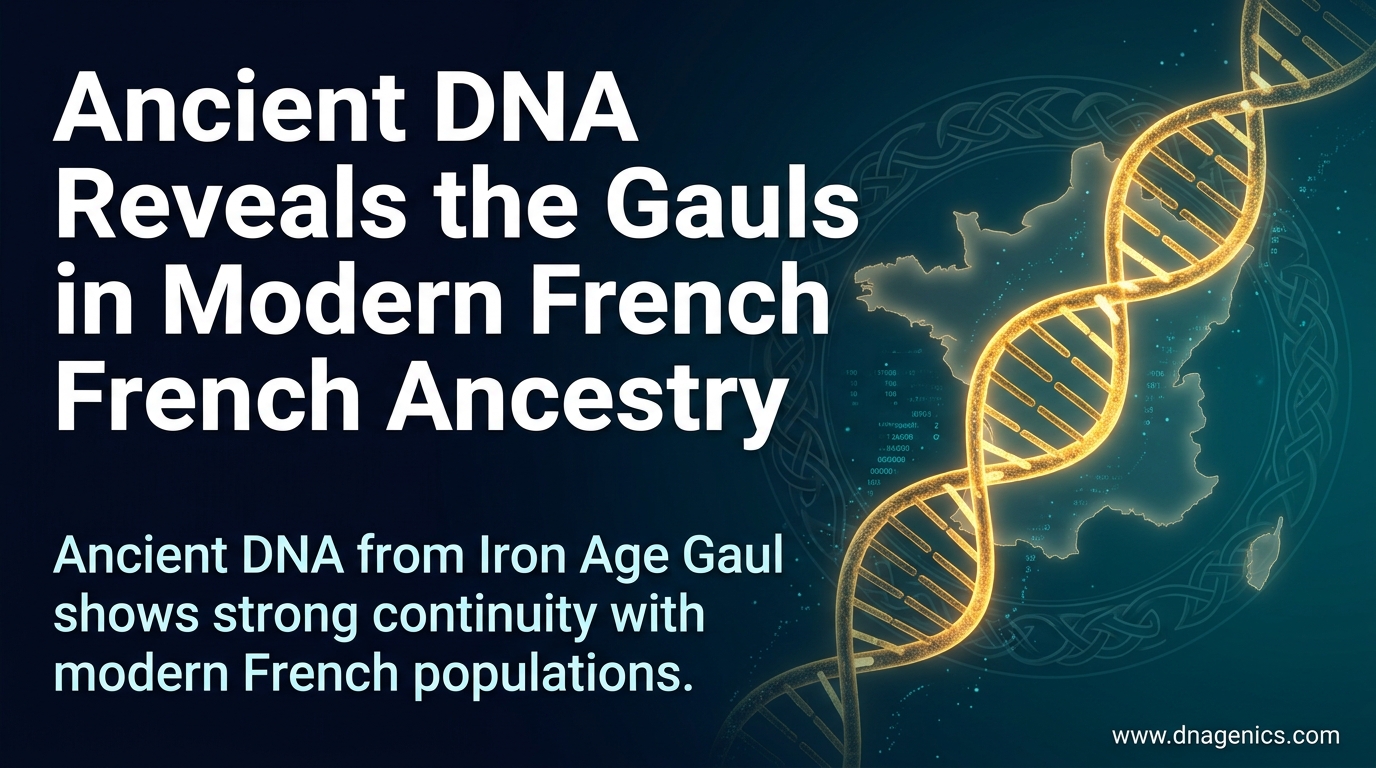
For generations, many people have heard the phrase “our ancestors the Gauls” as a cultural idea rather than a scientific claim. Ancient DNA is changing that conversation. New genetic evidence from Iron Age France suggests that, while French history includes many later migrations and influences, a large share of the ancestry found in modern French populations was already present in Gaul before the Roman era.
This matters because DNA can clarify where population stories reflect political memory, and where they reflect real biological continuity. In this case, the genetic record does not support a simplistic story of one ancient people replacing everyone else. Instead, it shows a long, regional continuum across France, with strong links between Iron Age Gauls and present-day French groups, especially when ancestry is compared through population genetics and ancient DNA modeling.
Key Discoveries / Main Points
- Strong genetic continuity, Ancient DNA from Iron Age France shows that many modern French populations are genetically close to regional Gaulish groups.
- Regional ancestry patterns persist, Northern France generally carries more steppe ancestry, while southern France has more early farmer ancestry from the Mediterranean world.
- No major population turnover occurred between the Bronze Age and the Iron Age in France, suggesting that the shift from Bronze to Iron was mainly technological and cultural, not a complete replacement of people.
- Modern French and Belgian populations sit near the center of the same north-western European genetic cluster as the Gauls.
- Later migrations mattered, including Roman-era movement, Germanic settlement, and Viking influence in Normandy, but they modified rather than erased the Iron Age foundation.
What This Means for Your DNA
If you are interested in French ancestry, this study offers a useful reminder: your DNA is not a single-label identity card, it is a record of layered population history. A modern French ancestry result may reflect deep continuity with regional Iron Age populations, but it will also include later signals from Rome, Germanic migrations, and local demographic history. In other words, the genetic story of France is one of persistence plus mixture, not purity.
For people taking an ancestry test, this means regional matches can be especially informative. A person with family roots in northern France may show stronger genetic similarity to ancient Gaulish groups from Picardy or Normandy, while someone from Occitanie, Auvergne, or Provence may align more closely with southern Iron Age populations. These are not proofs of direct descent from a specific tribe, but they are meaningful statistical patterns that help place your family history within the broader history of DNA, ancestry, and population genetics.
It is also important to separate cultural ancestry from genetic ancestry. The Gauls are famous in French national memory, but the ancient DNA evidence does not mean every French person is equally “Gaulish” in the same way. Instead, it shows that much of the ancestry present in France today was already established in the Iron Age, and that many regional populations still resemble their ancient counterparts.
Historical and Archaeological Context
The Gauls were Celtic-speaking peoples living in Iron Age France and nearby regions, including what is now Belgium. They were not a single nation, but many tribes with local identities, such as groups in Burgundy, Auvergne, Languedoc, and the north. Archaeology places them within two major cultural horizons: the Hallstatt period of the early Iron Age, known for elite burials and long-distance exchange, and the later La Tène culture, associated with classic Celtic art, fortified settlements, coinage, and the societies encountered by Julius Caesar.
The deeper background goes even further. The people of Iron Age France were already the product of earlier prehistoric layers: western hunter-gatherers, early farmers arriving from Anatolia around 5000 BC, and steppe-related populations that reached France around 2300 BC. By the Iron Age, these ancestries had blended into local populations with regional variation. The new ancient DNA results are important because they show that the Bronze Age to Iron Age transition did not bring a sweeping replacement of those populations.
History did not stop there, of course. Roman conquest, late antique Germanic kingdoms, and Viking settlement in Normandy all left genetic traces. But the archaeological and genetic picture together suggest that these later events added to an existing French population base rather than replacing it wholesale. That is why regional continuity is so striking: the past is visible not only in texts and artifacts, but in the genome.
The Science Behind It
The study of ancient DNA works by sequencing genetic material from archaeological remains and comparing it with both other ancient genomes and modern populations. In this case, genomes from Bronze and Iron Age France were analyzed and modeled against present-day French and neighboring populations using Global25, a method that measures genetic similarity across broad ancestry components. The key result was not just that ancient Gauls resemble modern French people in general, but that the relationship is strongly regional and structured.
Researchers also modeled ancestry as mixtures of broad sources, including western hunter-gatherer, early farmer, and steppe components, then compared Iron Age groups with modern regional French samples. The same north-to-south gradient appears in both ancient and present-day France, with more steppe-related ancestry in the north and more early farmer ancestry in the south. That pattern is exactly the kind of signal population genetics can detect when a long-lived population structure survives multiple historical periods.
In Simple Terms: ancient DNA lets scientists compare old and new populations the way you would compare family photo albums from different centuries. If the photos look similar across time, that suggests continuity, even if some new faces were added along the way.
There is one important technical caution. Gauls and early Germanic populations were genetically close to each other to begin with, because both belonged to the wider north-western European gene pool. That means ancestry models can estimate broad similarity, but they cannot always draw a sharp line between “Gaulish” and “Frankish” DNA. For that reason, the strongest conclusion is not exact percentages, but a broad and robust one: much of the genetic background of modern France was already present in Iron Age Gaul.
Why It Matters
This study shows how ancient DNA can refine long-standing historical narratives without turning them into myths. It confirms that the old textbook slogan about the Gauls was too simple as a cultural statement, but not entirely wrong as a population-history statement. That distinction matters for anyone interested in ancient DNA, migration, and the genetics of European populations.
It also highlights the value of regional analysis. France is not genetically uniform, and neither was Iron Age Gaul. Future research will likely keep exploring local continuity, subtle migration events, and how Roman, Germanic, and Viking-era movements shaped regional ancestry. For genealogy, archaeology, and population genetics alike, the big lesson is clear: history leaves signatures, and sometimes the genome preserves them for thousands of years.
References / Further Reading
- Ancient genomes from Bronze and Iron Age France, as summarized in the source research
- Published ancient DNA work on France that included 243 ancient genomes from earlier studies
- Archaeological context on Hallstatt and La Tène cultures, and the Iron Age history of Gaul