Introduction
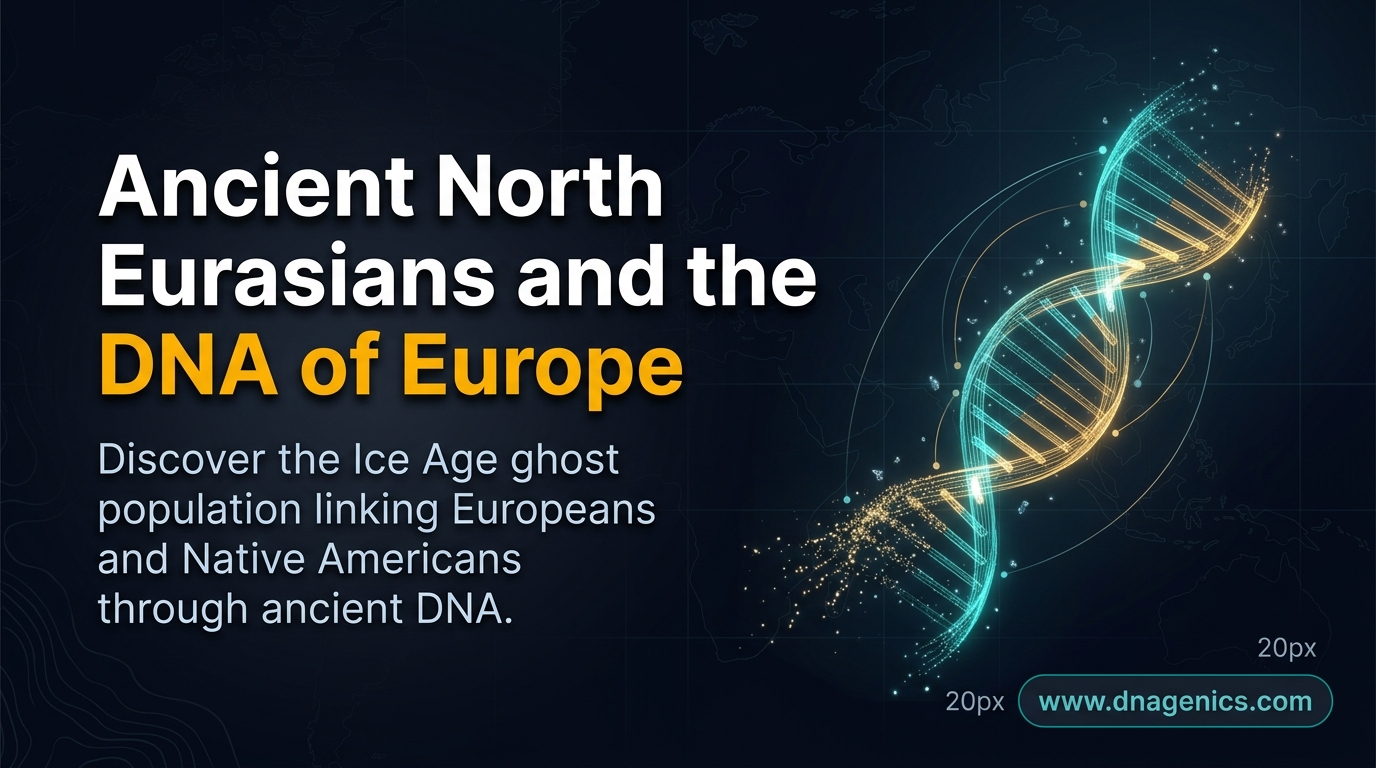
When people look at DNA ancestry results, they often expect a direct story, one lineage leading neatly to one modern population. Ancient DNA tells a much messier and more interesting story. Some of the most important populations in human history left no living descendants under their original name, yet still shaped the genomes of millions of people today. One of the clearest examples is the Ancient North Eurasians, an Ice Age population first predicted from genetics before it was ever identified in a skeleton.
Why does this matter? Because this group helps explain a major connection between Europe, Siberia, and the Americas. It also shows how population genetics can reveal “ghost populations,” meaning ancient groups that are not directly sampled at first but can still be detected through patterns in modern and ancient DNA. For anyone interested in ancestry testing, haplogroups, migration, or ancient human history, this is one of the most important discoveries in the field.
Key Discoveries / Main Points
- Ancient North Eurasians were an Ice Age population from northern Eurasia whose genetic legacy survives in both Europeans and Native Americans.
- Geneticists predicted this population in 2012 from statistical patterns in DNA before any genome from the group had been sequenced.
- The 24,000-year-old Mal'ta boy from southern Siberia provided the first direct genome and confirmed the prediction.
- Earlier remains from the Yana site, about 31,600 years old, showed an even older northern population with mixed West Eurasian and East Asian related ancestry.
- Later populations such as Eastern hunter-gatherers and Yamnaya herders carried this ancestry into Europe, while related ancestry also entered the Americas through ancient migration routes.
What This Means for Your DNA
For people exploring their ancestry, the key lesson is that your genetic history may reflect very ancient mixing events, not just recent family origins. If you have European ancestry, part of your DNA may ultimately trace back to populations that inherited Ancient North Eurasian ancestry through later groups such as steppe pastoralists and eastern hunter-gatherers. If you have Native American ancestry, some of that deep ancestry can also connect back to the same Ice Age source population, although through different ancient pathways.
It is important to understand that this does not mean a direct family link to one named skeleton like the Mal'ta boy. In ancestry analysis, we look at statistical similarity to ancient reference genomes and models, not personal identity or a one-to-one descent line. Instead, these results show that large-scale human migration and mixing happened repeatedly over tens of thousands of years, leaving signals that can still be detected in modern DNA.
For beginners, this is a useful reminder that ancestry is layered. Your results may reflect recent relatives, medieval populations, Iron Age groups, and also deep prehistoric sources from the Ice Age. Ancient North Eurasians are one of those deep sources, a hidden layer that helps explain why some populations in Europe and the Americas share genetic affinities even though their histories diverged long ago.
Historical and Archaeological Context
The story begins in Ice Age Siberia, a region that was not empty and isolated, but home to people who adapted to some of the harshest climates in human history. The Mal'ta site near Lake Baikal, in southern Siberia, produced famous archaeological finds including mammoth ivory carvings and figurines. Among the remains was a child buried about 24,000 years ago, whose genome became the first direct evidence for the Ancient North Eurasians.
Even older is the Yana Rhinoceros Horn Site in Arctic Siberia, where two boys lived around 31,600 years ago. Their genomes showed that people were already present far north of the Arctic Circle during a very cold phase of the Ice Age. These Yana individuals were genetically closer to early western Eurasian hunters than to later East Asians, but they also carried East Asian related ancestry. This suggests that northern Eurasia was a contact zone where ancient populations mixed long before the Last Glacial Maximum.
After the peak of the Ice Age, descendants of these northern populations spread and mixed with other groups. Some ancestry moved westward into populations that later contributed to Europeans, including eastern hunter-gatherers and steppe herders. Another branch of this deep ancestry contributed to people who crossed into the Americas. That is why the same ancient genetic signal appears, in different proportions, across a vast arc from Siberia to Europe and into Native American populations.
The Science Behind It
The Ancient North Eurasians were first identified through admixture analysis and related statistical methods, which test whether a population can be modeled as a mixture of other groups. Researchers noticed that Europeans appeared to have ancestry from one source related to western European hunter-gatherers and another source distantly related to Native Americans. Because no known population fit this second source, scientists inferred a vanished ancestral group, later named the Ancient North Eurasians.
Once ancient genomes were sequenced, the model became much stronger. The Mal'ta boy and later Siberian genomes showed that this ghost population was real and distinct. In comparative analyses, the Mal'ta genome sits between West Eurasian and Native American related lineages, while the Yana boys sit closer to early West Eurasians but still preserve the broader northern ancestry profile. This is exactly the kind of pattern population genetics is designed to uncover, especially when ancient DNA is sparse and fragmented.
In Simple Terms: Scientists compared ancient and modern genomes like pieces of a puzzle. They found that some people today share DNA patterns that point to an ancient Siberian population no one had sampled yet. When a 24,000-year-old child from Mal'ta was later sequenced, that missing piece finally appeared.
The broader technical point is that ancient populations are often reconstructed through reference genomes, coverage levels, and model fit rather than through a single perfect specimen. Some samples, like the Mal'ta boy and the Yana boys, are informative enough to define deep ancestry branches. Others, like later Siberian individuals, help show how that ancestry persisted and moved across time and geography. This is why ancient DNA is so powerful: it can turn a statistical ghost into a documented population history.
Why It Matters
The Ancient North Eurasians matter because they connect several major chapters of human history that once looked unrelated. They help explain why Europe contains a component of ancestry tied to ancient Eurasian steppe and Siberian populations, and why Native American ancestry also carries traces of the same deep source. In other words, one Ice Age population helped shape genetic lineages across two continents.
This field will keep evolving as more ancient genomes become available, especially from under-sampled regions of Siberia and eastern Europe. Each new sample can refine migration models, improve our understanding of haplogroups like R and Q, and show how climate, geography, and human mobility shaped the ancestry patterns we see today. For ancestry researchers and curious readers alike, Ancient North Eurasians are a reminder that the history written in DNA is often older, broader, and more interconnected than we expect.
References / Further Reading
- Ancient DNA studies of the Mal'ta boy (MA-1)
- Ancient genome research from the Yana Rhinoceros Horn Site
- Studies on Eastern hunter-gatherers, Yamnaya, and the peopling of Europe and the Americas
- General background on population genetics, ancient DNA, and Ice Age migrations