Introduction
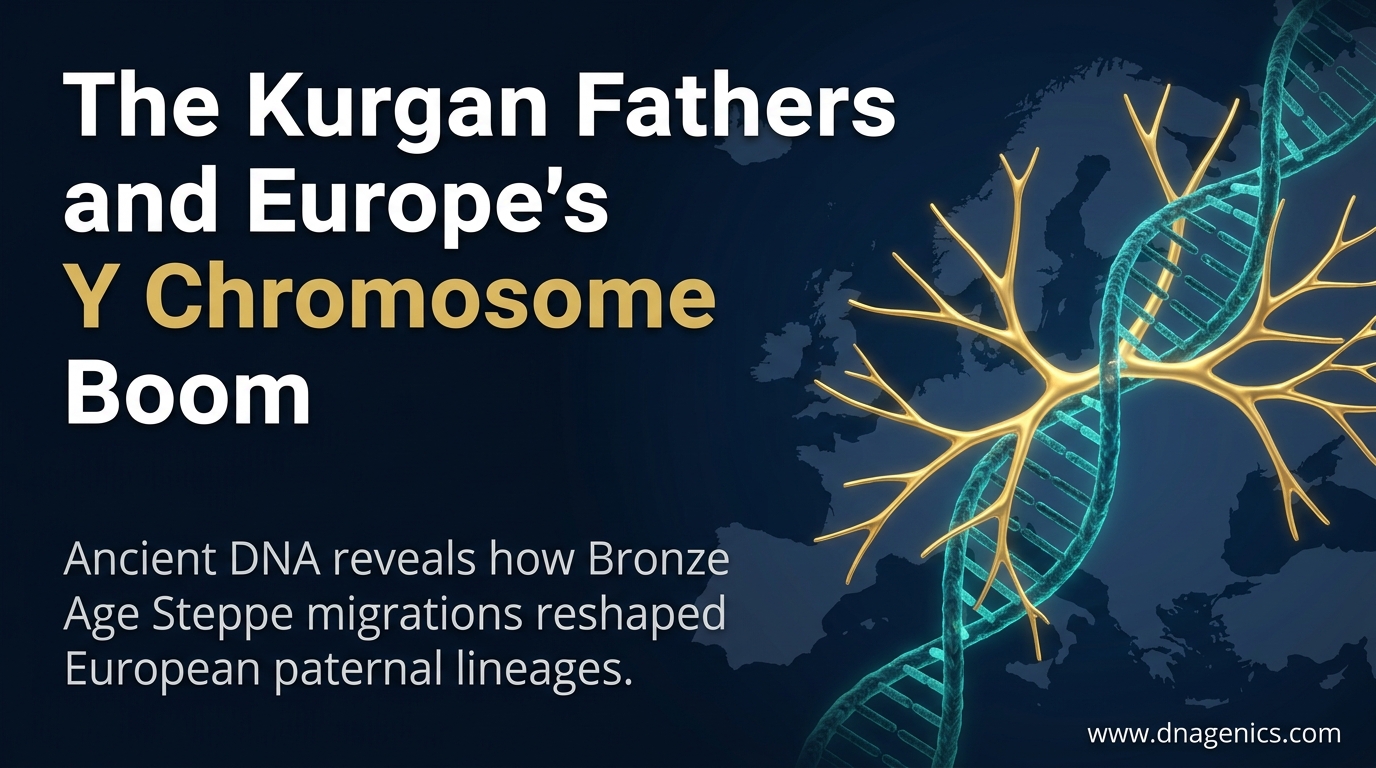
For many people, DNA ancestry testing is most exciting when it reveals where their maternal line, paternal line, or deeper population history may have come from. But sometimes the most surprising story is not about where ancestors lived, it is about which ancestors left the most descendants. In Europe, ancient DNA shows that a few Bronze Age steppe herders had an outsized impact on the Y chromosome, reshaping paternal lineages across much of the continent.
This matters because the genome does not always change evenly. The autosomes, the 22 non-sex chromosomes used in most ancestry analysis, can show a broad mix of ancestry from different groups. The Y chromosome, inherited only through the paternal line, can tell a much more selective story. In parts of Europe, the male line was transformed far more dramatically than the rest of the DNA, offering a powerful example of how migration, social organization, and demographic competition can leave very different signatures in ancient and modern populations.
Key Discoveries / Main Points
- Steppe ancestry spread widely across Europe during the late Neolithic, Copper Age, and Bronze Age, but its impact was often much stronger in paternal lines than in the rest of the genome.
- A small number of Y chromosome lineages, especially R1b, I1, and R1a, became very common in Europe, suggesting major founder effects and male-line expansion.
- In Britain, Beaker-period migrants replaced about 90% of the gene pool in a few centuries, and the Y chromosome shift was even more extreme.
- In Iberia, around 40% of overall ancestry changed by the Bronze Age, but nearly all of the earlier paternal lines were replaced by R1b-M269.
- The pattern suggests that many steppe-associated groups expanded through patrilineal clans, where men shared a paternal lineage, competed as groups, and passed their Y chromosomes forward more successfully than others.
What This Means for Your DNA
If you have European ancestry, especially from western or central Europe, your DNA may reflect one of the largest prehistoric demographic changes ever identified. That does not mean you are “descended from” a single ancient group in a simple direct sense. It means your ancestry is statistically similar to people whose families were shaped by repeated migrations, mixing events, and large-scale turnover during the Bronze Age.
For people who take DNA ancestry tests, the most relevant lesson is that autosomal ancestry and Y chromosome haplogroups can tell different stories. Someone may have only a moderate amount of steppe-related ancestry across the genome, yet belong to a paternal lineage that became very common after the Bronze Age. That is why a man with a R1b Y haplogroup can have a family history that reflects a much older social and demographic process than his overall percentage estimates suggest.
This also helps explain why paternal-line results sometimes feel more concentrated than expected. A single successful lineage can spread rapidly if it is associated with a growing clan, social advantage, or repeated local replacement. In ancestry terms, that means your Y haplogroup may point to a deep prehistoric expansion, while your broader DNA still carries layers from farmers, hunter-gatherers, and later migrants.
Historical and Archaeological Context
The people often linked to this transformation are the Yamnaya, mobile herders of the Pontic-Caspian steppe who appeared around 3300 BC. Archaeology associates them with burial mounds, or kurgans, wagons with solid wheels, and a mobile pastoral way of life. Over time, related populations moved into central and western Europe, where they encountered local farming societies that had developed much earlier in the Neolithic.
What happened next was not the same everywhere. In Bohemia, early Corded Ware groups were initially very steppe-rich and then gradually mixed with local farming communities. In Britain, the transition was much sharper, with Bell Beaker-associated groups replacing most of the island’s ancestry and nearly all of its paternal lines within a relatively short period. In Iberia, the replacement was more partial in the genome but especially dramatic on the Y chromosome, showing how local and incoming groups could blend socially while paternal descent became concentrated in a few lineages.
This period also helps contextualize the rise of major European haplogroups today. The current high frequencies of R1b in western Europe, R1a in parts of eastern Europe, and I1 in northern Europe are not random. They are the result of prehistoric expansions that likely amplified a small number of successful male lines during the Bronze Age and afterward.
The Science Behind It
Ancient DNA studies combine genome-wide data, radiocarbon dating, and statistical modeling to reconstruct population history. In the cases discussed here, researchers compared ancient individuals to reference groups such as hunter-gatherers, Anatolian Neolithic farmers, and steppe herders linked to the Yamnaya. By estimating the proportions of these sources in each ancient genome, scientists could measure the rise of steppe-related ancestry over time.
The Y chromosome adds another layer. Because it is passed from father to son, it acts like a surname line in genetic form, but far older and far less stable across history. When a lineage expands, it can dominate a population even if the rest of the genome remains mixed. That is exactly what happened in several parts of Europe, where the steppe-related paternal lines rose much faster than steppe-related ancestry across the whole genome.
In Simple Terms: Ancient DNA lets researchers compare the family history written in the whole genome with the story written only on the father-to-son line. In Bronze Age Europe, those two stories were not the same, the paternal line changed much more dramatically.
One especially important idea here is sex-biased migration. If incoming men married local women, their Y chromosomes could spread quickly while much of the local mitochondrial DNA, inherited from mothers, remained in place. Another possibility is social competition between patrilineal clans, where related men expanded together and rival male lines disappeared. The data do not require a single cause, but they strongly suggest that male social structure played a major role.
Why It Matters
This research changes how we think about ancestry. It shows that population history is not just a story of mixing percentages, it is also a story of who had children, whose descendants survived, and which social systems favored certain lines over others. For modern ancestry interpretation, that means a Y haplogroup can be an informative clue, but it is only one part of a much larger historical picture.
It also has broader implications for population genetics and archaeology. Europe’s Bronze Age was not simply a time of cultural exchange, it was a period of major demographic restructuring. Ancient DNA now allows researchers to connect migrations, burial traditions, and genetic turnover in a way that was not possible before. Future studies will continue refining when, where, and how these steppe-related expansions occurred, and how they interacted with language spread, social hierarchy, and local resistance.
References / Further Reading
- Batini et al. 2015, Y chromosome diversity in Europe and the Middle East
- Karmin et al. 2015, Y chromosome bottlenecks in human history
- Olalde et al. 2018, Beaker genomes and Britain
- Olalde et al. 2019, ancient DNA from Iberia
- Papac et al. 2021, Corded Ware and prehistoric population change
- Haak et al. 2015, steppe ancestry and the spread into Europe