Preparando el informe

Cargando la información y las referencias disponibles

Consultando el registro arqueológico...

Recopilando registros antiguos

Saltar al contenido principal
Aligrama Iron Age Voices
Cultura destacada

Aligrama Iron Age Voices

Fragments from the Swat Valley that whisper of life between 978–550 BCE

978 CE - 550 BCE
Swat Valley, Pakistan
Desplázate para empezar
Capítulo I

La historia

Comprender la cultura Aligrama Iron Age Voices

Archaeological and ancient-DNA evidence from Aligrama (Swat Valley, Pakistan) illuminates a small Iron Age community dated 978–550 BCE. Three genetic samples offer a preliminary glimpse of ancestry, showing West and South Eurasian maternal lineages and a single G Y-haplogroup — evidence that suggests complex regional connections.

Time Period

978–550 BCE

Region

Swat Valley, Pakistan

Common Y-DNA

G (observed in 1 of 3)

Common mtDNA

H, M, U (each observed among samples)

Capítulo II

Cronología

Momentos clave de la historia de esta cultura

978 BCE

Aligrama Iron Age horizon

Radiocarbon-associated contexts mark occupations in Aligrama beginning around 978 BCE, initiating the local Iron Age sequence in the Swat Valley.

Capítulo III

Origins & Emergence

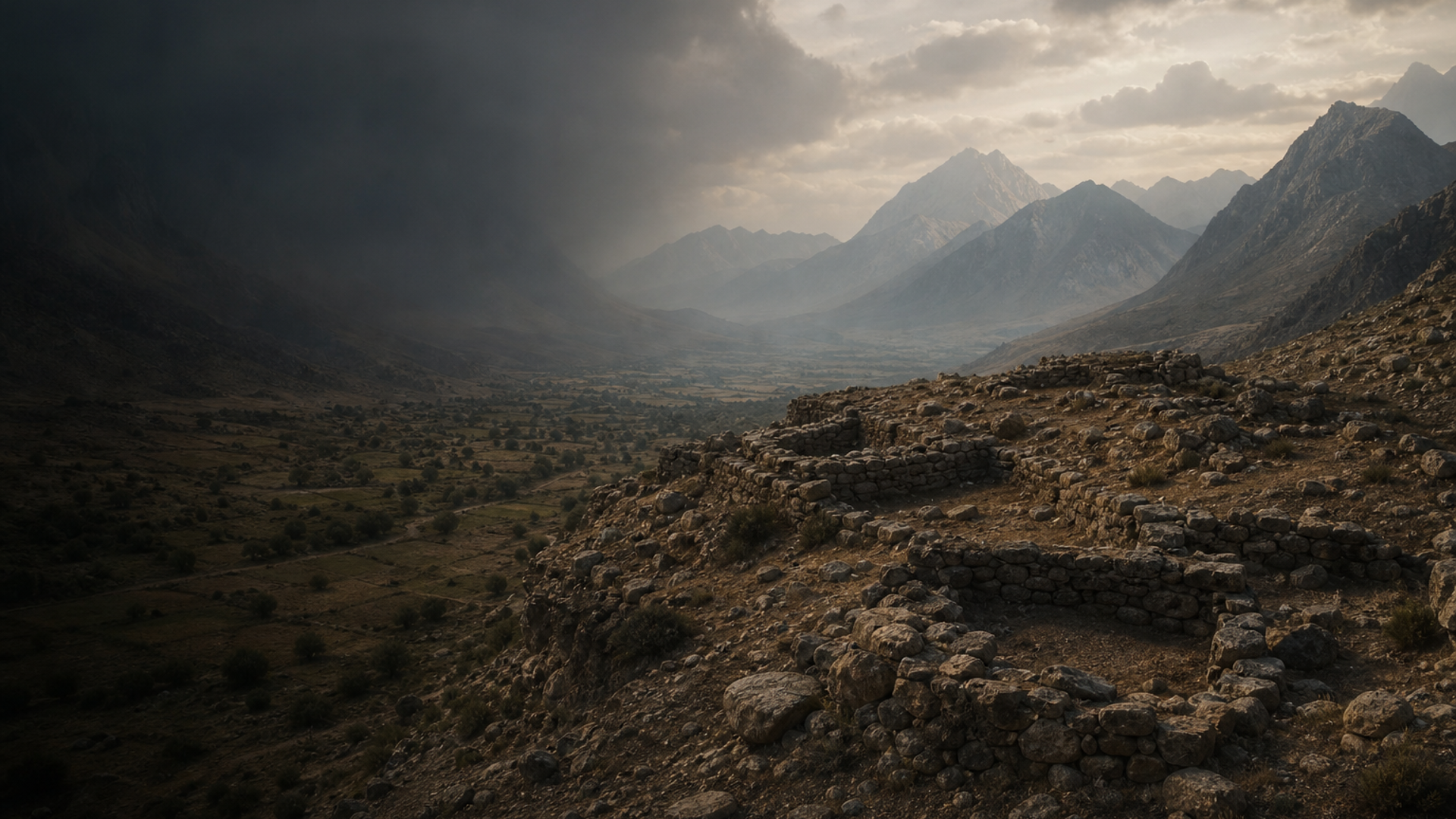
In the high green bowl of the Swat Valley, the settlement horizon at Aligrama emerges in the archaeological record between 978 and 550 BCE. Excavations and surface surveys reveal stratified Iron Age deposits—fragmentary architecture, hearths, and assemblages that suggest a settled community adapting to upland ecologies. The material signature is modest but telling: iron objects and charcoal-rich features indicate metallurgical activity and fuel use consistent with Iron Age technological shifts across northern South Asia.

Archaeological data indicates connections along riverine corridors that linked the Swat Valley to Trans-Indus routes and the highlands beyond. These lifelines carried goods, people, and ideas, and they likely shaped Aligrama’s cultural palette. Limited evidence suggests craft specialization and small-scale trade rather than an urbanized center. Radiocarbon samples associated with occupation layers provide the date range used here, but site formation processes mean chronology retains degrees of uncertainty.

Cinematic in its archaeology yet measured in interpretation, the story of Aligrama is one of a community at the crossroads—local lifeways framed by wider movements of technology and exchange. Given the limited number of excavated contexts and small genetic sample set, conclusions about origins remain provisional, inviting further fieldwork and sampling to refine the narrative.

  • Occupation dated to 978–550 BCE from radiocarbon-associated layers
  • Material culture shows local Iron Age traits with external connections
  • Evidence points to small-scale craft and river corridor exchange
Capítulo IV

Daily Life & Society

The everyday world at Aligrama can be imagined through hearth-smoke, iron tools, and the clink of traded metal—yet the archaeological record is fragmentary. Excavated features suggest households operating on mixed strategies: agriculture on valley floors, pastoral grazing on slopes, and exploitation of woodland resources. Iron tools and probable implements hint at agricultural intensification and craft activities; pottery sherds and small ornaments point to local ceramic traditions and personal adornment.

Burial practices at nearby Swat Valley sites show variability across the Iron Age, and though burials at Aligrama remain limited, they indicate social differentiation and enduring ties of kinship and place. Textural traces—floor surfaces, post-holes, hearths—suggest compact domestic compounds rather than sprawling settlements. Seasonal rhythms of planting, herding, and exchange with valley and highland neighbors would have structured labor, ritual, and identity.

Archaeological data indicates that Aligrama’s inhabitants participated in broader networks of exchange, receiving raw materials and ideas while maintaining a resilient, locally adapted lifeway. Because excavation coverage is partial, interpretations of household composition, craft specialization, and social hierarchy are necessarily cautious and open to revision.

  • Mixed farming and pastoralism likely sustained households
  • Iron tools and craft debris indicate local production and exchange
Capítulo V

Genetic Profile

Ancient-DNA sampling at Aligrama comprises three individuals dated within the 978–550 BCE window. Because the sample count is small (<10), all genetic inferences are preliminary. The Y-chromosome profile includes one individual carrying haplogroup G, a lineage with deep roots in West Eurasia and the Caucasus that also appears in later South and Central Asian contexts. Maternal lineages are diverse: one H, one M, and one U mtDNA haplogroup were detected. Haplogroup H is common across west Eurasia; M is widespread in South Asia; and U spans much of Eurasia, often associated with prehistoric mobility.

This mixed maternal signature—H, M, U—suggests ancestry contributions from both western and southern Eurasian sources, consistent with the Swat Valley’s role as a conduit between regions. The single G Y-haplogroup might reflect male-mediated gene flow or a snapshot of a particular kin group. However, with only three genomes, we cannot robustly model admixture proportions, demographic continuity, or population structure.

Archaeological context and these genetic signals together paint an image of Aligrama as a place of intersecting ancestries. Future sampling with larger numbers and genomic coverage will be required to test hypotheses about migration, local continuity, and the demographic processes behind these early Iron Age communities.

  • Sample size is small (3); conclusions are preliminary
  • Observed lineages: Y-G (1); mtDNA H (1), M (1), U (1) — suggesting mixed West/South Eurasian affinities
Capítulo VI

Legacy & Modern Connections

Aligrama’s whisper across millennia resonates in the genetic mosaic of the region today. The mix of mtDNA H, M, and U and the presence of Y-G in these ancient samples align with broader patterns of layered ancestry in northern South Asia, where West Eurasian and South Asian genetic threads have intertwined over millennia. Archaeological continuity in certain craft traditions and regional settlement patterns suggests elements of cultural persistence even as populations shifted.

Because the ancient sample is small, we must be cautious: these three individuals offer intriguing but limited evidence for long-term genetic continuity or direct ancestry to modern communities. Nonetheless, they reinforce the idea that the Swat Valley functioned as a dynamic meeting ground—demographically and culturally—shaping the genetic landscape of later populations. Ongoing fieldwork, expanded aDNA sampling, and integration with linguistic and archaeological studies will better reveal how Iron Age communities like Aligrama contributed to the deep ancestry of the region.

  • Genetic mix echoes longer-term West/South Eurasian interactions in northern South Asia
  • Small sample size means direct links to modern populations remain tentative
Con IA

Asistente de IA

Haz preguntas sobre la cultura Aligrama Iron Age Voices

Asistente de IA por DNAGENICS

Desbloquear esta función
Pregunta sobre la cultura Aligrama Iron Age Voices. El asistente con IA puede explicar hallazgos genéticos, contexto histórico, pruebas arqueológicas y conexiones modernas, con sus límites de interpretación.

Ejemplo de análisis con IA

La cultura Aligrama Iron Age Voices representa un capítulo de la historia humana...

El análisis genético permite estudiar similitudes con poblaciones anteriores y posibles adaptaciones. Las muestras de ADN antiguo aportan información para investigar patrones migratorios y relaciones entre poblaciones, con límites que dependen del estudio y del contexto arqueológico.

Esta es una vista previa del análisis con IA. Accede al asistente completo para explorar información sobre:

  • Composición y similitud genética
  • Patrones migratorios y orígenes
  • Vida cotidiana y prácticas culturales
  • Contexto genético moderno

Explora más culturas antiguas

Descubre la historia de civilizaciones de distintas partes del mundo antiguo