Preparando el informe

Cargando la información y las referencias disponibles

Consultando el registro arqueológico...

Recopilando registros antiguos

Saltar al contenido principal
Devil's Gate Neolithic Echoes
Cultura destacada

Devil's Gate Neolithic Echoes

Early Neolithic occupants of Devil's Gate Cave reveal Northeast Asian maternal lineages

5830 CE - 5481 BCE
Primorsky Krai, Russian Far East
Desplázate para empezar
Capítulo I

La historia

Comprender la cultura Devil's Gate Neolithic Echoes

Archaeological and genetic data from seven individuals (5830–5481 BCE) at Devil's Gate Cave, Primorsky Krai, Russia, point to Neolithic coastal lifeways and a dominant mtDNA D4 profile. Small sample size makes conclusions preliminary but evocative of deep Northeast Asian connections.

Time Period

5830–5481 BCE

Region

Primorsky Krai, Russian Far East

Common Y-DNA

C (1/7)

Common mtDNA

D4 (4), D4m (3)

Capítulo II

Cronología

Momentos clave de la historia de esta cultura

5830 BCE

Early Occupation at Devil's Gate

Radiocarbon dates indicate human activity and burials at Devil's Gate Cave beginning around 5830 BCE, marking early Neolithic coastal occupation in the Primorye region.

Capítulo III

Origins & Emergence

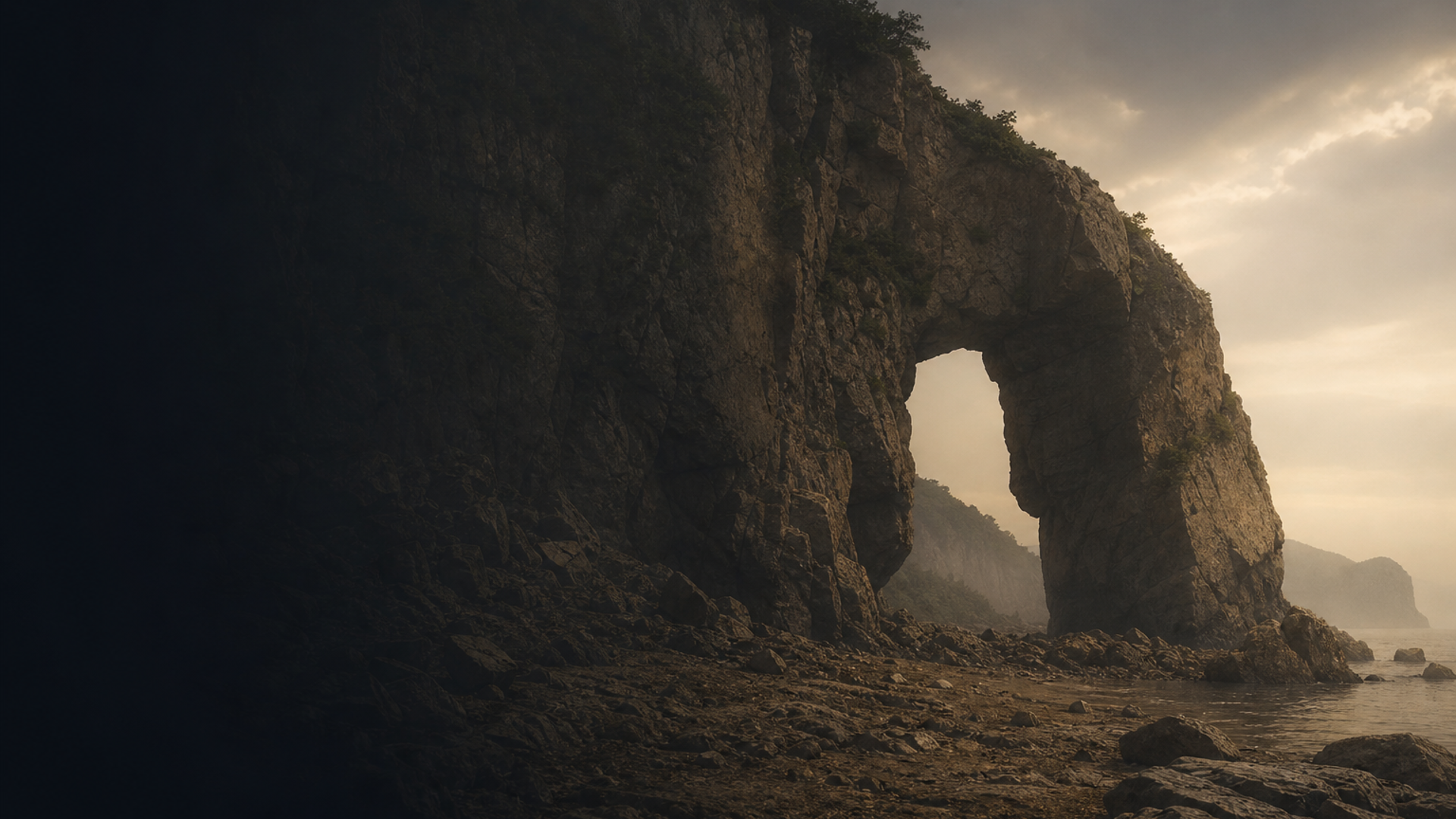
The people sampled from Devil's Gate Cave (Devil's-Gate-Cave, Dalnegorsk municipality, Primorsky Krai) lived during the early Neolithic, with radiocarbon-dated remains spanning roughly 5830–5481 BCE. Archaeological data indicates repeated cave occupation along a temperate, riverine-to-coastal landscape. Stone tools, hearth features and faunal assemblages suggest a mobile economy oriented to fishing, shellfish and small-game resources rather than intensive agriculture.

Cinematic in its immediacy, the site captures a marginal yet productive littoral zone where human groups exploited tidal flats and river mouths. Limited evidence suggests regional connections across the Amur–Primorye corridor: material parallels link local lithic traditions and subsistence strategies to contemporaneous communities across northeastern Asia. Given only seven genetic samples, any narrative of arrival or population replacement must remain cautious. The archaeological record situates these people within a broader Neolithic mosaic of hunter-fisher groups adapting to rich coastal environments rather than large-scale agrarian transformations.

  • Occupations dated ca. 5830–5481 BCE at Devil's Gate Cave, Primorsky Krai
  • Archaeological indicators: stone tools, hearths, fish and shellfish remains
  • Evidence suggests regional ties across the Amur–Primorye corridor
Capítulo IV

Daily Life & Society

Archaeological traces evoke daily rituals shaped by water and rock: hearths warmed the cave mouth, while discarded shells and fish bones accumulated in living floors. Osteological data from the site indicate intentional burial practices; skeletal remains preserve information on diet, health and tool-related wear. The lithic toolkit is consistent with hunting and fishing economies—blades, scrapers and bone implements suited to processing fish, mammals and shells.

Social organization can be inferred only indirectly. The cave context—repeated interments and domestic debris—hints at residential stability for parts of the year, with mobility likely tied to seasonal resource pulses. Ornamentation, if present, appears modest; personal items may have been organic and are thus underrepresented in the surviving record. Archaeological data indicates a community intimately tuned to coastal rhythms, where knowledge of tides, fish runs and shelter construction shaped cultural lifeways.

Because material culture is sometimes ephemeral in cave contexts, interpretations remain provisional and should be read alongside genetic signals that hint at population affinities rather than fully detailed lifeways.

  • Subsistence focused on fishing, shellfish, and small game
  • Burials and domestic deposits point to repeated cave use and seasonal residency
Capítulo V

Genetic Profile

Seven genetic samples from Devil's Gate Cave offer an intimate but small window into early Neolithic ancestry in the Russian Far East. Maternal lineages are dominated by mtDNA D4 (4 individuals) and D4m (3 individuals), a cluster of haplotypes widely observed in ancient and modern populations of Northeast Asia and the adjacent islands. Y-chromosome data are sparse: one individual carries haplogroup C, a lineage present in multiple ancient East Asian and Siberian contexts and among several modern groups.

The mtDNA signal suggests strong maternal continuity in this coastal region through the Holocene, consistent with archaeological impressions of long-term exploitation of regional marine resources. However, with only seven samples (<10), patterns of genetic diversity, sex-biased mobility or gene flow from inland or island populations remain preliminary. Archaeogenomic comparisons hint at affinities between these individuals and other Northeast Asian hunter-fisher groups, but the limited sample count precludes firm claims about demographic processes such as migration, admixture, or population continuity.

Future, larger datasets are needed to resolve whether the Devil's Gate profile reflects a local enduring population, seasonal aggregation of related groups, or broader regional networks across the North Pacific edge.

  • Dominant maternal lineages: mtDNA D4 and D4m (7/7 samples)
  • Single observed Y-DNA: haplogroup C (preliminary, 1 sample)
Capítulo VI

Legacy & Modern Connections

The genetic and archaeological impressions from Devil's Gate Cave resonate with patterns seen across the North Pacific Rim: maternal haplogroups like D4 persist among many modern Northeast Asian and some circumpolar populations, suggesting threads of deep regional continuity. Archaeological continuity in coastal resource use underscores long-term adaptation to marine ecologies that shape cultural identities across millennia.

Yet caution is paramount. With just seven samples, the portrait is necessarily incomplete. The site offers a compelling snapshot, not a full biography, of Neolithic lifeways in Primorye. Ongoing genetic sampling, integrated with careful archaeological excavation, will clarify how these early coastal communities relate to later populations in the Russian Far East, Hokkaido, Sakhalin and beyond. For visitors and descendants alike, Devil's Gate Cave evokes a landscape of survival, skill and connection to the sea—an archival silence that we are only beginning to read through DNA and stone.

  • mtDNA continuity suggests links to modern Northeast Asian maternal lineages
  • Small sample size requires cautious interpretation of long-term continuity
Con IA

Asistente de IA

Haz preguntas sobre la cultura Devil's Gate Neolithic Echoes

Asistente de IA por DNAGENICS

Desbloquear esta función
Pregunta sobre la cultura Devil's Gate Neolithic Echoes. El asistente con IA puede explicar hallazgos genéticos, contexto histórico, pruebas arqueológicas y conexiones modernas, con sus límites de interpretación.
Ejemplo de análisis con IA

La cultura Devil's Gate Neolithic Echoes representa un capítulo de la historia humana...

El análisis genético permite estudiar similitudes con poblaciones anteriores y posibles adaptaciones. Las muestras de ADN antiguo aportan información para investigar patrones migratorios y relaciones entre poblaciones, con límites que dependen del estudio y del contexto arqueológico.

Esta es una vista previa del análisis con IA. Accede al asistente completo para explorar información sobre:

  • Composición y similitud genética
  • Patrones migratorios y orígenes
  • Vida cotidiana y prácticas culturales
  • Contexto genético moderno

Explora más culturas antiguas

Descubre la historia de civilizaciones de distintas partes del mundo antiguo