Preparando el informe

Cargando la información y las referencias disponibles

Consultando el registro arqueológico...

Recopilando registros antiguos

Saltar al contenido principal
Echoes of Scotland's Megalith Builders
Cultura destacada

Echoes of Scotland's Megalith Builders

Neolithic tomb builders of Orkney and Ross, revealed by bones and stones

3623 CE - 3102 BCE
Scotland, United Kingdom
Desplázate para empezar
Capítulo I

La historia

Comprender la cultura Echoes of Scotland's Megalith Builders

Archaeological contexts and ancient DNA from four individuals (c. 3623–3102 BCE) from Balintore, Midhowe and Knowe of Lairo illuminate early Scottish megalithic communities. Limited sample size makes conclusions tentative but points to male-line continuity and mixed maternal ancestry.

Time Period

c. 3623–3102 BCE

Region

Scotland, United Kingdom

Common Y-DNA

I (3 of 4)

Common mtDNA

H1, H, K, U (one each)

Capítulo II

Cronología

Momentos clave de la historia de esta cultura

3623 BCE

Earliest dated sampled burials

Radiocarbon dates for the four sampled individuals fall between 3623 and 3102 BCE, linking them to early to middle Neolithic megalithic activity in Scotland.

Capítulo III

Origins & Emergence

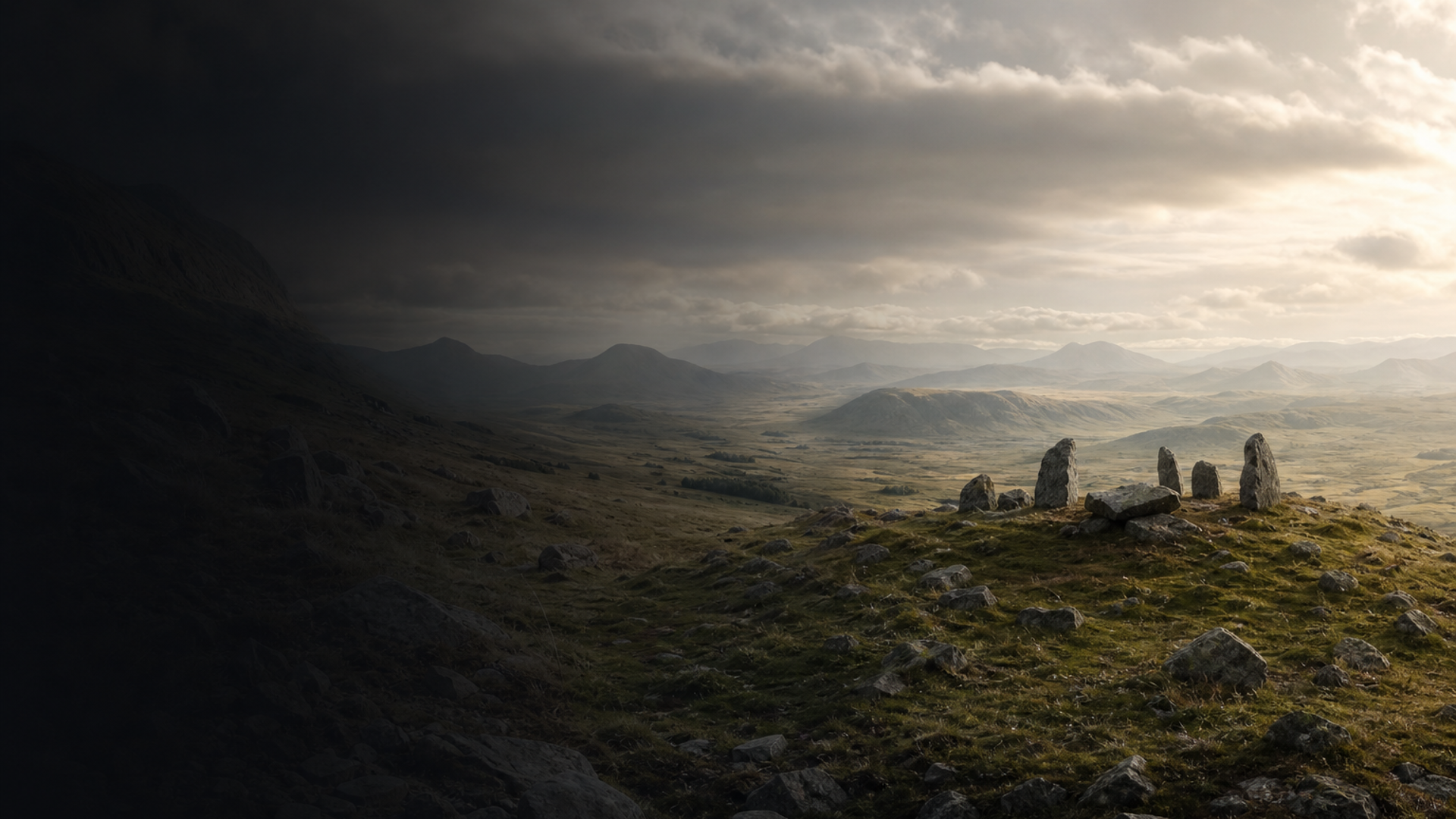
Between roughly 3623 and 3102 BCE, people in northern Scotland set stones and shaped horizons. Radiocarbon-dated human remains from Balintore (Ross and Cromarty) and the island of Rousay in Orkney (Midhowe and Knowe of Lairo) place these individuals within the broader sweep of Megalithic Scotland. The monuments themselves—chambered cairns, clustered standing stones and communal tombs—are markers of a social landscape in which memory, landscape and sea routes were stitched together.

Archaeological data indicates sustained ritual investment: large stone chambers, carefully placed human deposits and material traces of feasting and craft. Orkney, especially Rousay, functions as a focal point for this regional expression of Neolithic monumentality. Limited evidence suggests maritime connections along the Atlantic façade, where similar megalithic practices develop in diverse but interacting communities.

The skeletal samples sampled for ancient DNA come from funerary contexts associated with these monuments. While the stones preserve the choreography of ritual, the genetic traces begin to reveal who took part in those rites—showing both continuity and mixture across the Neolithic seascape.

  • Samples dated c. 3623–3102 BCE from Balintore and Rousay (Midhowe, Knowe of Lairo)
  • Megalithic architecture indicates communal ritual landscapes and regional networks
  • Orkney served as a prominent ritual and possibly maritime hub in Neolithic Scotland
Capítulo IV

Daily Life & Society

Life around these monuments combined subsistence farming, coastal foraging and specialized craft practices. Archaeobotanical and zooarchaeological patterns across Neolithic Scotland indicate mixed cereal cultivation, domestic cattle and sheep, and intensive use of coastal resources—shellfish, fish and sea mammals—especially on island landscapes like Orkney. People lived in nucleated farmsteads and dispersed hamlets; monuments anchored seasonal gatherings, rituals and perhaps redistribution of resources.

Material culture—stone tools, pottery, polished stone axes and personal ornaments—speaks to skilled craftsmanship and long-distance exchange. The scale of some cairns and tombs suggests coordinated labor beyond single households, implying social ties that could span kin groups and neighboring communities. Mortuary deposition within chambered cairns reflects collective identities: the dead were curated within monuments that continued to be visited and re-used across generations.

However, direct evidence for social hierarchy, political structures or precise seasonal routines remains limited. Organic preservation is uneven and the present genetic sample is small, so reconstructions of everyday life must remain cautious and open to revision as more data arrives.

  • Mixed farming, herding and maritime resource use shaped subsistence strategies
  • Monuments served as communal ritual centers and nodes of social exchange
Capítulo V

Genetic Profile

Ancient DNA from four individuals associated with Scotland_Megalithic provides a preliminary genetic snapshot. Three of the four males carry Y-chromosome haplogroup I, while the mitochondrial haplogroups observed are H1, H, K and U (one individual each). These patterns suggest a degree of paternal continuity in this small sample and diverse maternal lineages that reflect a mixed ancestral background.

Haplogroup I is often interpreted in European prehistory as connected to long-standing male lineages present since the Mesolithic in parts of Europe, though its presence in Neolithic and later contexts can reflect complex local histories. Maternal haplogroups H and K are widespread in Neolithic agricultural populations of Europe, while U links to older hunter-gatherer maternal lineages—together indicating admixture between incoming farming groups and local foragers in varying proportions.


Because the dataset comprises only four samples, any inference about population-wide structure is tentative. Limited evidence suggests regional continuity of male lines in these megalithic communities, but we cannot yet quantify ancestry proportions or demographic shifts. Future sampling across more sites and time-depth will be necessary to resolve patterns of migration, marriage networks and kinship tied to the stones.

  • Three of four samples carry Y-DNA haplogroup I, suggesting possible paternal continuity
  • mtDNA diversity (H1, H, K, U) indicates mixed maternal ancestries and potential farmer–forager admixture
Capítulo VI

Legacy & Modern Connections

The stones still shape modern imagination: chambered cairns and standing stones remain visible anchors in Scottish landscapes and in public memory. Genetic echoes—haplogroups I, H and K—persist in the modern British gene pool, but continuity is complex. Centuries of migration, later Bronze Age movements and historic upheavals have layered additional genetic signals onto these Neolithic foundations.

For genetic ancestry platforms, these samples demonstrate how archaeology and DNA can speak in concert: monuments record ritual behaviors and place; ancient genomes reveal biological ties and movements. Yet with only four individuals, conclusions must be cautious—these samples are suggestive rather than definitive. Continued sampling across Orkney, mainland Scotland and comparative regions will refine how the lives within megalithic stones connect to the lineages carried into later ages and into living populations today.

  • Megalithic monuments remain cultural landmarks and markers of long-term ritual landscapes
  • Genetic continuity is plausible but complex; small sample size makes broad claims tentative
Con IA

Asistente de IA

Haz preguntas sobre la cultura Echoes of Scotland's Megalith Builders

Asistente de IA por DNAGENICS

Desbloquear esta función
Pregunta sobre la cultura Echoes of Scotland's Megalith Builders. El asistente con IA puede explicar hallazgos genéticos, contexto histórico, pruebas arqueológicas y conexiones modernas, con sus límites de interpretación.
Ejemplo de análisis con IA

La cultura Echoes of Scotland's Megalith Builders representa un capítulo de la historia humana...

El análisis genético permite estudiar similitudes con poblaciones anteriores y posibles adaptaciones. Las muestras de ADN antiguo aportan información para investigar patrones migratorios y relaciones entre poblaciones, con límites que dependen del estudio y del contexto arqueológico.

Esta es una vista previa del análisis con IA. Accede al asistente completo para explorar información sobre:

  • Composición y similitud genética
  • Patrones migratorios y orígenes
  • Vida cotidiana y prácticas culturales
  • Contexto genético moderno

Explora más culturas antiguas

Descubre la historia de civilizaciones de distintas partes del mundo antiguo